Researchers at the University of Glasgow have developed a method for printing tiny semiconductors from arsenide.
Gallium arsenide is widely used inhigh performance electronics. But, as a rule, such devices are installed on a solid substrate. In their work, the researchers adapted a previously developed silicon semiconductor roll printing system to deposit gallium arsenide electronics on a flexible surface using wire arrays 15 µm wide.
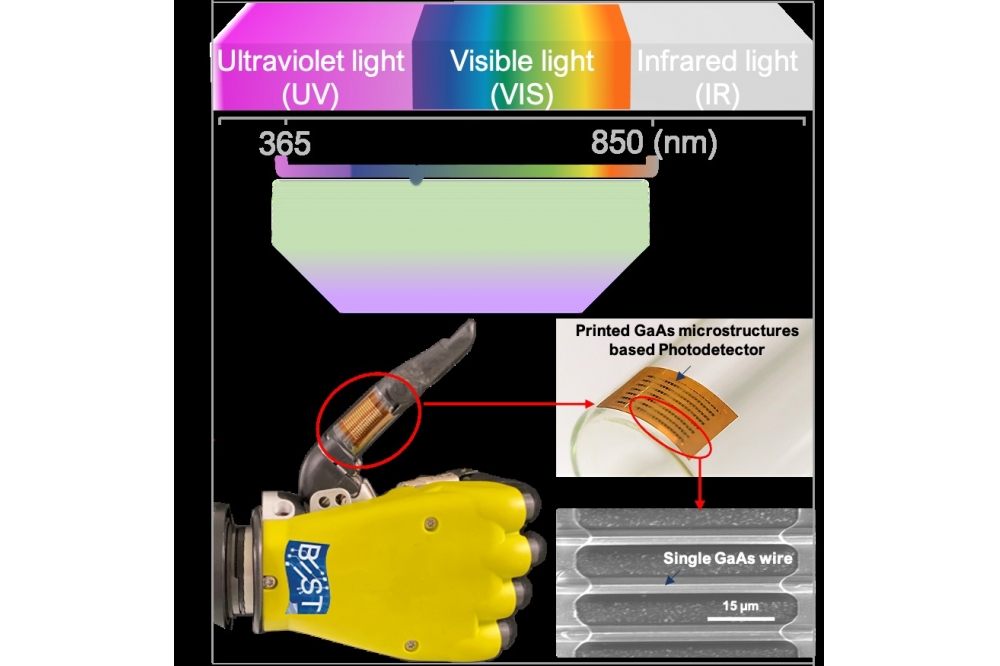 Image: University of Glasgow
The developed flexible photodetector can detectlight from the ultraviolet range through the visible part of the spectrum to the infrared. At the same time, the device operates at a low operating voltage of 1 V. The authors of the technology note that the system is able to respond very quickly to light: only 2.5 ms is required to measure light and 8 ms to recover.
To test the reliability of the system, scientistssubjected the material to rigorous testing on a machine that folded and twisted it hundreds of times. As a result of an experiment of 500 cycles, the material did not show a significant loss of performance.
In the future, this type of photosensitive flexiblematerial can give robots new capabilities. For example, mechanical arms used for manufacturing in light-sensitive environments can detect when conditions change and their safety or efficiency is compromised.
Ravinder Dahia, professor at the James Watt School of Engineering at the University of Glasgow, study co-author
Engineers believe that the new photodetector will alsocould come in handy in wireless communications and to create a wearable patch that people could use to control their exposure to ultraviolet light on sunny days.
Read more:
The oldest Voyager 1 mission has a strange glitch that cannot be fixed
Scientists have found a "Pandora's box" in the bowels of the Earth: the energy from there feeds life on the planet
Scientists understand why T-Rex and other large dinosaurs had small "hands"