Bioengineers at the Massachusetts Institute of Technology have developed a two-component system,
When internal damage occurs,platelets are attracted to this site and initiate a cascade of blood clotting. The result is a sticky plug of platelets and clotting proteins, including fibrinogen. But if patients lose a lot of blood, like in a severe car accident, they don't have enough platelets or fibrinogen to form clots. Researchers have created a system that replaces both key components of blood clotting, platelets and fibrinogen, with artificial bodies.
Scientists have used previously developedbiocompatible polymer nanoparticles that can bind to activated platelets. Such particles with a size of 140 to 220 nm accumulate in the area of damage, but "ignore" healthy organs - for example, the lungs, where the formation of blood clots can be dangerous.
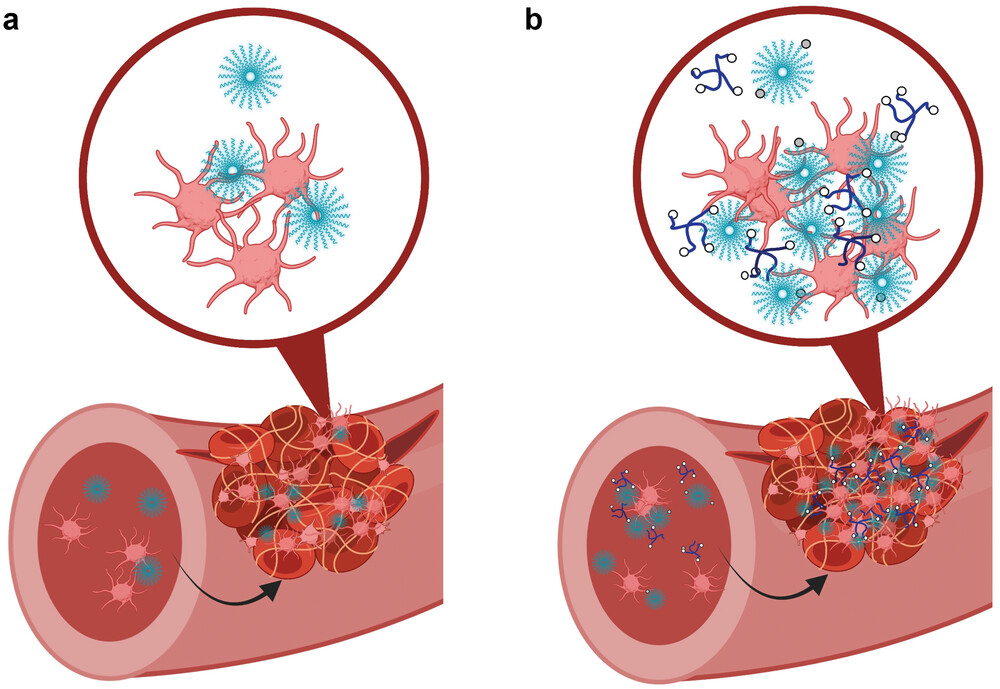 Nanoparticles that bind to platelets(left), and a system supplemented with "crosslinkers" (right). In the second case, more stable blood clots are formed. Image: Celestine Hong et al., Advancesd Healthcare Materials
As the second component of the system, engineersdeveloped particles they called crosslinkers. They are made of polyethylene glycol, are able to find target nanoparticles in the wound area using special markers, and form clusters that mimic blood clots.
The researchers tested their system onmouse model. Experiments showed that the two-component system was more effective than existing methods in stopping internal bleeding in animals and did not cause a significant allergic reaction. At the same time, unlike natural blood clots, artificial formations turned out to be more stable: they are not destroyed by the introduction of saline, which is used in medical institutions to maintain blood pressure during large blood loss.
The researchers plan to test the technology in other animal models before starting clinical trials.
Read more:
There was a photo inside the second deepest underwater sinkhole in the world
See what happened to Mercury when it got as close as possible to the Sun
Scientists are ready to recognize the new tree as the oldest in the world
On the cover: artistic illustration of artificial blood clots. Image: Christine Daniloff, MIT