Researchers used the James Webb Telescope to look inside the brown dwarf VHS 1256-1257 b.
Brown dwarfs are an intermediate stagebetween gaseous exoplanets and the smallest stars. The mass of such an object is not enough to start the fusion of hydrogen. But they can synthesize deuterium (a heavy isotope of hydrogen). Because of this, they have their own heat and radiation, not bright enough like stars, but enough to detect them.
In the new study, scientists used the spectrumradiation from a brown dwarf to determine the composition of VHS 1256-1257 b. The study showed that in In the atmosphere of a brown dwarf, water, methane, carbon dioxide and carbon dioxide, sodium and potassium are common.
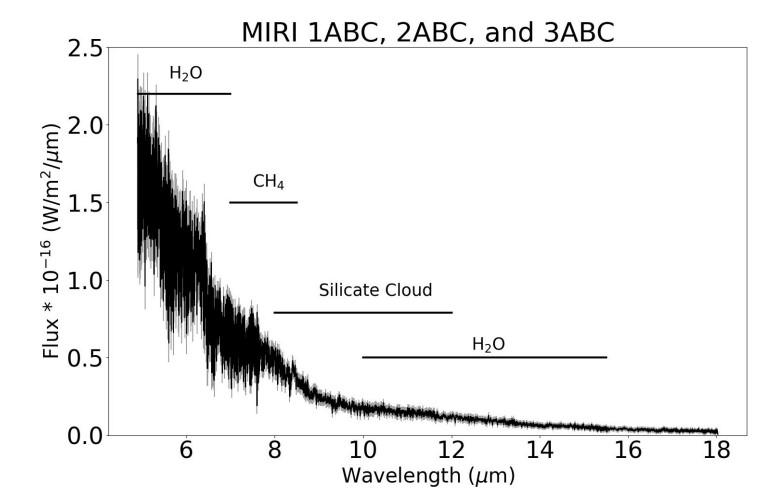 Spectral observations of the MIRI camera of the James Webb telescope with individual elements in the composition of the atmosphere. Image: Brittany E. Miles et al., arXiv
Scientists discover clouds inside the atmospherefrom silicates. These are long structures of and particles with submicron grain sizes. Such clouds have been previously predicted theoretically, but no one has been able to confirm them. The researchers believe that these clouds are forsterite, enstatite and quartz.
Planetologists note that this is the first such detailed study of the composition of a brown dwarf. Its results can be used to observe other similar objects.
Read more:
Plant on Mars produces oxygen at the rate of an average tree
Physicists have cooled atoms to record temperatures. They are a billion times colder than outer space.
A small dinosaur "turned" into a gem. He is almost 100 million years old
On the cover: artwork of a brown dwarf. Image: NASA/JPL-Caltech