Microneedle patches are a painless alternative to conventional injections. Researchers from Gorodskoye
Microneedle patches are intended forapplication to the skin for the administration of drugs. The side facing the skin contains many tiny needles. Their length is less than 1 mm. They penetrate the skin, but do not reach the nerve endings, so such applications are painless.
Typically the needles themselves are made from biodegradablepolymers. They dissolve, releasing their payload—drugs, vaccines, or other therapeutic molecules. But for the new study, CityU researchers made microneedle patches from a simpler material: ice.
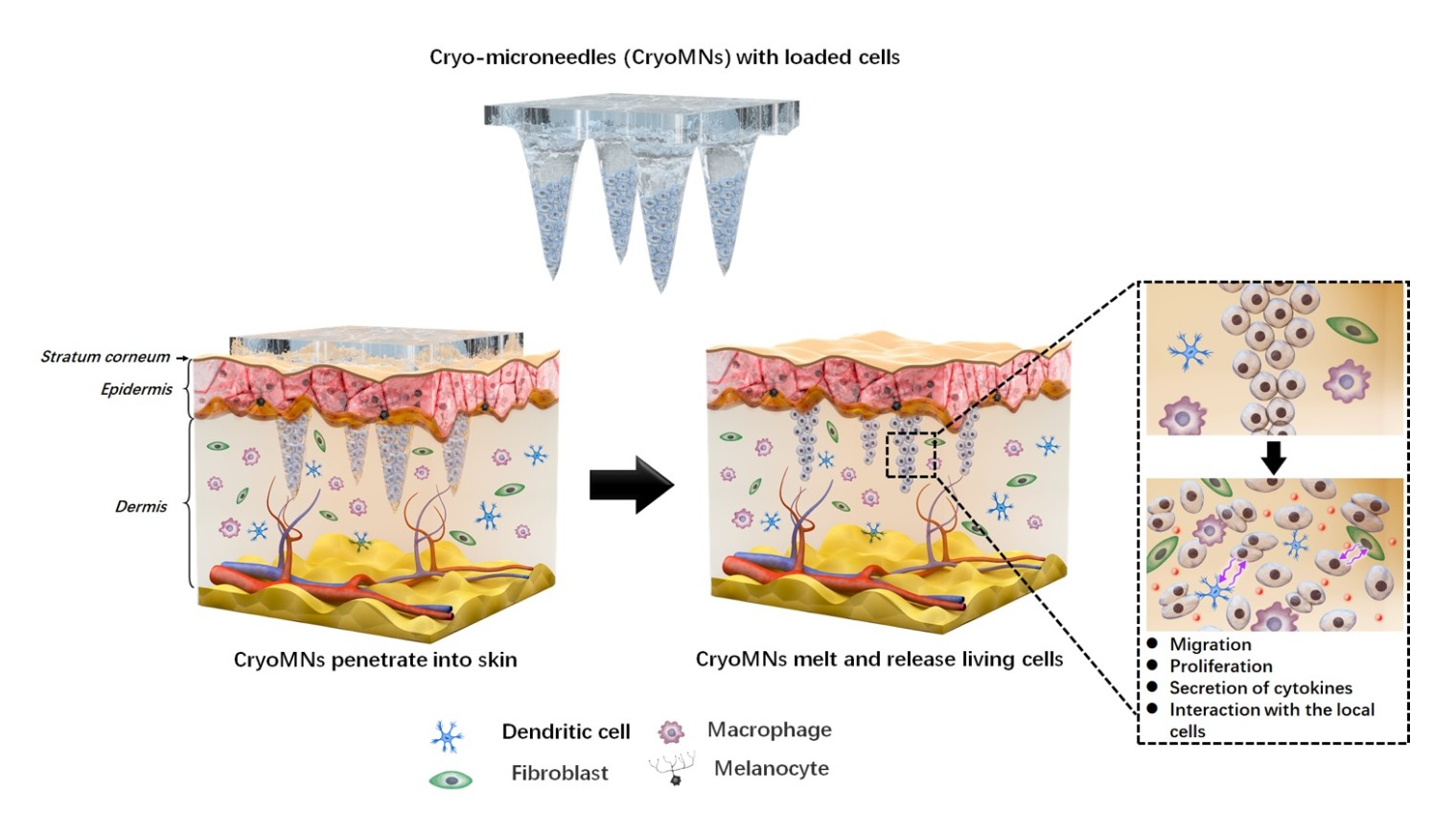 Diagram showing how the new cryo-micron needle patch works. Hong Kong City University
The principle of operation of these cryomicron needles inbasically the same. The therapeutic cells are loaded into microneedles (although in this case they are attached to the cryoprotectant) and then frozen in ice. Once the needles enter the skin, they break off the lining. The patient's body heat melts them, delivering the payload.
The authors of the development explain that usingice has several advantages over existing microneedle systems. The most obvious is that this material is easier to manufacture than biodegradable polymers. In addition, they leave less waste, and ice is suitable for long-term storage of cells in the refrigerator.
Read more
Elon Musk: the first tourists to Mars will die
The first accurate map of the world was created. What's wrong with everyone else?
Ingenuity completes fourth longest flight