Albert Einstein called quantum entanglement "the creation of spooky actions at a distance", another
To confuse two objects, you usually need to bringthem very, very close to each other so they can interact. In their work, the researchers used an alternative method. They entangled the atoms using light reflected between mirrors called optical resonators. In this way, up to a million atoms can be entangled, located at a distance of several millimeters or more from each other.
The second line of research was related todelocalization. The researchers used pulses of light to make the atoms both move and not move at the same time, absorbing and not absorbing laser light. This causes the atoms to be in two different places at the same time over time.
We aim laser beams at atoms, so wewe actually split the quantum wave packet of each atom into two parts, in other words, the particle actually exists in two separate spaces at the same time.
Chenggi Luo, NIST graduate student and co-author
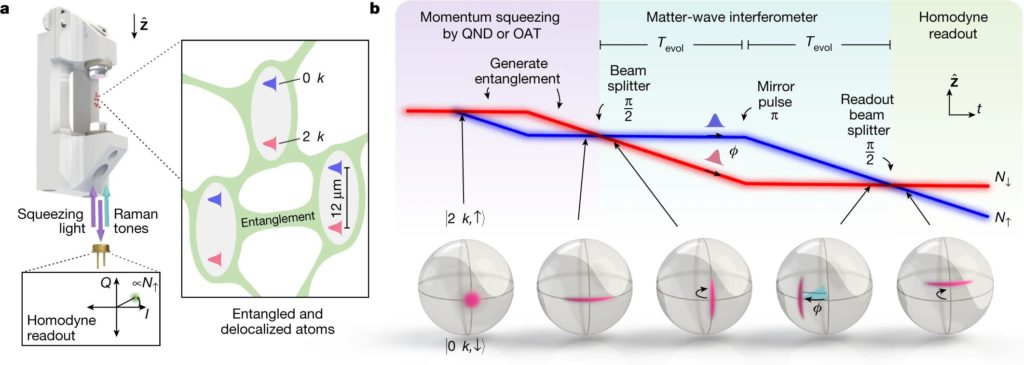 Experiment design. Image: Graham P. Greve et al., Nature
By combining these two effects, the researchers createdbased on an optical resonator matter-wave interferometer. This instrument measures free-fall acceleration with an accuracy that exceeds the standard quantum limit. This is a limitation on the accuracy of a continuous or repetitive measurement due to the quantum noise of unentangled atoms.
The authors of the study believe that the sensors,which will use entanglement and delocalization together, provide more accurate navigation in the future, help explore natural resources, determine fundamental constants more accurately, and look for dark matter.
Read more:
Starlink signal hacked to be used as an alternative to GPS
NASA revealed the origin of Haumea - the most mysterious planet in the solar system
A monster black hole was found in the "backyard" of the Earth: it is very close to our planet