Using the GOES-17 satellite of the Nationalof the Oceanic and Atmospheric Administration (NOAA), scientists from the Joint Institute for Research in Environmental Sciences (CIRES) made the first-ever images of the Sun's middle corona.
The middle corona is the region of the Sun thatresponsible for the movement of the solar wind and solar flares. They reach Earth, interfere with radio communications, damage electrical networks and reduce the accuracy of navigation systems. New observations have revealed connections between the inner corona, with its complex magnetic structure, and the outer corona, where the solar wind flows into the heliosphere, the huge bubble of space surrounding the Sun. “We didn’t think these regions were connected, but we now know they interact all the time,” explains CIRES researcher Dan Seaton, who is the lead author of the new research project.
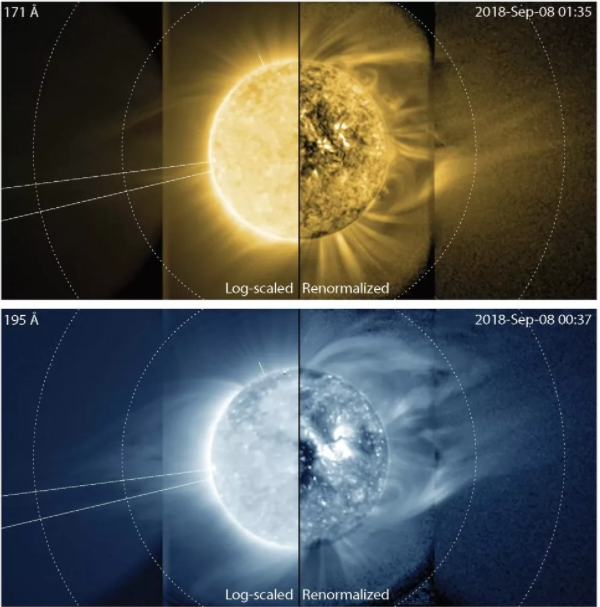 Courtesy of Dan Seaton, NCEI and CIRES.
The photographs with which the scientists worked were obtainedSolar Ultraviolet Visualizer (SUVI) on the GOES-17 spacecraft in 2018. The researchers combined existing data to create a large-scale composite image. It helps to understand the structure and nature of extreme ultraviolet phenomena in the Sun's middle corona.
“New images of the middle crown will helpimprove space weather forecasting. We will be able to more effectively detect and track coronal mass ejections, which pose significant threats to Earth’s infrastructure,” the scientist concludes. In the future, researchers will continue to study the Sun's middle corona.
To read Further
A supercapacitor the size of a speck of dust has appeared: it is 3 thousand times smaller than its analogues
Tyrannosaurus Rex had neural sensors in its teeth to recognize prey
The age-old mystery of the source of cosmic rays in the Milky Way revealed