When you have a skin disease, the affected area usually becomes either stiffer or softer than normal. New
A wired sensor only 2.5mm thick is neededjust put on human skin. The alternating current then passes through special coils on the device. The built-in magnet begins to vibrate quickly and sends special waves to a depth of up to 8 mm into the skin.
In response, the skin is invisible to humans, but notthe device is subject to deformation. The underside of the sensor measures it by transmitting the data to a connected computer. He, in turn, translates them into the meaning of the stiffness of the skin. This value is then compared with indicators associated with specific diseases. The whole process takes one minute.
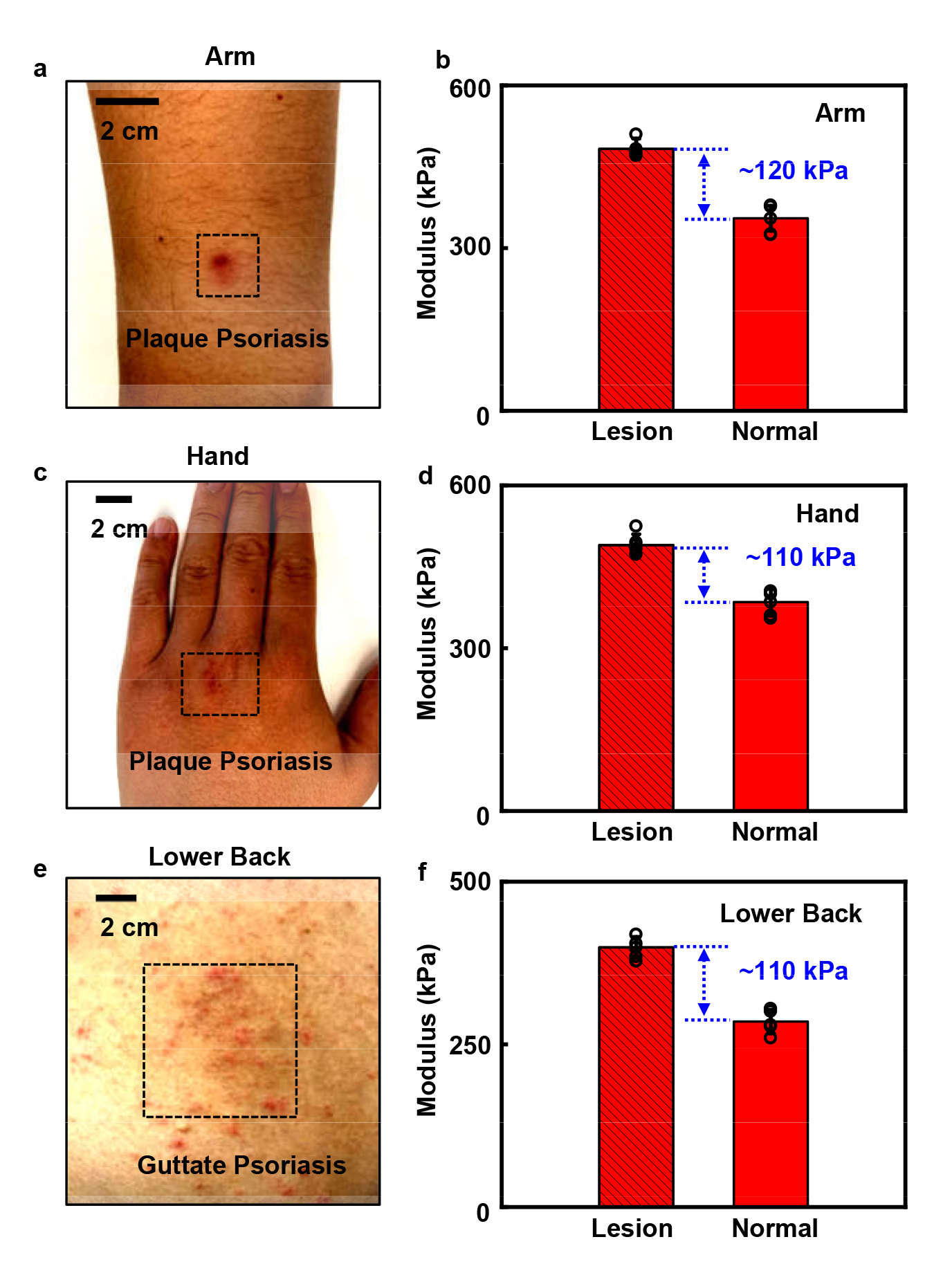 The team applies the device to skin lesions,associated with psoriasis, on the arm (a), arm (c), lower back (e) and unaffected skin. Figures b, d and f show the results of the change in stiffness between unaffected skin and lesions. (Photo source: Song, E., Xie, Z., Bai, V. et al. / DOI number: 10.1038 / s41551-021-00723-y)
And, although alreadyexistdiagnostic systems that measureskin stiffness, these are usually large devices that must be operated by trained technicians. In addition, they can only “read” the outermost layer of skin. If commercialized, the new inexpensive and portable sensor could be used by doctors in regular offices or even by people monitoring their skin conditions at home.
Read more
Japanese scientists drilled the ocean floor near Fukushima at a depth of 8,000 meters
A mathematical model of the brain will allow AI to think like a human
Uranus has received the status of the strangest planet in the solar system. Why?