Researchers from the Karlsruhe Institute of Technology (KIT) and Carnegie Mellon University (CMU) have developed
“Transmitting data from a depth of 4 km through salt water without any loss is extremely difficult,” says Professor Alex Waibel, co-author of the study carried out by KIT staff.
During the experiment, the researchers developedsynthetic methods for converting video data into text. The sound recording is first converted in the submersible and then transmitted to the surface by sonar sound pulses. There the video is restored from text.
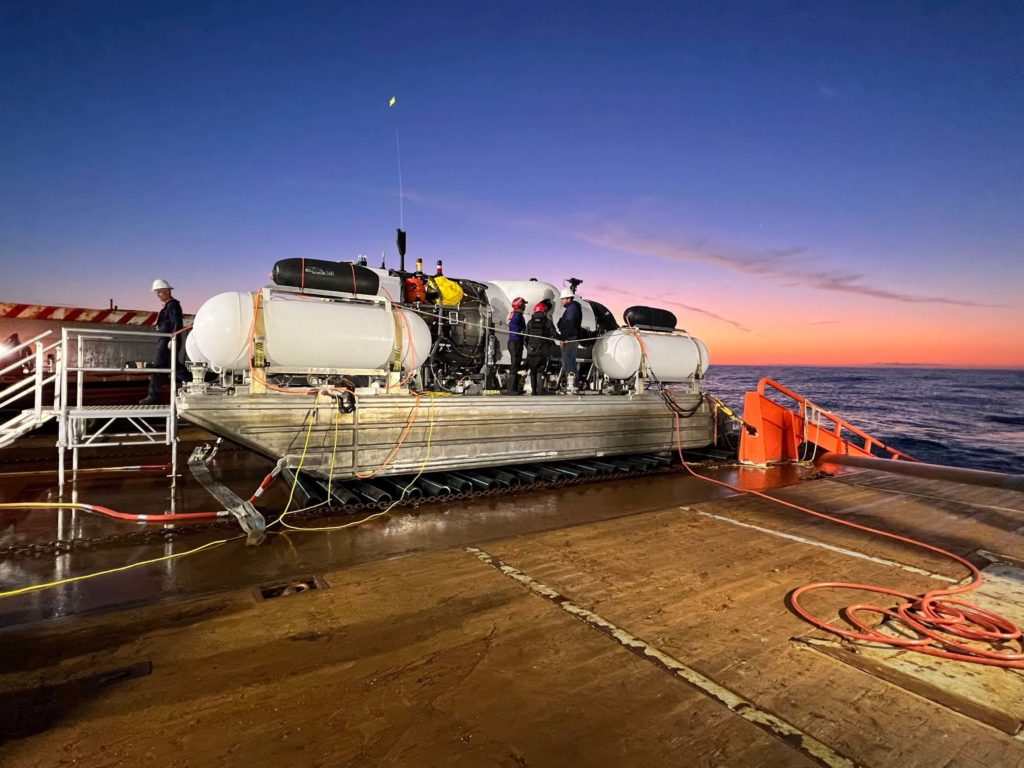 The submersible is prepared to dive to the Titanic wreck on the morning of July 14, 2022. Author: Alex Waibel, KIT
Then a synthetic voice appears in the video,which is matched to the person’s voice. Video synthesis is controlled in such a way that the speaker's lips move in sync with the sound. In the future, this will make distance communication easier
Technology tested by engineersdiving to the wreck of the Titanic builds on decades of pioneering work in the field of speech translation. Previously, Alex Waibel, co-author of the study, created a lecture translator, which is used at the Karlsruhe Institute of Technology to automatically record professors' speech in lectures and simultaneously translate speech signals into written text in English.
Read more:
Created a quantum computer that "went beyond the binary system"
The supersonic plane will fly at a speed of 2,000 km/h and cross the ocean in 3.5 hours
A compelling new theory emerges as to why the Mayan civilization collapsed