Over the past 100 million years, mammals have adapted to almost every possible environment - ecosystems on
In several articles in the special issuejournal Science researchers show how comparative genomics can shed light on how certain species achieve evolutionary success and help scientists better understand which parts of our genome are functional and how they may influence health and disease.
What is the Zoonomia project studying?
Zoonomia is an international project thatuses modern advances in DNA sequencing technology to understand how genomes give rise to the vast diversity of mammals. The research project brings together more than 30 groups of scientists from around the world, led by geneticists from the University of Uppsala in Sweden and the Broad Institute, a joint research center of the Massachusetts Institute of Technology and Harvard University.
Back in 2020, researchers completed work onWhole genome sequencing of 240 mammalian species, 131 of which have not yet been described. While this seems like a small number—more than 6,500 species of mammals are known—the sample is designed to collect data from different subgroups of animals. Therefore, the study includes more than 80% of the families of mammals, covering almost 110 million years of evolution.
In new work, scientists use the alignmentgenome sequences to determine the changes that drive evolution. This is a bioinformatics method based on the placement of sequences of DNA or protein monomers, one under the other in such a way as to find similar sites in them.
Researchers have identified the most conservativeareas of the genome, and sometimes individual nucleotides (“letters”) of DNA, that remain unchanged in mammals over tens of millions of years of evolution. These are the areas that seem to be biologically the most important. They also found part of the genetic basis for unusual mammalian traits, such as the ability to hibernate or detect faint scents over great distances.
Timeline of mammalian evolution
Mammals lived alongside dinosaurs and surviveda mass extinction that wiped out most of these ancient species, except for the ancestors of modern birds. For a long time, researchers believed that the massive diversification of mammals (the rapid growth in the number of new species) began precisely after this event.
In one study, scientists tracked changes in non-coding regions of the genome of various mammals to build a “molecular clock.
The molecular clock gives us the ability to understand exactly when and where different lines of mammals last shared common ancestors, even in the absence of a fossil record.
William Murphy, co-author of the study from Texas A&M University
The researchers found that the first divisionmammals into species occurred before the mass extinction - in the Cretaceous and Tertiary periods. For example, the evolution of placental mammals can be traced back to 102 million years ago. Perhaps the first impetus for the formation of new species was the drift of the continents, which led to the fact that huge landmasses parted and reassembled over the course of millions of years.
Another period of active diversificationreally happened right after the extinction of the dinosaurs - about 65 million years ago, when mammals had more space, resources and stability. This accelerated evolution has resulted in a rich diversity of mammals, including such disparate groups as carnivores, primates, and ungulates.
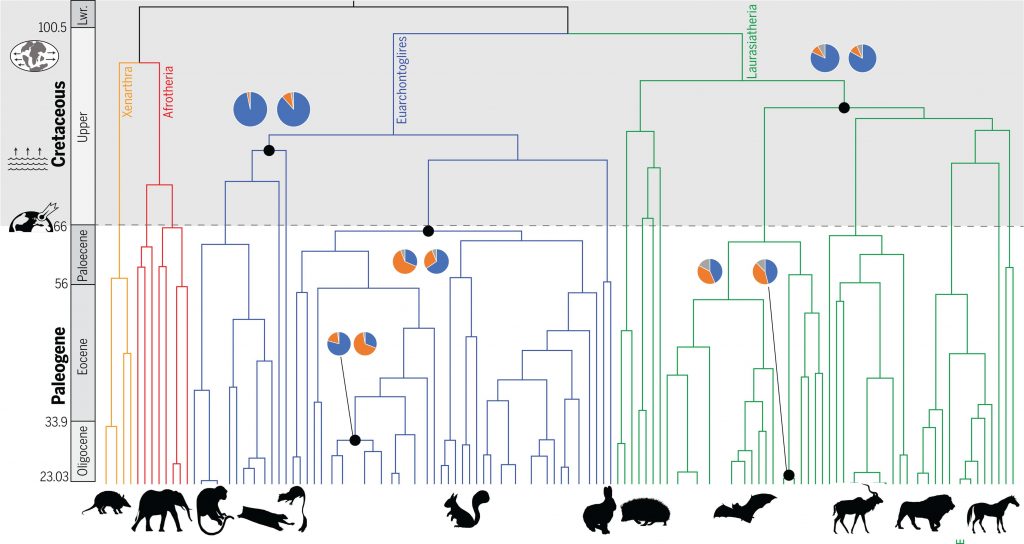 The genetic history of the evolution of mammals. Image: Nicole M. Foley et al., Science
Lost human genes
DNA functions are affected not only by new genes, but also bylost regions of the genome. In the study, led by the Broad Institute and Yale University, the researchers looked at highly conserved genes — ones found in nearly all mammals. By comparing the human genome with other species, especially our close relatives the primates, the researchers looked for parts of the genome lost during evolution.
The analysis showed that people compared withother species of mammals have 10,032 deletions - chromosomal rearrangements, as a result of which a small section of DNA is lost. Most of them are very short sequences consisting of only a few base pairs.
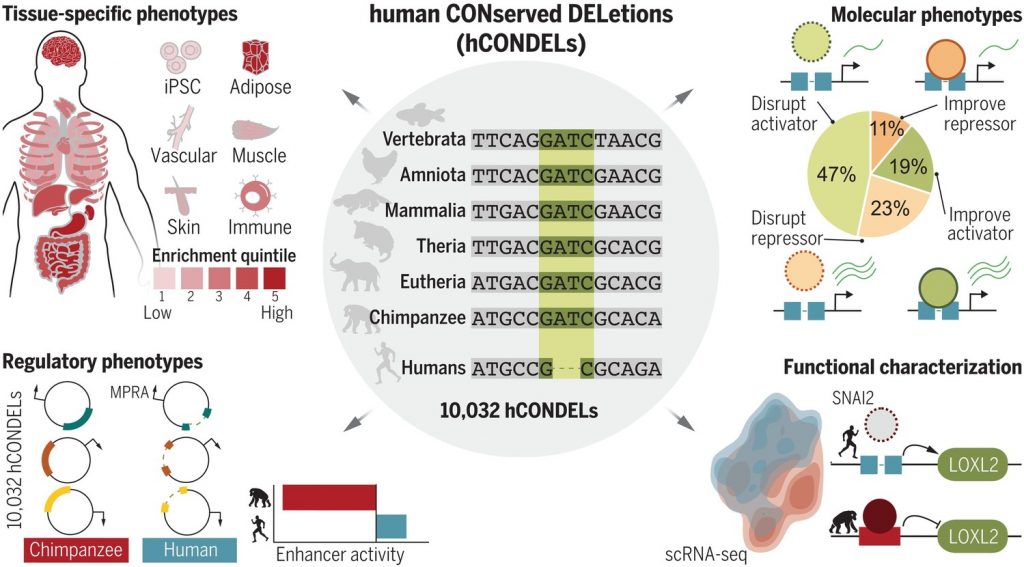 Illustration of the study of deletions in the genomeperson (in the center). The researchers studied how such changes affect the function of various tissues and organs (top left), alter the phenotype from chimpanzees to humans (bottom left), alter gene activity (top left), and how the return of lost fragments will affect processes in cells. Image: James R. Xue et al., Science
Some of the changes relate to genes with neuronal andcognitive functions, including the formation of cells in the developing brain, others control metabolism, including the work of fat cells and the liver. The researchers noticed that instead of destroying human biology, some of these deletions created new genetic codes - they removed elements that would normally turn off genes.
This can be compared to the phrase "do nothing"from which the particle “not” falls out in the process of evolution, scientists explain. As a result, the “instruction for creating a living organism” is flipped 180°. Such small changes have led, among other things, to the formation of complex cognitive functions and a unique human brain.
We often think that new biological functionsshould require new pieces of DNA, but this work shows us that deleting the genetic code can have serious consequences for the traits that make us unique as a species.
Stephen Reilly, a geneticist at Yale School of Medicine and co-author of the study
Search for the causes of the development of diseases
Comparative genetics also helpsresearchers to understand how certain diseases occur in both animals and humans. In one study, geneticists focused on some of the most conserved single-letter regions found in the genomes of most mammals studied and compared them to genetic variants previously linked to diseases such as cancer.
In people with cancer, mutations can bescattered throughout the genome. As the disease progresses, these genetic changes tend to accumulate. It is often difficult to understand which mutations matter, which ones cause or promote disease.
The researchers found that changes inconservative regions of the genome, the least subject to evolutionary changes, are highly correlated with the development of diseases. Scientists have identified mutations that are likely to be the cause of both rare and common diseases.
For example, researchers have shown thatmedulloblastoma, the most common type of malignant brain tumor in children, patients have many new mutations in evolutionarily conserved positions.
We hope that the analysis of these mutations will lay the foundation for new methods of diagnosis and treatment.
Karin Forsberg-Nielsson, professor at Uppsala University and study co-author
Other discoveries
The results described above are only part of a large-scale genetic project. Other studies such as:
- explained why the famous sled dog of the 1920s named Balto was able to survive in the harsh conditions of Alaska;
- showed that 'jumping genes' are more common in carnivores than in herbivores"
- found that species with historically smaller populations are today at higher risk of extinction;
- identified using machine learning partsgenomes associated with several exceptional features of the mammalian world, such as extraordinary brain size, superior sense of smell, and the ability to hibernate in winter.
Published results are just the beginninglarge-scale work, much remains to be analyzed. They show the variety of possibilities for using comparative genetics, the project researchers note. Collected data on mammals and sequencing the genomes of other animal species will help to learn more about evolution, diseases and their treatment.
Read more:
The shape of the Milky Way is not at all what we thought all along, scientists have found
Two super-Earths found on the edge of the habitable zone: one of them has a comfortable temperature
Found a black hole that destroys a star record close to Earth