Scientists believe that the Milky Way galaxy may contain several tens of billions of planets, i.e. V
What is known
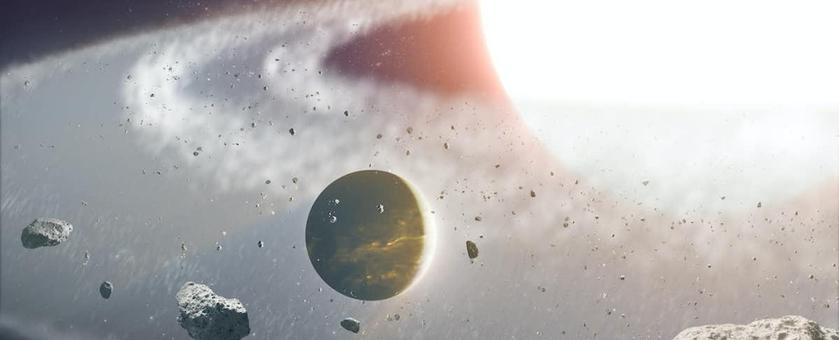
One such planet is 8 Ursae Minoris b.It was discovered in 2015 by South Korean researchers and named Halla. The star around which it revolves is named Baekdu. Both space bodies were named after the highest mountains of the Korean Peninsula.
Halla is twice as close to its star asEarth to the Sun, and the mass is comparable to the mass of Jupiter. Scientists have discovered the planet by fluctuations in the Doppler shift, when the planet and star revolve around a common center of mass, while the star either moves away from us, or moves in our direction.
Further studies showed that in the calculations there is noerrors, i.e. Halla does exist. At first glance, it seems that there are no problems. However, the following studies showed that the planet should not be there.
Spectral analysis showed that Baekdu is activelyburns helium. This means that the star has shed its shell and could expand more than 100 times, destroying everything in its path. In a few billion years, the same thing will happen to the Sun. After the expansion, Mercury, Venus and Earth will be destroyed.
Astronomers have found two explanations for how the planetHalla was able to survive. The first option is the existence of a second star. In such a case, the expansion of the envelope of the old star would be blocked by the younger star. The second option is that the planet could have formed after Paekdu shed its shell and expanded.