An international team of scientists has discovered that Sagittarius A*, a supermassive black hole located at the center
Sagittarius A* is much less bright than other blacksholes in the centers of other galaxies that astronomers have observed. This means that it is currently not absorbing the material around it. The researchers used data from X-ray telescopes to find out how the behavior of the massive structure at the center of our Galaxy has changed in the past.
Astronomers used NASA's IXPE satellite tostudy the polarization of light that comes from galactic molecular clouds located near Sagittarius A*. Precise measurements, compared with observational data from the Chandra X-ray observatory and the XMM-Newton satellite, made it possible to determine the signal emitted in the distant past and find its source.
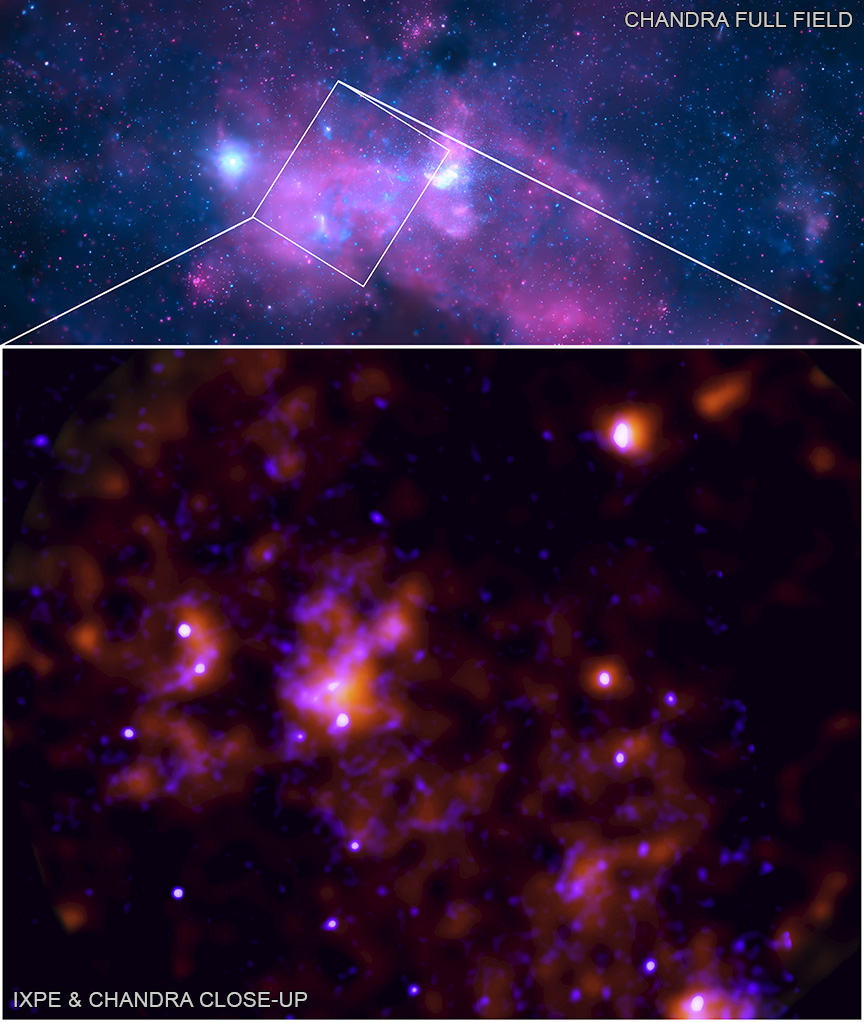 X-ray emission from molecular clouds at the center of the Milky Way. Image: Chandra: NASA/CXC/SAO; IXPE: NASA/MSFC/F. Marin et al; image processing: L.Frattare, J.Major & K.Arcand
By analyzing the data, the team found thatthe X-rays that cause the molecular clouds to glow brightly are reflected light from an intense but brief flash that originated in Sagittarius A*. Although the source of "light" itself has long gone out, its reflected radiation continues to affect nearby objects.
The researchers concluded that the outbreak wasassociated with the absorption of Sagittarius A* part of the material of molecular clouds that approached too close to the black hole. This event occurred about 200 years ago, and the radiation intensity at that moment was at least a million times higher than the current one.
The sound of the echo of black hole activity. Video: NASA/CXC/SAO/K.Arcand, SYSTEM Sounds (M. Russo, A. Santaguida)
Further observations will help clarify the timeoutbreak and its intensity, scientists believe. In addition, using data on reflected radiation, it will be possible to construct a three-dimensional distribution of giant molecular clouds surrounding a black hole at rest.
Read more:
See 100 lightning bolts that hit the ground and water during a thunderstorm in Turkey
An artifact resembling a phallus was found in Mongolia: it is about 42,000 years old
Found the tallest tree in Asia: show how it looks
Cover image: Chandra: NASA/CXC/SAO; IXPE: NASA/MSFC/F. Marin et al.