Astronomers have reported the discovery of an exoplanet in the AF Hare system, a Sun-like star located in
The researchers used the method of astrometry tosearch for exoplanets. This approach allows us to measure subtle changes in the position of the parent star relative to other stars over many years, associated with the gravitational attraction from objects orbiting it. Although the mass of the exoplanet AF Hare b is much less than that of its star, its movements caused fluctuations that were detected in the observational data of the Hipparcos and Gaia satellites over 25 years.
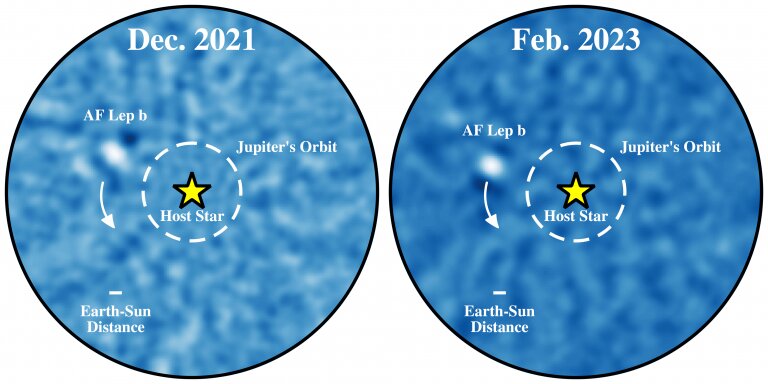 Exoplanet AF Hare b. Image: Kyle Franson, University of Texas at Austin/W. M. Keck Observatory
To take a direct picture of the planet,the researchers used the adaptive optical system of the Keck Observatory. By suppressing the light from the star with a coronagraph, the researchers were able to observe a source that glows about 10,000 times fainter. Direct images taken by Franson's team showed that AF Lep b has about three times the mass of Jupiter.
The researchers note that direct observationexoplanets is a difficult task, so far no more than two dozen planets have been discovered by this method. Traditionally, a transit method is used to detect distant worlds - a partial eclipse by a planet of its own star, but in this case, not the planet itself is visible, but only the consequences of its movement.
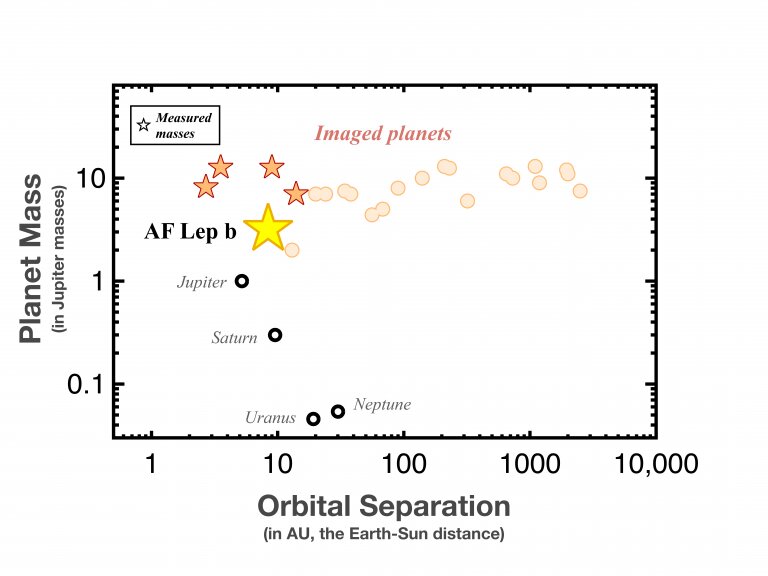 Distribution of known direct imaged planets by mass (compared to Jupiter) and orbit (in AU). Image: Brendan Bowler, University of Texas at Austin
The combination of astrometry and direct observations canhelp astronomers find exoplanets that have been difficult to find with alternative methods. For example, those that were too far from their star, had too little mass, or did not have edge-on orbits to produce an eclipse as seen from Earth.
Read more:
See 100 lightning bolts that hit the ground and water during a thunderstorm in Turkey
An artifact resembling a phallus was found in Mongolia: it is about 42,000 years old
Found the tallest tree in Asia: show how it looks
On the cover: Image by jcomp on Freepik