Roman Fedorenko— Associate Professor at the NTI Competence Center in the direction of “Technology of robotics components and
Dmitry Devitt— Junior Researcher at the NTI Competence Center in the direction of “Technology of Robotics and Mechatronics Components” at Innopolis University.
Everybody leaves the garage
Roman Fedorenko: Just as Google, Apple, Microsoft and other IT giants came out of the garage, our research group began with the same thing.We have high hopes for our garage.This is a robot development and testing center. And we are primarily engaged in robots and we perceive drones exclusively as robots. This may be an unusual story for many. Traditionally, people imagine a robot as a walking android. But there is an area of field robotics in which we work. Essentially, these are all robots that move: drive, swim or fly.
Robotics (field robotics)- applied science involved in the developmentautomated technical systems and is the most important technical basis for the development of production. There are construction, industrial, household, medical, aviation and extreme (military, space, underwater) robotics.
R.F .: Our center works mainly under the auspices of the National Technology Initiative (NTI).Among our partners there are 6 academicinstitutes, 18 industry partners and 7 foreign partners. What are we doing? All robotics, with the possible exception of microrobots. Starting from industrial ones: from manipulators, including modern collaborative robots, to neurotechnologies, ending, of course, with artificial intelligence (this is generally an end-to-end technology).
R.F .: The project that started it all for me is autonomous airships.And this is a non-standard path.Usually when they talk about drones, they think that you are most likely involved in copters. In my case the reason lies in the case. At the university where I studied, the Southern Federal University, there was a Research Institute of Robotics and Control Processes. I came there and immediately became interested in airships. How this all happened is now difficult to understand. But I went from a small airship, which I worked on in the student office, to a 70-meter full-fledged device for the Chinese Space Agency. The student project was flying indoors and it was a separate challenge to operate without GPS. And the Chinese airship already needed a control, navigation and telecommunications system.
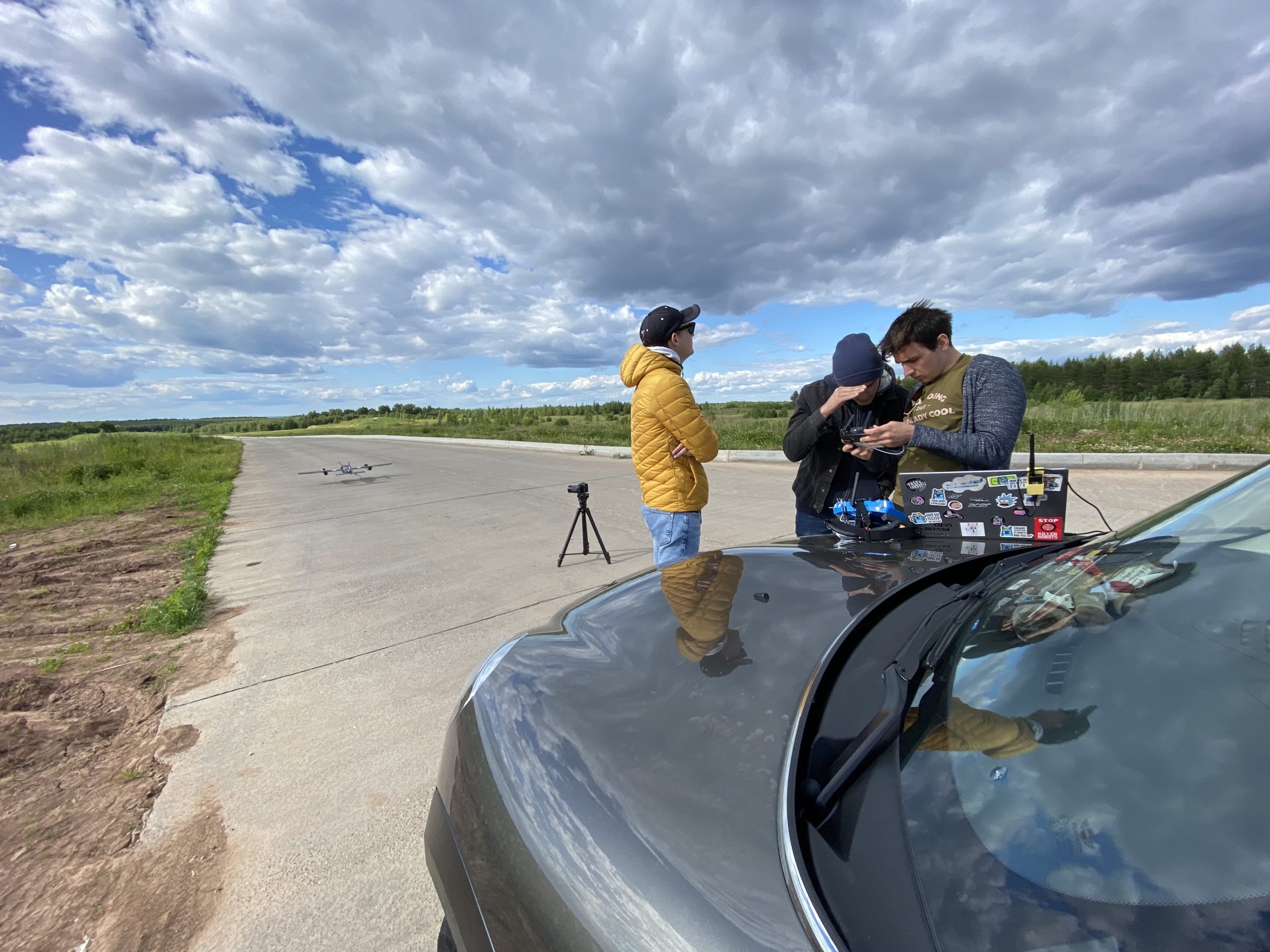
Dmitry Devitt: We are working on control systems and obstacle avoidance systems.Actually, this is what they are doing nowRussian and world scientific schools. In particular, we created systems for the operation of drones intended for filming. This is actually our first independent work. And this thing has already been used in several films - “Godzilla”, “Mulan” and others. So that directors don’t have to worry about how to frame the picture, everything is done using a drone in automatic mode.
From Chinese lanterns to drones
R.F .: The first aircraft were Chinese lanterns.Further, we can give an example of a hot air balloon -balloon. But the most famous of the first devices was the Wright brothers' airplane with a motor. They made their first aircraft as gliders, but in 1903 not yet automatic, but controlled flight was recorded. But in fact, the story is controversial, because in 1901 airships were already flying. At the beginning of the last century, airplanes and airships competed strongly. Airships made transatlantic flights. They were huge, comfortable, beautiful, almost like airliners now. But in the end, the planes, one might say, won. Although airships remain and still find their niche.
R.F .: There are three principles for creating lift.There are airships - and this is the aerostatic principle.Like a balloon, due to the force of Archimedes, it rises and stays in the air. There is an aerodynamic method - with a fixed wing or a rotating rotor. This includes helicopters and well-known copters. Of course, jet propulsion can be classified as another type - there are also jet planes, but first of all these are rockets.
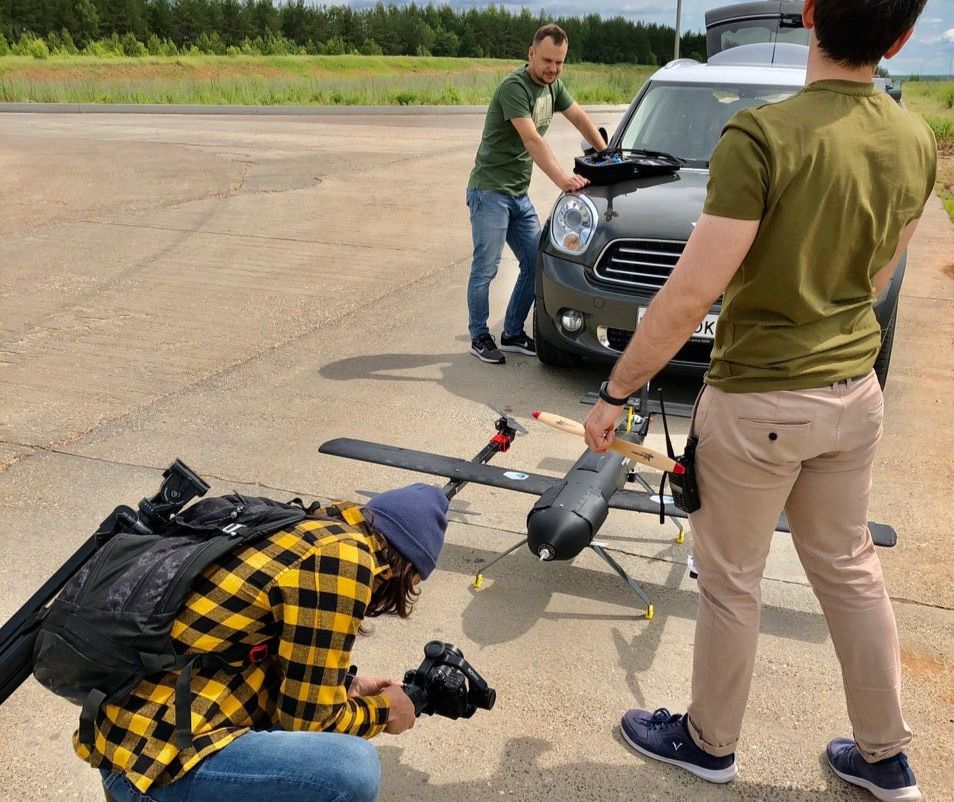
R.F .: We are working with a hybrid of two of the listed lift technologies - a tiltrotor.This is a device that has the abilityvertical takeoff and landing, as well as wing propulsion. If we talk about the use of unmanned aerial vehicles (UAVs), the most popular today is hobby photography and video shooting. Moreover, we are talking about a completely competitive and mature market. The next application is military and finance. If we talk about military applications, Russia today accounts for 15% of the global practice of using aerial robotics. Another segment in which drones are used is monitoring. Today, solutions for delivery and last-mile tasks are actively developing. Precision agriculture, industrial applications and telecommunications are also on the rise. One of the cases is Google Ballon - balloons that distribute the Internet. The leading manufacturer of drones is the Chinese company DJI, with more than millions of flight hours and already more than 70% of the entire global market.
R.F.: One of the tasks of precision farming is crop monitoring.In addition, analysis of the vegetative index andidentifying problem areas. Of course, you can spray the entire field with a tractor, it is cheaper per unit area, but not very effective. The task is to find problem areas, outbreaks of some pests, etc., using drones equipped with specialized infrared cameras. Another application option is irrigation and spraying. The guys from Kazan made a cool project BRAERON - a Russian-made agricultural drone. This is such a huge device, it has two propellers that are powered by an internal combustion engine. They create the main lifting force. And there is a copter circuit that creates a torque using the steering force to control the movement.
R.F .: Another option for using UAVs for a hobby is drone racing. Drone Racing League (DRL) is the most popular of the organizations that host these competitions. There are also virtual races based on simulators.
"Walk, so to speak, a doggie!"
D.D.: There are a total of eight stages of drone development.In general, a quadrocopter, an unmanned aircraft and an unmanned vehicle are all robots, they have similar structures and control algorithms must be applied everywhere. At the same time, the sensorics are not always similar.
R.F.: The motors found in drones are usually brushless.They have a separate control unit thatis a multi-level structure. The engine has an ESC - electronic speed controller. We set the desired thrust, and he works out how to control the engine, how to switch the winding, and so on. The next link is the autopilot, a complex thing with a controller and many sensors: GPS, inertial navigation system, barometer and others. The motion control logic runs inside the autopilot. There are also functional separate blocks - a controller block, motion planning, simple point-to-point movement, and a block for combining data from different sensors. For example, our GPS data arrives at a low frequency, while our inertial system data arrives at a higher frequency, but has an accumulating error. There are algorithms that allow us to combine all this and give us good data.
R.F.: Autopilot in a drone is a low-level basic thing.For further and more intelligent control, an on-board computer, cameras, sensors and other additional devices are used.
R.F .: Drone development starts with conceptual calculations.The appearance of the device and its system are being designedcontrols: what thrust is needed, what aerodynamics will be, and so on. Then mathematical modeling is performed. Essentially, this is work without hardware. The next stage is the development of a control system, namely algorithms. For simulation, various approaches and packages are used, for example, MATLAB, or ready-made simulators - Gazebo, Microsoft FS. Innopolis University has its own simulator - Innopolis Simulator. It not only has a visual demonstration, but also a simulation of all the sensors, meaning it provides the same data as GPS sensors, perception sensors, cameras and lidars. This allows you to develop multi-level highly intelligent control technologies. When we have debugged everything in the simulator (and it usually works well there), we can move on to the most interesting part - tests, production of a test sample and flight tests. As part of our cooperation with the Kazan Aviation Institute, production facilities for the production of UAVs are being built, where carbon fiber drone manufacturing technologies will be used. If we talk about additive technology, we can do this right in Innopolis.

D.D.:First of all, we test the control system,so that it is as stable as possible. Let's say you need to check how a quadcopter resists the wind. This can be imitated - for example, Roman tries to tug at him and tear him apart, essentially acting as an external disturbance. But these are not exactly flight tests, these are so-called gimbal tests. We are watching how the device stabilizes itself. We also conduct crazy experiments - in a flying copter we turn on the main engine, an aircraft one, and see how it behaves. That is, does it keep its orientation as correctly as it should in copter mode. When we are already sure in our hearts that this thing will not fall, we can launch it. Walk the dog, so to speak!
R.F.: The main problem in developing aircraft that are not airships is that the slightest mistake can lead to a crash.It’s easier with an airship - you can connect to it there and even restart something. But with an airplane and a copter, the slightest error, inaccuracy in the settings, and that’s all.
Top trends in drone development
R.F.: The main trend in robotics that we are involved in is increasing autonomy.Previously, a drone was a simple carrier of usefulload, that is, rather blunt and moving from point to point. It's not easy either. I flew from point to point, but knew nothing about obstacles, working in urban environments and sensors. And if there were sensors on it, they simply recorded data and collected photographs. Now there is a trend away from the payload carrier to a smarter robot. That is, it not only takes data, but immediately analyzes it and uses it for its own management. A drone, for example, may not build the entire map, but find some areas on it, immediately analyze and further explore interesting territories. It is clear that this requires software and algorithms.
R.F .: The main trend in terms of drone design is energy efficiency.We use the best batteries, but howAs a rule, a quadcopter cannot fly for more than an hour (even the best one). Therefore, there are various options for how to deal with this for the end use. And they usually fall into two components. These are either some kind of automatic drone maintenance stations that allow you to expand its autonomous functioning by changing batteries or automatically charging at the landing station. And another direction is hybrid structures. That is, more efficient devices that use different principles of movement for their modes. In addition, with the current development of sensor technology, drones have the opportunity to use various cool sensors that previously weighed a lot and were expensive. These are lidars, multispectral cameras and other cool cameras.
D. D .: Now in the world they are actively engaged in obstacle flying systems.Most often this is work in premises, complex andnoisy places. This is mainly needed for analyzing destroyed buildings. Zurich and leading laboratories in the USA, MIT, and Skoltech are now actively working on such systems capable of operating in emergency conditions. We are also doing this - we inspected ourselves, tried to fly around the basement. And there are a lot of tasks here - navigation without GPS, using only sensors for movement and planning itself, that is, how we need to move in order to get maximum information about a given area. Today, about 20 laboratories compete with each other in quality and speed, because it is important not only to make a flight, but also to do it in less time. This is one of the challenges in terms of sensors, processing, and algorithms. Now the most active developer is ETH Zurich. They developed their own camera, in fact, this is a completely new type of camera, similar in structure to the physiology of the human eye and can produce not frames per second, but the difference between frames. Because of this, we get a frequency of millions of frames per second. That is millions of changes. If we have hardware on board that allows us to process this, then we can accept and give control with lightning speed.
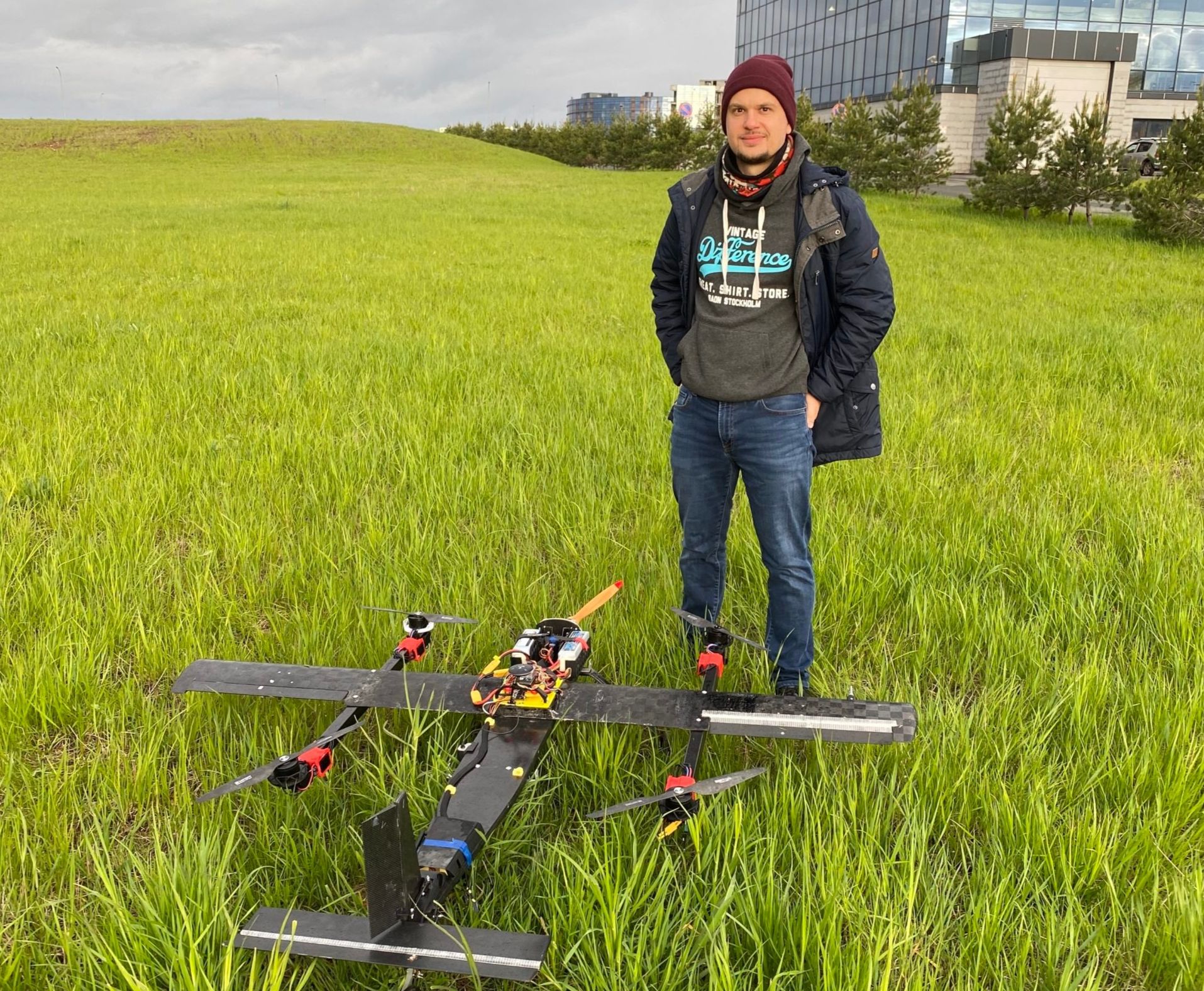
D.D.:The system is developing very activelyinspections, even started a competition at DARPA - SupT Challenge. Teams try to inspect tunnels with different types of robots. It should be understood that there is just a terrible electromagnetic background in the tunnel. Of course, we cannot use any radio navigation. This means that it is necessary to develop technologies for autonomous planning and navigation. This is a very interesting challenge. It can be applied simply in colossal areas. It is commonplace - in a fire. Why send a person when you can send a drone with a radar. Let him fly, build a map, let him look where people are. All this will be in real time on board. And just an applied application - a drone that flew through the window and continued to move without GPS indoors.
D.D .: The main drone manufacturer on the market today is DJI. You can even say that DJI can do everything.The Chinese company makes very high quality anddebugged product. Even their obstacle avoidance system ensures that the drone will stop and not fly at any point at breakneck speed. That is, the main thing is the safety of the device and others. The latest cutting-edge developments they have integrated are already being sold. For example, the Skydio 2 drone from MIT. Such a device for $1,000 will fly around obstacles in the forest. In terms of autonomy, it is better than the DJI, it has all-round visibility and can perform analysis and map construction, as well as avoid collisions. If the DJI drone stops, this one moves away and continues moving. In general, a cool thing, but they are sold on pre-order.
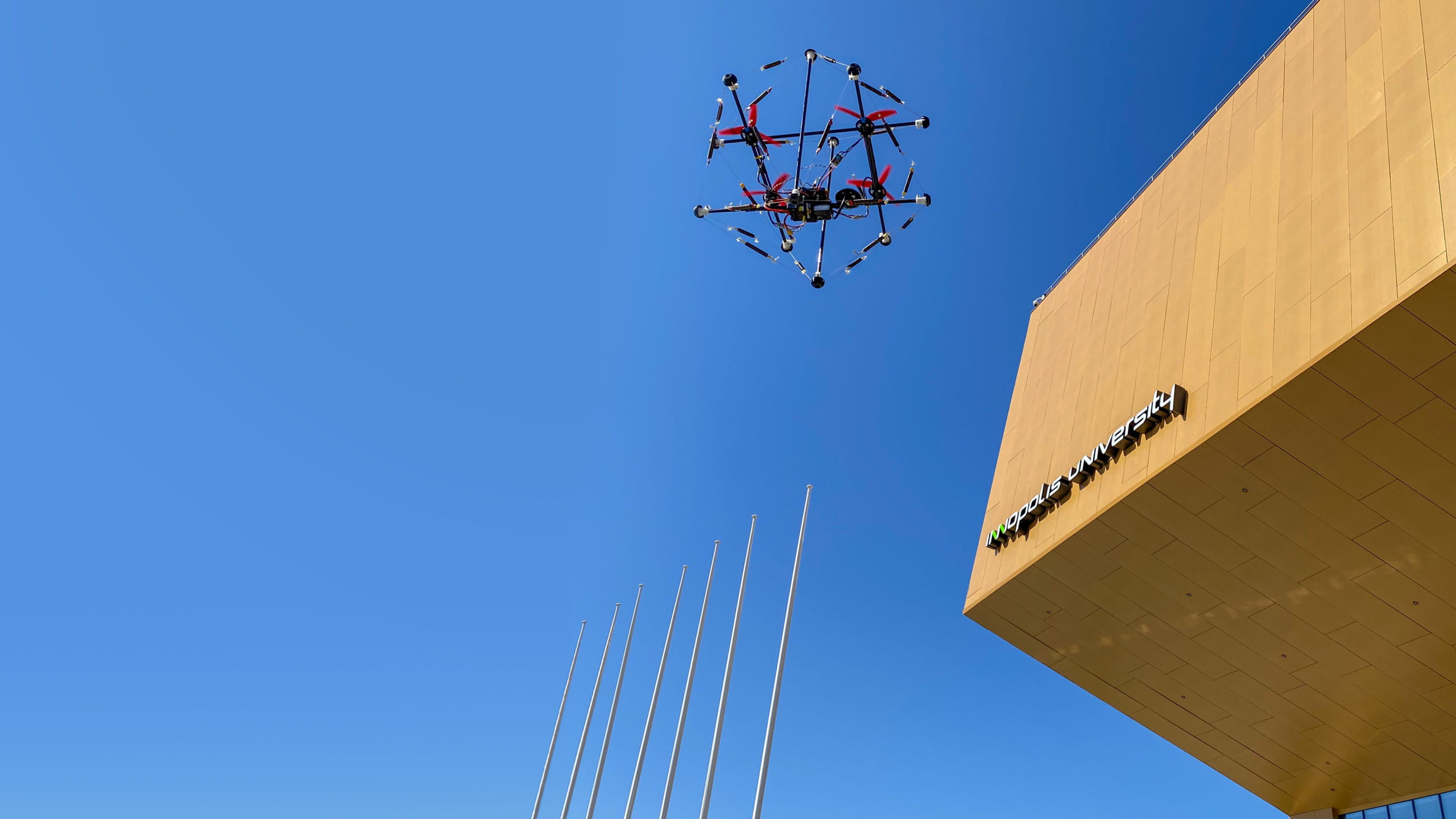
R.F .: There are interesting solutions in terms of design, for example, when a drone needs to fly through a hole, it can fold up and do it dynamically.We are also currently working on an interestingdesign. It is both foldable and partly indestructible. This is the so-called tensor drone. The principle of tensegrity, which is used in architecture, is applied here. This is a drone in which the frame and the protective cage structure are combined and implemented as a tensegrity structure, allowing it to survive falls. We threw it from 20 meters, threw it against the wall. Only schoolchildren on an excursion were able to break it.
Tensegrity- the principle of constructing structures from rods andcables in which the rods work in compression and the cables work in tension. In this case, the rods do not touch each other, but hang in space, and their relative position is fixed by stretched cables, as a result of which none of the rods bend.
DD: One of the popular commercial applications is offline inspection.For this purpose, DJI industrial drones are usedthermal imagers. They can fly up and see the condition of, for example, power lines, telecommunication towers, gas pipelines and everything. We solved the problem of pointing the camera at the wire, which is quite difficult for a pilot to do while moving. We want the drone to be guided by the camera and accompany it as it moves. There is a cool project on this topic - “Rope walker”. This is a drone that moves along wires, along a rope and flies over poles. Cool thing, and Russian.
R.F.: If we talk about autonomy, charging stations are now actively developing.At Innopolis University we have developeda special landing platform for the drone. It was originally made for KamAZ - it is an unmanned truck with a drone that can build a map for him and tell him where to go. But the platform has other commercial uses as well. We can put it near the quarry, watch the development, or at the construction site, and periodically perform flights or surveys on a schedule and draw up a change map.
R.F.: Another trend is the combination of a landing station with a parcel terminal.The Russian company "Copter Express", whichis now actively developing in the production of drones, has made such a postamat and is now promoting it together with drones. He has storage cells, knows how to issue parcels and so on.
D.D.: Flying completely autonomously using neural networks is one of the promising tasks in the direction of autonomy.The level of technology has reached the stage where wewe can make decisions on board the quadcopter right during the flight. And there are two approaches. One approach is classical, when we have a scheduler, a regulator, separate perception modules and we have a neural network. And the other is the so-called end-to-end with a single neural network. It works like a black box. It has inputs, sensors and control outputs. And it implements the already set criteria.
See also:
See what Hubble's successor telescope can see in space
The history of the origin of "strange" meteorites is revealed: they fell to Earth in the 60s
There was a photo of how desert dust "flows" into the Atlantic Ocean