More than a year has passed since my last publication about 5G, and you can appreciate what has changed in a year in
Why is it all Huawei
The company, as we all remember very well, is locatedin a state of confrontation with the current US administration. The United States is waging a trade war with China, represented by Huawei, the victory of which will be the influence of the communications technologies of the future on the whole world. Just like in the movie “12 Monkeys” - the war is not about the current situation, but about the scenario according to which the future will develop. In this war, Huawei has both a history of defeats (for example, in the form of a ban on using the Google Play application store or a ban in some countries to use the company’s equipment) and victories: sanctions forced them to intensify work on their package of HMS mobile services and the AppGallery application store. And also develop our own Harmony operating system, which we will probably hear about more than once. It is worth saying that although the sanctions hit the company hard, they did not stop its growth - the company continues to sell more and more of its smartphones, largely thanks to the huge domestic market of China, where, by the way, it has been operating without Google services for a long time , blocked, in turn, by the Chinese government.
But now we will not talk so much about smartphones,how much about Huawei infrastructure equipment for operators, which is used for 5G networks. And where Huawei actively takes part in the development of this standard, consolidating its successes with numerous international patents, of which the company has (in total, not only in the field of 5G, there are more than a thousand - at the headquarters there is an entire wall dedicated to plaques with these patents, it looks very impressive ). Well, to give even more weight and symbolism to the exhibition, it was named after Galileo Galilei. According to the company, the telescope created by Galileo made it possible to expand the boundaries of human perception of the Universe - thanks to this invention, people were able to learn about the existence and see with their own eyes the craters on the Moon, the moons of Jupiter and the Leaning Tower of Pisa. It's easy to see the intention to draw a parallel between Huawei and the amazing future world that awaits us with the advent of 5G. Although with the same success it was possible to take the name of Newton, Marconi or Tesla instead of Galileo.
What's happening with 5G in the world
According to the latest data, the numbers look prettier than one might expect. Judge for yourself:
- more than 400 models of smartphones with 5G support have already been released in the world
- over the year, the minimum price of a 5G smartphone dropped from $ 500 to $ 150
- there are already more than 100 million 5G users in the world
- nearly 100 mobile operator networks have deployed their 5G networks
- the growth rate is three times faster than the growth rate at the launch of 4G (the first 100 million users were gained not in 3 years, but in a year)
Another interesting fact: only Asian companies make weather in 5G smartphones: Chinese and South Korean: Samsung, Huawei, LG, OPPO, vivo, Xiaomi and OnePlus.
What Huawei can boast about
In addition to smartphones, as we remember, Huawei is still inLast year it introduced the Kirin 990 processor, which integrates a 5G module. But the focus of the presentation was, as I already said, on 5G equipment for operators. For example, Huawei showed a base station module weighing 28 kilograms, which, according to a company representative, weighs significantly less than previous versions. Which allows one person to lift it. In theory, this should all contribute to easier installation of equipment, which, as you know, is installed on the roofs of buildings and masts. All this happens thanks to constant rationalization and miniaturization, as a result of which the size and weight of base station equipment are constantly decreasing. The company not only creates new products, but also constantly improves old ones. For example, it demonstrates a radiator grille, which, thanks to its cellular structure, removes heat more effectively than the simple plate previously used.
Data rates in 5G
For lovers of measurements, they showed the difference betweentechnologically achievable data transfer rates in 5G networks. While 4G can reach 88 megabits, 5G easily delivers 827 megabits under the same conditions, approaching wireless gigabit. It is clear that in a truly deployed 5G mobile network we will not see such speeds, just as we do not see 80 megabits in our smartphones on 4G networks, because in a city, all this gigabit will be divided into a huge number of connected devices (up to a million per square kilometer) , most of which will no longer be smartphones (mainly sensors, and in terms of the volume of transmitted data - CCTV cameras).

</ img>
5G use cases
If a year ago we talked about the futurescenarios for using 5G have yet to be invented and implemented, and representatives of Ukrainian mobile operators directly said that they do not see (yet) a real application, but today it’s already… in fact, little has changed, but there is more understanding in which industries and what types of enterprises will benefit from the introduction of 5G (previously, they mainly talked only about smart city systems). It’s worth saying here that all these solutions are not for consumers at all, but for commercial companies. In addition, every single one of them must use the networks of mobile operators, albeit in the form of specially designated segments. And Ukrainian operators do not yet have either licenses or allocated frequencies for 5G; realistic prospects for the appearance of both are indicated at the level of 2024-2025, and our operators have many other problems.
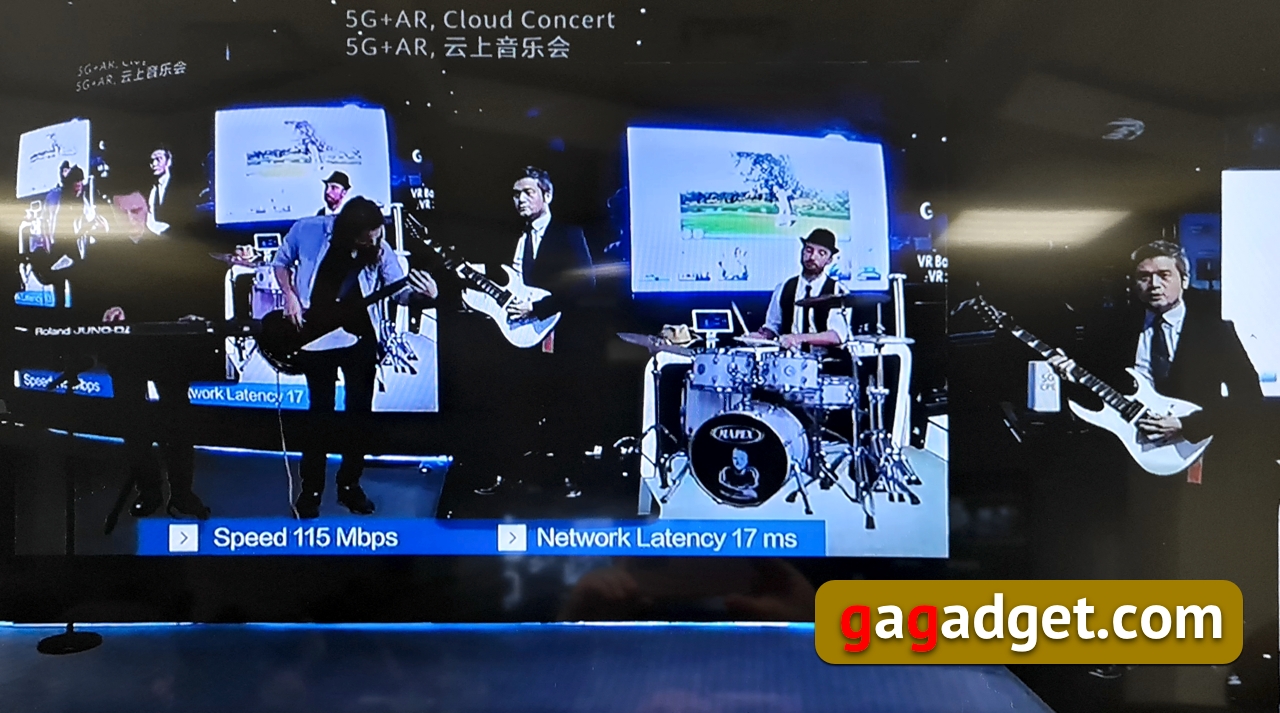
But the Huawei Galileo Exhibition pavilion wasdeployed to demonstrate capabilities, so they showed us some of them. Here, for example, is a virtual concert of a band, each musician of which can be in his own home (hello, quarantine), but thanks to video streaming and augmented reality technologies, all musicians can be placed on one stage in the frame, broadcasting each one separately.
</ img>
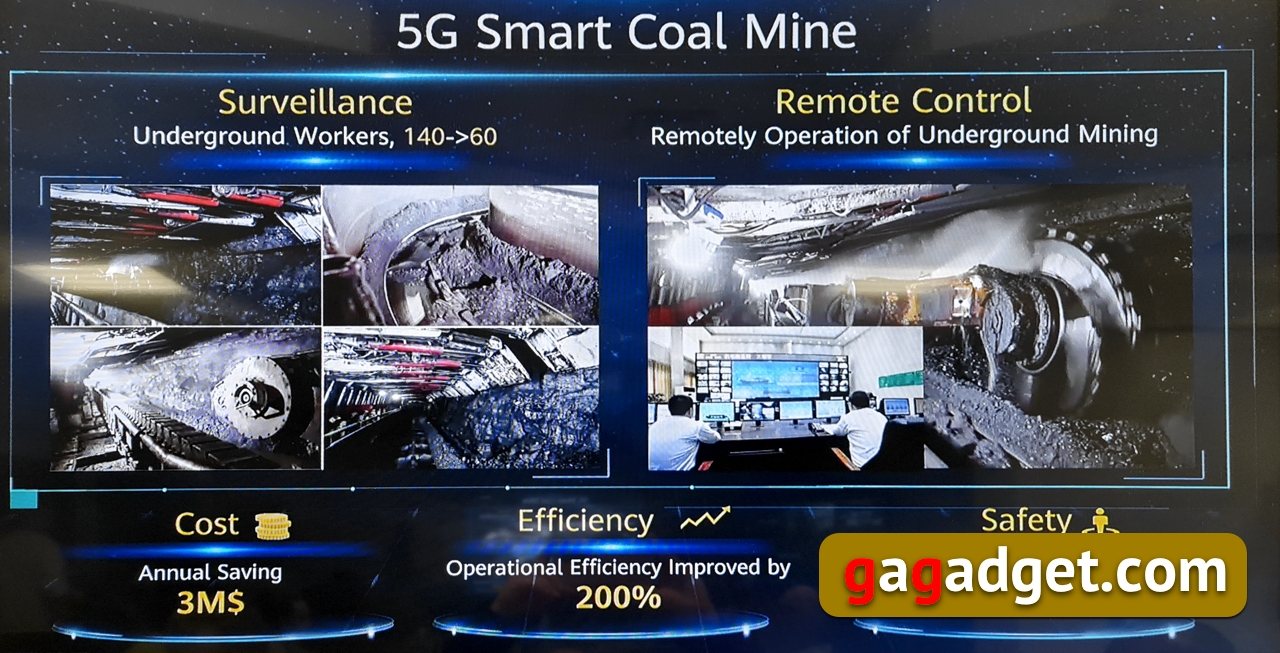
Here is an example of using a 5G network in complexconditions - underground, in a mine. Of course, deploying a 5G network in a mine is not an easy task, but today it is the only way to guarantee the stability of video transmission with the constant movement of mobile equipment (the mine is constantly deepening, therefore, to monitor the work, it is necessary to constantly carry the camera and, accordingly, it must be mobile and with a reliable high-speed connection.
</ img>
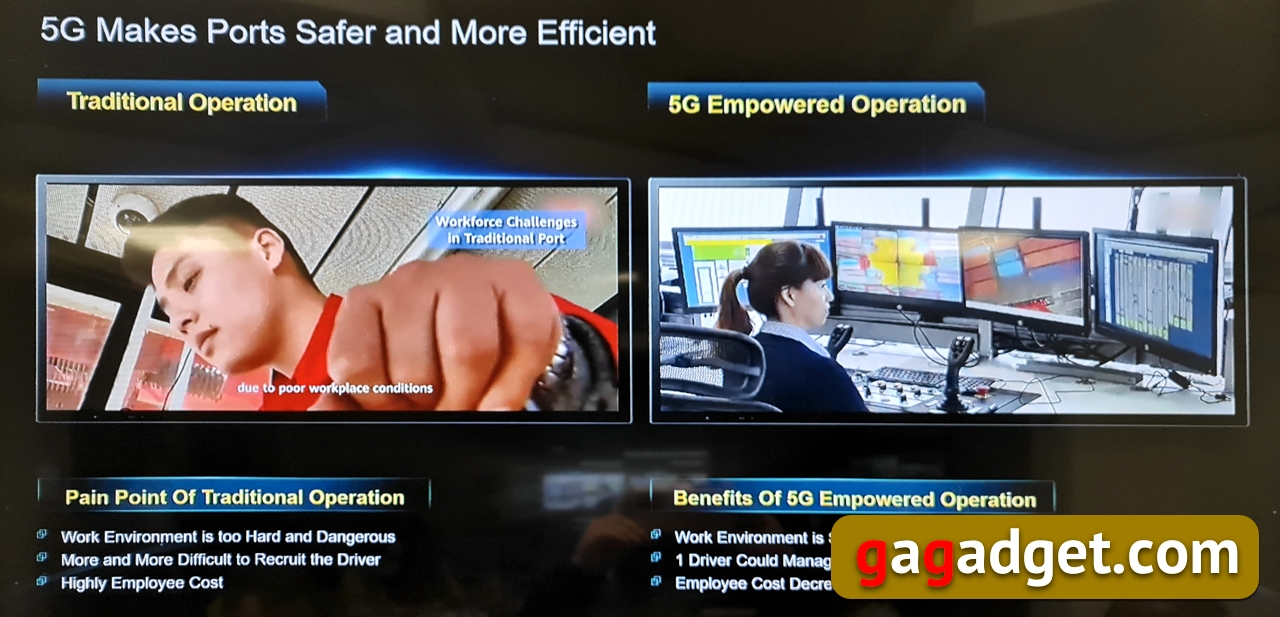
Another scenario for using the 5G network is maritimeport. According to calculations, instead of 6 crane operators with high salaries for difficult working conditions associated with danger to life and health, you can use one operator who will operate the same port cranes, while being safe, in the comfortable conditions of the control room. Please note that the dispatcher in the picture is a woman - this is not about gender equality (although it is there too), but to show that such work does not require good physical shape.
</ img>
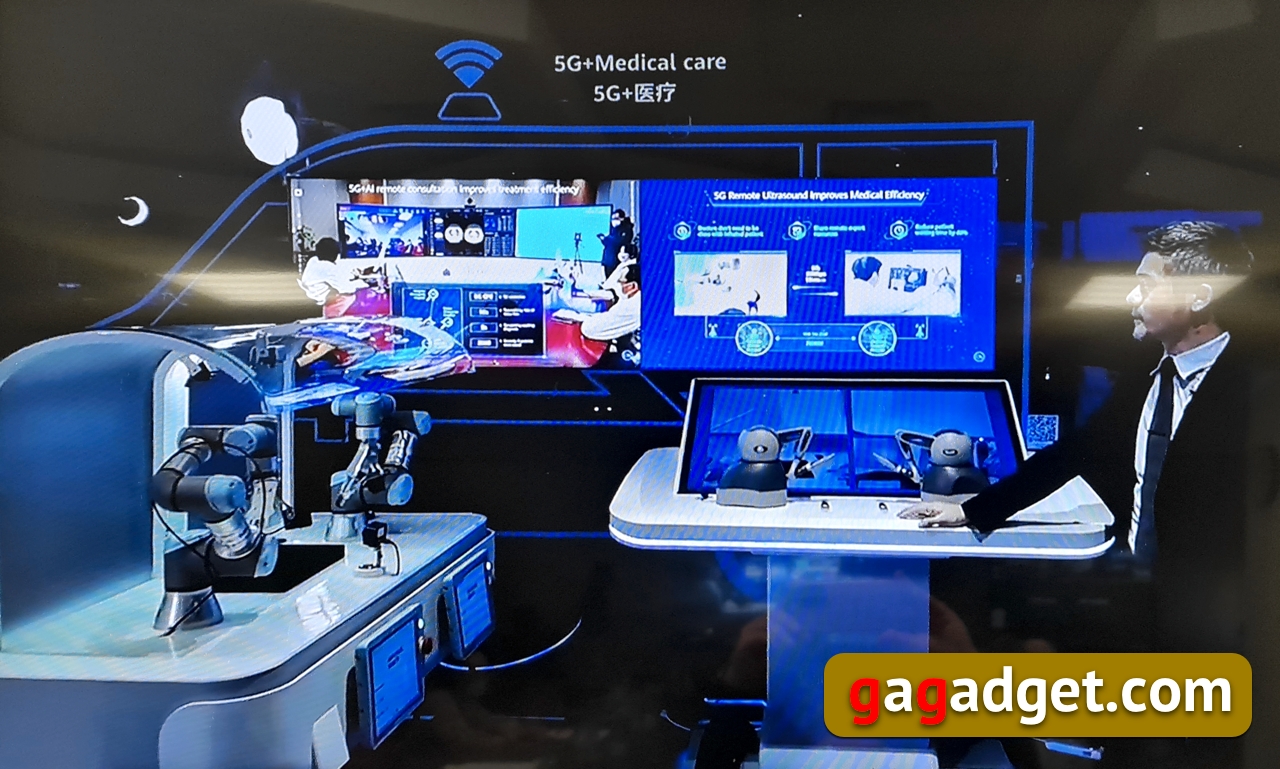
Huawei sees great prospects in 5G forapplications in telemedicine. With the low latency, remote surgical operations are possible. In the exhibition pavilion, there is a stand that allows you to remotely thread a thread into the corner eyelet using remote manipulators.
</ img>
Everything is clear, but what does 5G have to do with it? All this can be done with Wi-Fi
Yes, but no. Wi-Fi operates in an unlicensed radio frequency spectrum, so with Wi-Fi, no one can guarantee anything about the speed and signal delay time. That is categorically unacceptable for business and even more so for medicine. Radio frequencies for mobile communications are licensed by the state, so each operator has its own dedicated spectrum, within which it can guarantee what the client needs (remember, by the client, in this case, we mean not a pimply young man with a smartphone in his hands who makes Speedtest measurements, but enterprises) baud rates and low latency.
Let me remind you that 5G is fundamentally based on threeChina: data transfer speeds (up to gigabytes per second), increased network capacity (up to a million devices per square kilometer) and minimal latency (1 ms), but with the condition “select any two points”. Therefore, we will still see and feel the value of 5G, but this story is not about measuring parrots, as was the case with the launch of 3G and 4G, but about a new level of opportunity and comfort for humanity. Thanks to 5G, new services will appear that would not be possible without it. For example, it was impossible to watch streaming video on a phone without 3G.
The bottom line: Five things you need to know about 5G
- 5G networks and smartphones with 5G are evolving around the world, technology growth rate surpasses the pace of 4G launch
- The value of 5G lies in three things: faster speed, higher network capacity, lower latency
- 5G will bring a new level of automation to enterprises, allowing them to be more efficient (for example, spend less money)
- In our country, the appearance of 5G can be expected no earlier than 2024
- By this time, there will be even more smartphones with 5G, and their prices are lower.
P.S. The original version of this text contained several photographs of the equipment components shown, which we removed from the publication at the request of the company. As they say on the Internet, “shtosh.”