What is the human brain?
It is the main organ of the central nervous system of the vast majority
Despite significant progress in the studybrain in recent years, much of its work is still a mystery. The functioning of individual cells is fairly well explained, but understanding how, as a result of the interaction of thousands and millions of neurons, the brain functions as a whole is available only in a very simplified form and requires further in-depth research.
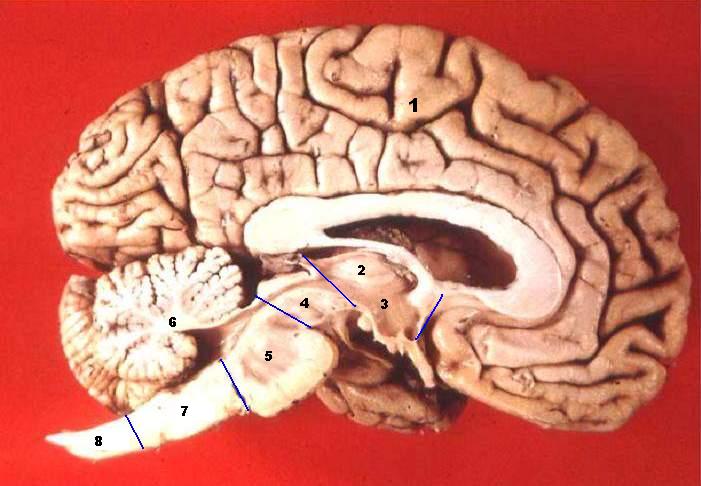 Human brain:
1. Cerebral hemisphere (telencephalon)
2. Thalamus (diencephalon)
3. Hypothalamus (diencephalon)
4. Midbrain
5. Bridge
6. Cerebellum
7. Medulla oblongata
8. Spinal cord
Brain cells include neurons (cells that generate and transmit nerve impulses) and glial cells that perform important additional functions.
The brain weighs one and a half kilograms and contains 100 billion neurons (this is 15 times moreIn addition, there are glial cells in the brain, which are ten times more numerous than neurons.Previously, it was thought that glial cells merely held neurons close to each other.Recent research, however, shows that glial cells, which the human body possessesMore than any other, they are crucial for the chemical transmission of information and thus for all processes in the brain, as well as for long-term memory.
Why Study the Human Brain?
Any organ of the human body is examined first of all in order to learn how to treat it effectively if necessary.But the brain is too complex and interesting a system to be limited to a utilitarian approach.There are hundreds of laboratories in universities around the world that study completely different aspects of brain activity.
Some focus on specific types of disorderspsyche - for example, on schizophrenia. Others are in a dream. Still others are on emotions. Others want to find out what happens to the brain when a person experiences stress or drinks alcohol: this is done, among other things, by the psychophysiology laboratory of the Institute of Psychology of the Russian Academy of Sciences.
The results of such studies are not alwaysbecomes a method for solving a specific problem related to brain activity. Neuroscientists often obtain information that mainly helps us better understand the specifics of relationships between people and find out, for example, by what criteria we rank others as “us” and “stranger.”
There are laboratories that work simultaneouslyboth applied and basic research. In 2012, scientists at the Hebrew University of Jerusalem created a device that allows blind people to “see” with their hearing. It consisted of glasses and a small camera that recorded visual information, and a special program converted it into sound signals.
It is also assumed that one of the resultsA thorough, comprehensive study of the brain will make it possible to create artificial intelligence. In 2005, the famous multi-billion dollar Blue Brain Project was launched, the goal of which was to make a computer model of the human brain and simulate consciousness.
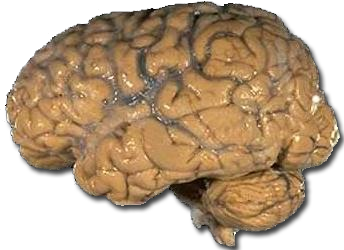 Human brain (fixed in formalin)
What is the human brain used today?
Current brain research methods can be ranked based on two criteria.
- The first is the frequency of information collection: it varies from milliseconds to several seconds.
- The second is spatial resolution: how much detail we can see in the brain itself.
So, electroencephalography is able to collectvery high frequency data. But fMRI (functional magnetic resonance imaging) can cover square millimeters of the brain, which is quite a lot, since there are about 100,000 neurons in one square millimeter.
There are also magnetic encephalography,positron emission tomography, transcranial magnetic stimulation. Methods are usually improved towards non-invasiveness: we want to learn as much as possible about the brain of a living person with minimal consequences for his health and psychological state. At the same time, it was with the advent of fMRI that scientists began to study literally all aspects of brain activity. We can take almost any type of behavior and be sure that there is definitely a laboratory in the world that studies it using fMRI.
Publicly available methods for diagnosing the brain:
- Ultrasound of the brain.The most common study in alldirections is ultrasound. There is also an ultrasound of the brain. This test uses ultrasound to examine the brain, which has been proven safe in multiple studies. Its impact does not accumulate and allows research to be carried out as often as needed.
- MRI of the brain. The method is harmless, since ionizing radiationis absent. You can carry out the procedure as needed, but you won't be able to get the result right away. Sometimes it can take from several tens of minutes to a couple of days to decipher and make a diagnosis.
- PET scan of the brain.The abbreviation stands forpositron emission tomography. Its main task is to diagnose brain metabolism in a number of diseases. For this, an assessment is made of various processes that occur in the brain tissues at the cellular level.
- CT scan of the head and brain. Computed tomography does not just givethe ability to obtain a detailed cross-sectional image of the brain, but also allows you to determine the position of formations or damage, as well as their scale. The procedure is considered quite safe, but there is still radiation exposure. This should be taken into account when choosing the frequency of examinations and combining them with other x-ray examinations.
The latest in brain research
New technologies allow us to better understand the structure of the brain, but their functionality is more precise. For example, at the end of October scientists inventeda new type of microscope that allows you to see biological tissue through an intact skull.It uses a combination of hardware and software adaptive optics to reconstruct an image of an object.
A group of researchers led by a professorChoi Wonshika of the Center for Molecular Spectroscopy and Dynamics of the Institute for Basic Sciences (IBS) in Seoul, South Korea has made a major breakthrough in deep tissue optical imaging. She has developed a new optical microscope that can take images through the intact skull of a mouse. As a result, scientists have access to a microscopic map of neural networks in brain tissues without loss of spatial resolution.
Another sensational development:Elon Musk's brain chip... He, according to the developers, will allow peoplehear sounds outside of normal frequencies. The main goal of the developers is to create a technology that will allow to implant electronic interfaces to paralyzed people, so that they can use computers and smartphones for communication.
Neuralink scientists plan to usespecial "filaments" 4-6 microns thick each, capable of transmitting information to the main processor. These "threads" will be implanted into the human brain. In theory, you can use them as you like. Here we can really talk about improving human abilities.
The "bundle" of six neuron threads contains 192electrodes, which are implanted into the brain with the help of a robotic surgeon. During the operation, the surgeon tries to avoid interaction with blood vessels, which minimizes inflammation.
Another recent invention:nanoparticles that can penetrate the brain.With their help, it will be possible to speed up the creation of drugs for Alzheimer's, Parkinson's and other neurodegenerative diseases.
At the end of July, Hi-Tech wrote in detail about how the technologies of the future are already working for the benefit of people: it was aboutвживлении в мозг нейроинтерфейсов.We are talking about a system that providesinteraction between the brain and the computer and thus allows them to exchange information with each other. The simplest example is the generation of commands for an external device using brain activity. An external device can be a computer, an application, a robot, a drone, a prosthesis, an exoskeleton, or anything else. The scope of application of such interfaces is very wide.
What do we still not know about the brain?
For all the time of research, scientists have not foundthe difference in the structure of the brain of a genius and an ordinary person. Most likely, the differences occur in the so far elusive interaction between neurons. Perhaps some pathology can play a role here. Pathology alone will not make a person a genius.
It is still unknown what the human braindifferent from the animal brain. And, moreover, it is not clear why our brain arose in this particular form, because at first we did not need it of this size for survival. We still have not found a transition bridge between Pithecanthropus and Homo sapiens. We have the genes of Neanderthals, but why they at some point turned aside and did not go further with us is also unclear.
And, of course, scientists still haven’t figured out howour brain works holistically: if the functions of individual areas are understood, then how this “machine” functions as a whole is still unknown.
Read also
Found the alleged kingdom of the disappeared Hittites. What have archaeologists found?
The Doomsday glacier turned out to be more dangerous than scientists thought. We tell the main thing
Biologists have figured out how to identify winning sperm