In a data-driven world, building hubs where you can store cheaply, quickly and efficiently
DNA storage systemsounds like science fiction. But such solutions have already been implemented. True, so far mainly for research purposes and for storing archival data that do not need to be used often. The key limitation for working with DNA is the difficulty with fast parallel access to a large number of files and read and write errors.
An international team of researchers has developedtechnology that can eliminate existing shortcomings. One of the authors of the study, published in the journal Nature, is confident that using the proposed solution within 5-10 years, full-fledged data centers based on DNA will become a reality.
DNA as a data storage system
The idea of using DNA strands to store datadiscussed for decades. Back in 1988, Harvard researchers and artist Joe Davies encoded a 5-by-7-pixel image of an ancient Germanic rune (35 bits of information in total) into DNA included in an E. coli bacterium. But this example was just a demonstration of future possibilities: the technology was too expensive and complicated.
Technically, storing data in DNA has become possible,when, in 2011, Harvard researchers developed a technology for controlled DNA synthesis. Further research in this area has greatly reduced the cost and increased the speed of creating synthetic DNA that contains the desired DNA sequences.
To store information in DNA, instead of the usual 0 and 1, which are used to encode data, base pairs "adenine-thymine" and "cytosine-guanine" can be used.In the lab, bases are joined in a specific order to form synthetic strands of DNA.
Benefits of DNA
Storing data in DNA has many advantages.For example, a DNA file does not take up much space: due to the high density of the molecule, each nucleotide, equivalent to two bits, is about 1 nm³. And an exabyte of data (1,000,000 TB) stored as DNA can fit in the palm of your hand. DNA is also extremely stable - the discovery of a preserved genetic code in the fossils of ancient microorganisms and animals is a prime example of this. And besides, this technology does not require significant energy costs.
The problem is that if in questionsSince existing solutions work well enough for writing data (although they remain relatively expensive), problems begin to arise with reading. The PCR random access method currently used for reading is prone to a large number of errors. Systems can only read one file at a time, and the quality of the data is severely degraded with each read.
The reading process works as follows:Each data file in DNA includes a sequence that binds to a specific primer. Using polymerase chain reaction (PCR), researchers start the process of synthesizing millions of copies of the desired fragment.
The same principle works, for example,testing for coronavirus: under the influence of a certain synthetic primer, a chain reaction starts and even a small amount of virus DNA becomes detectable. The problem is that reading several separate files requires several primers to work at the same time, and this leads to many errors in the copying process and the destruction of the original DNA.
Scalable technology
An international team of researchers proposesthe method they believe will overcome these limitations is heat-fixed PCR. Scientists have created microcapsules of proteins and polymers that act as separate files of DNA. Each such capsule is associated with one data file. In addition, they are designed in such a way that when a plurality of microcapsules are heated to temperatures above 50 °C, each of these capsules is sealed.
This allows the PCR process to readoccur independently in each capsule, leaving very little room for error. When the temperature normalizes, the original file remains attached to the capsule, and the copied files leave it. This keeps the original data and DNA from being corrupted.
Geneticists used their new approach tosimultaneous reading of 25 files stored in the split DNA. The results were positive and unexpected. On average, with thermal capsules, the read loss is 0.3% after three reads, compared to 35% with the current method.
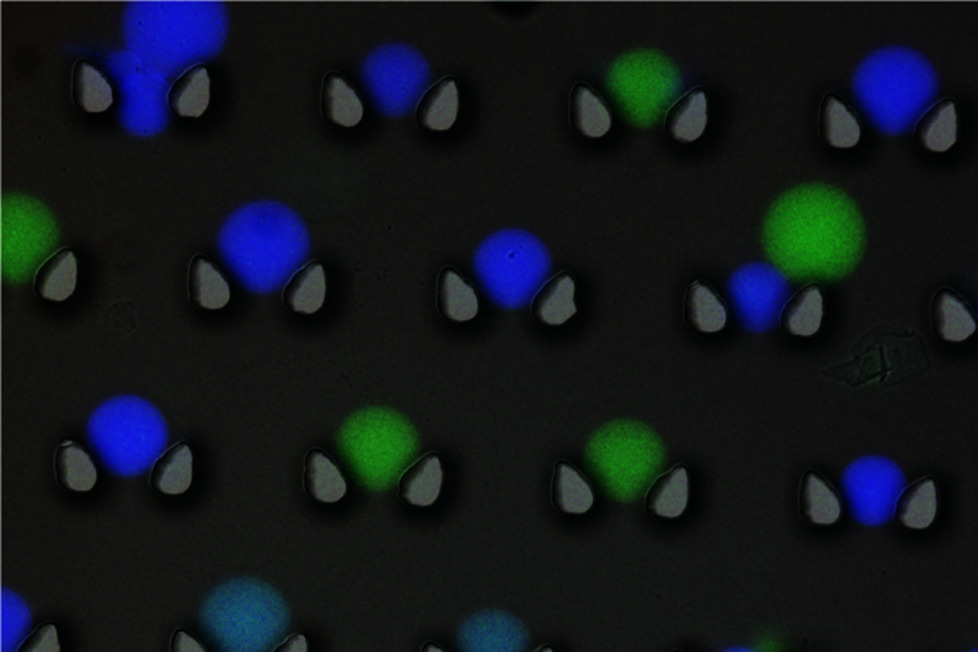 Microcapsules stained with fluorescent labels. Image: Tom de Greef
The second “innovation” - painted with specialtagged catalog. Each file is assigned a fluorescent label, and each capsule is assigned a different color. A special device can then recognize colors and separate them from each other to make it easier to sort and search information in a large repository.
The authors of the technology are confident that these innovationsenough to create a full-fledged DNA-based data center. “In one part of the building, new files will be encoded using DNA synthesis. The other one will contain large fields of capsules, each with a separate file. The robotic arm will take out the capsule, read its contents and place it back, ”says one of the authors of the study. The point is small: to wait until the cost of DNA synthesis is reduced even more, and for this one decade is enough, scientists are sure.
Read more:
Artificial intelligence has found four Nazca geoglyphs - giant drawings in the desert
The absence of "lumpy" in the universe was explained by ultralight particles of dark matter
About a billion years, a day on Earth lasted 19 hours: researchers explained why
On the cover: Image by Freepik