In 2006, miners discovered a hominin cranial vault with peculiar features in the Salkhit Valley of Eastern Mongolia.
Ancient DNA extracted from the cranial vaultshows that it belonged to a modern woman. She lived 34,000 years ago and was more associated with Asians than Europeans. Comparison to the only other person from East Asia genetically studied to date, a 40,000-year-old male from Tianyuan Cave near Beijing, China, shows that the two people are related. However, they differ in that a quarter of the ancestors of the individual Salkhites descended from Western Eurasians, probably as a result of mixing with the ancient Siberians.
“This is direct evidence that modernhuman communities in East Asia were already quite cosmopolitan even earlier than 34,000 years ago, ”said Diyendo Massilani, lead author of the study and fellow at the Max Planck Institute for Evolutionary Anthropology. "This rare specimen shows that migration and interactions between populations in Eurasia often took place as early as 35,000 years ago."
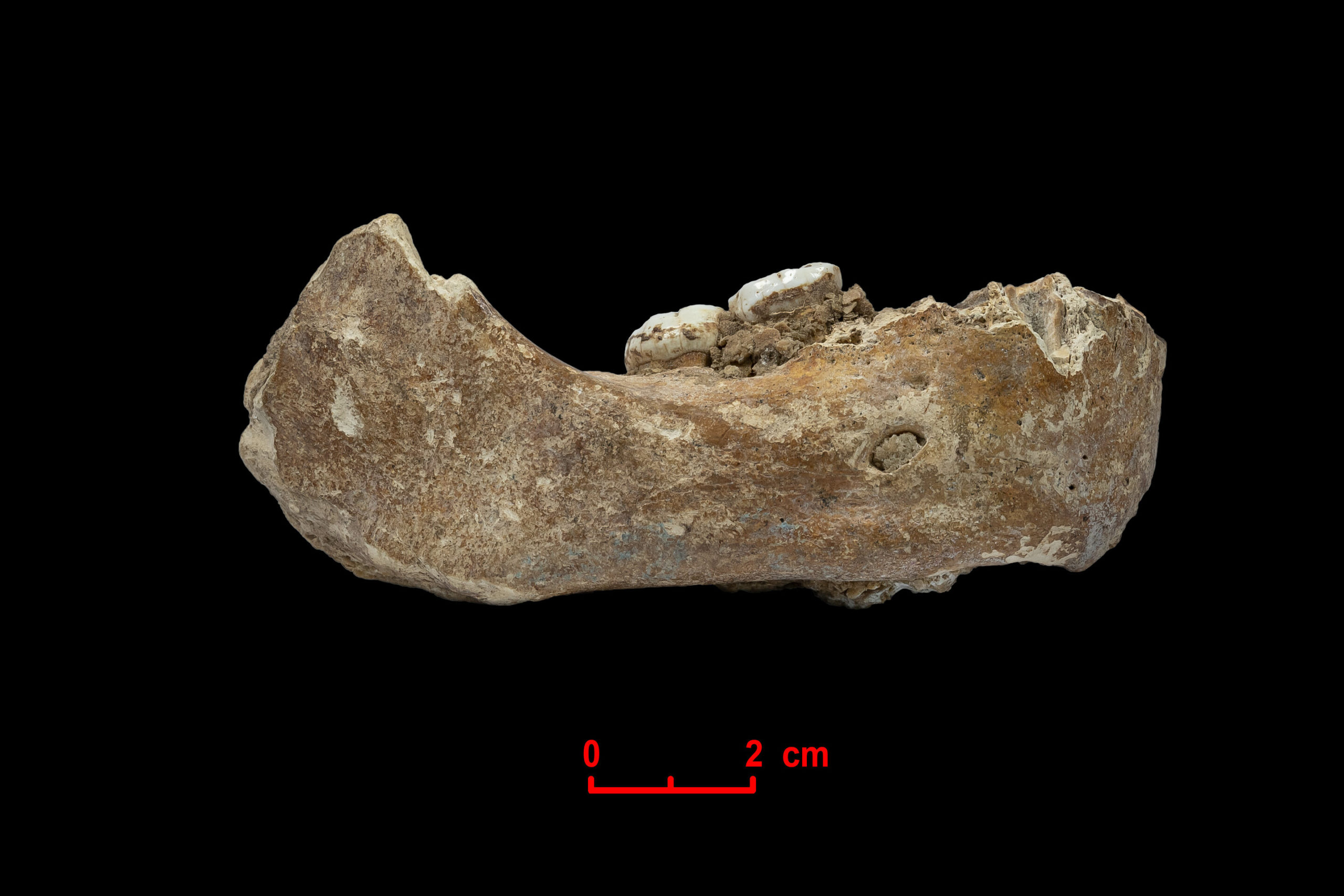 Syahe Mandible. Credit: Menggang Qiu, Dongju Zhang, Lanzhou University
The researchers used a new methoddeveloped at the Max Planck Institute for Evolutionary Anthropology to find DNA segments of extinct hominins in the genomes of Salkhit and Tianyuan. They found that the two genomes contained not only DNA from Neanderthals, but also DNA from Denisovans, an elusive Asian relative of Neanderthals. “It is good to see that the ancestors of the earliest humans in East Asia, from whom we were able to obtain genetic data, had already interbred with the Denisovans, an extinct form of hominin that contributed to modern populations in Asia and Oceania. - says Byambaa Gunchinsuren, researcher at the Institute of Archeology of the Mongolian Academy of Sciences. “This is direct evidence that Denisovans and modern humans met and mixed more than 40,000 years ago.”
“It is interesting that fragments of Denisov's DNA in thesevery old East Asians overlap with Denisovan DNA fragments in the genomes of modern East Asians, but not with Denisovan DNA fragments in Oceanians. This supports the theory of multiple intersections between Denisovans and modern people, the scientists conclude.
Read also
On the threatening Earth asteroid Apophis noticed a dangerous phenomenon. What's happening?
Scientists have found out why children are the most dangerous carriers of COVID-19
What the Parker Solar Probe discovered when it flew as close to the Sun as possible