Ajnabia odysseus He was a member of the order Hadrosaurs. Hadrosaurs Hadrosauridae is a family of platypuses
They fed on plants and grew up to 15 m in length.However, the new dinosaur was tiny compared to its brethren – only 3 m in length.
 A silhouette showing the size of Ajnabia in comparison with humans and the modern Maastrichtian dinosaur fauna of Morocco. Credit: Dr. Nick Longreach
"Platypus" dinosaurs evolved in the NorthAmerica and eventually spread to South America, Asia and Europe. Since Africa was an island continent in the Late Cretaceous period, isolated by deep sea routes, scientists were convinced that the platypuses could not get there.
The discovery of a new fossil in Morocco made a difference, explains Dr. Nicholas Longreach of the Milner Center for Evolution at the University of Bath, who led the study.
It was completely inappropriate how to find a kangaroo in Scotland. Africa was completely isolated by water - so how did they get there?
Dr. Nicholas Longreach of the Milner Center for Evolution at the University of Bath
Examination of teeth and jawbonesAjnabiashows that this dinosaur belonged to the lambeosaurines.It is a subfamily of dinosaurs from the hadrosaurid family, the characteristic feature of which is a bony formation on the head.Lambeosaurs evolved in North America before spreading to Asia and Europe, but were never seen in Africa before.
Because Africa was isolated by deep oceans at the time, the "platypus" dinosaurs seem to have traveled hundreds of kilometers in open water, possibly floating on debris to colonize the continent.They were probably good swimmers – this species is distinguished by large tails and powerful legs, and their remains were often found in river sediments and sea cliffs.It looks like "duck-billed" dinosaurs really covered these huge distances.
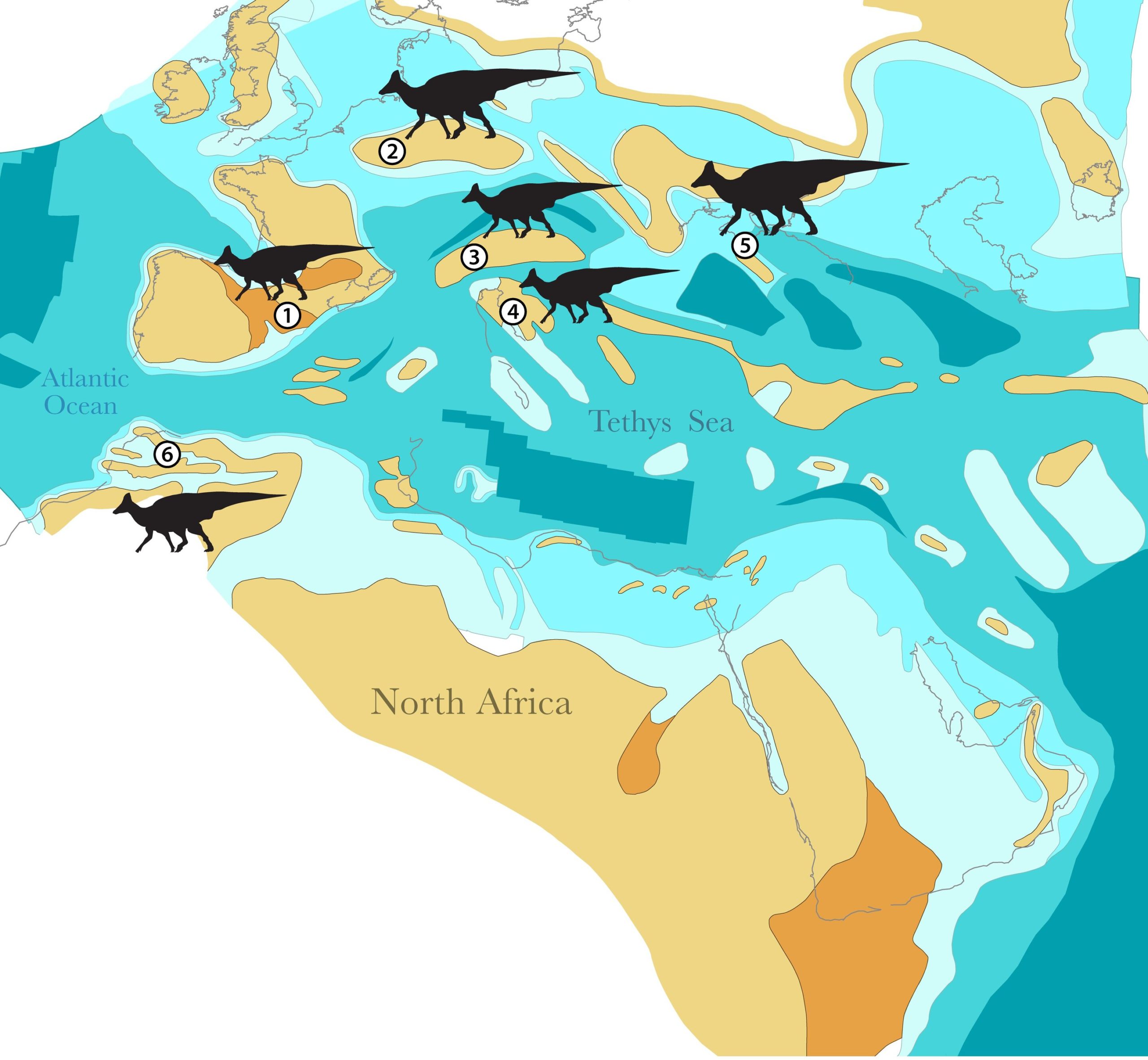 Map showing the location of platypus dinosaurs in the Late Cretaceous period. Credit: Dr. Nick Longreach
In connection with this feat, the dinosaur was namedAjnabia odysseus.Ajnabiameans "foreigner" in Arabic, and Odysseus is a Greek navigator.
The fact that the "platypus" dinosaursspread over several continents even at high sea levels, suggests that dinosaurs traveled across the oceans. “As far as I know, we are the first to suggest this,” concludes Dr. Nicholas Longreach.
Read also
Physicists have figured out the trajectory of the cough drops. Dangerous distance - more than 6 meters
The annual mission in the Arctic has ended and the data are disappointing. What awaits humanity?
Scientists are trying to understand how long a neutron lives. Why is it so difficult and important?