Effects of quantum mechanics, including entanglement of two particles (a phenomenon in which separate states
Two independent groups of researchers have announcedcreating sources of single photons that are necessary for data transmission in a quantum network. German researchers from the Max Planck Institute for Quantum Optics and the Technical University of Munich used erbium atoms embedded in a silicon crystal, which produce light with a frequency corresponding to modern communications networks.
And engineers from the Massachusetts Institute of TechnologyInstitute uses perovskite nanocrystals, the production of which is easy to scale. However, they do not require extreme cooling and can operate at room temperature.
What is a quantum network?
Quantum computers can theoretically performtasks that cannot be solved even on the most powerful supercomputers in the world. They can be used to model the properties of materials and complex systems. But to achieve truly meaningful results, we need an efficient way to connect nodes of quantum information - distributed quantum processors.
Because quantum computers are fundamentallydiffer from classical ones, the usual methods used to transmit information are not directly applicable to them. Quantum information is more complex: instead of storing only the value 0 or 1, as in classical computers, a qubit can simultaneously take on the values 0 and 1 (a phenomenon known as superposition).
The ideal solution is a quantum network −a compound in which a direct exchange of information qubits is carried out with the preservation of quantum mechanical properties. The quantum network links the processing nodes with photons that pass through special interconnections known as waveguides.
The advantage of such a connection is thatquantum devices communicate directly, enabling faster data processing. In addition, such networks can be used for secure data transmission: as soon as an attacker tries to intercept the information "encoded" in photons, the quantum properties of the particles will be lost, and the data will become unusable.
Erbium atoms in a silicon crystal
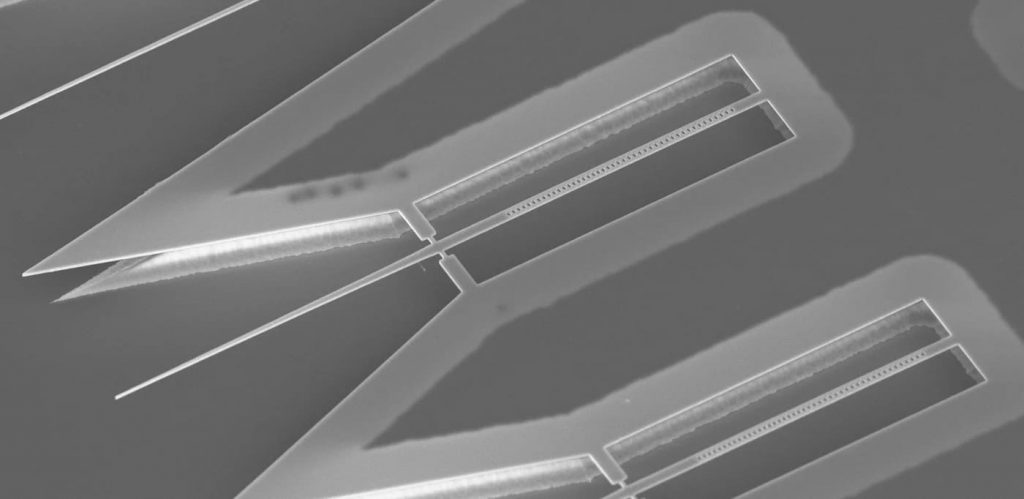 Quantum resonator based on a silicon crystal. Image: MCQST
German engineers have developed an opticala resonator for quantum networks based on a silicon crystal doped with erbium atoms. The development follows a previous study by the same group on incorporating individual rare earth atoms into crystalline silicon using a relatively low temperature (about 500°C) to ensure that large numbers of erbium atoms do not cluster together in the silicon lattice.
In a new study whose resultspublished in the journal Optica, the researchers showed that using such crystals it is possible to generate single photons with desired properties. Erbium atoms placed in a silicon crystal have excellent optical properties, the authors of the study note. They emit light with a wavelength of 1536 nm. This is almost identical to the light that is used to transmit data in classic fiber optic networks.
Engineers have developed a resonator dopederbium, which differs from conventional designs in that it does not contain mirrors. Instead, a regular pattern of nanometer-sized holes in crystalline silicon is used. This means that the entire resonator is only a few microns long and contains only a few tens of erbium atoms. By connecting a resonator to an optical fiber and excitating atoms with a laser, the researchers demonstrated that individual photons with desired characteristics can be emitted.
Researchers note two main benefits,which they say makes erbium-doped silicon “an ideal candidate for building quantum networks.” Firstly, it is based on a classic material that is widely used in semiconductor production, which means the large-scale creation of the necessary components will not require the creation of new complex production facilities.
And secondly, the system operates at relativelyhigh (for quantum technologies) temperature - about 8 K (-265 °C). Unlike systems operating near absolute zero, such conditions are easier to create by cooling in a liquid helium cryostat.
Perovskites as Single Photon Sources
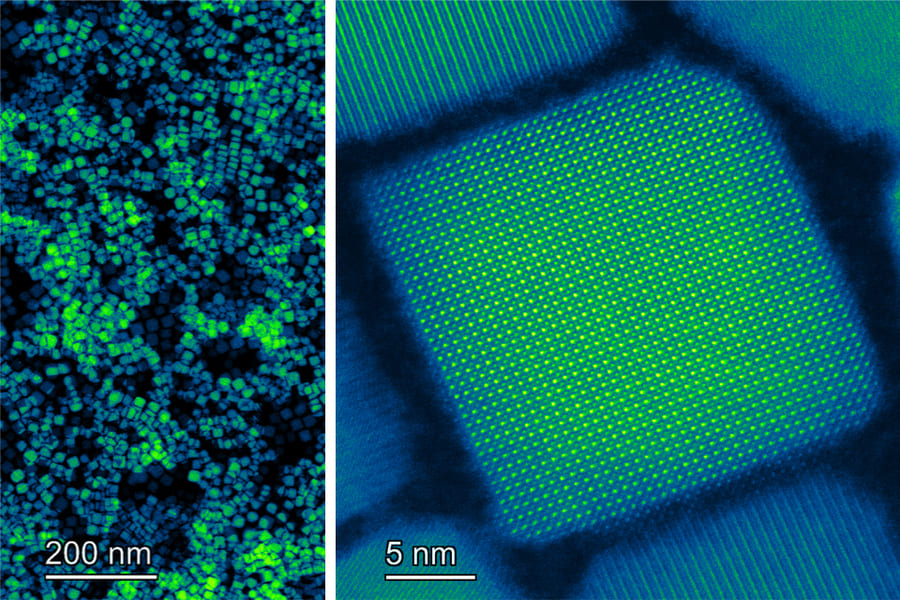 Perovskite nanocrystals. Image: MIT
MIT researchers propose an alternativeThe material for creating quantum networks is perovskites. This material has already widely established itself as a potential alternative to silicon in solar cells. In a study published in the journal Nature Photonics, the engineers showed they could also generate a stream of identical photons.
For their study, physicists usednanoparticles of lead halite perovskite. Photovoltaic cells use thin films of this material, and in the form of nanoparticles, they have an incredibly high rate of cryogenic radiation, which distinguishes them from other colloidal semiconductor nanoparticles. The faster light is emitted, the more likely it is that the output signal will have a well-defined wavefunction, which is essential for quantum networks.
To check that the photons they aregenerate really have the desired properties, the researchers conducted a standard test. It consists in detecting a special kind of interference between two photons, the Hong-Wu-Mandela effect. The results of the experiment confirmed that the source emits quantum light.
The researchers note that so far the installation has notis perfect and works with interference, but they are confident that this can be overcome by placing perovskites in an optical cavity - an effect that works with other materials.
At the same time, researchers note the advantagetechnology in ease of production. “The reason other sources are coherent is because they are made from the purest materials and one after the other, atom by atom. So we have very poor scalability and very poor reproducibility,” says Alexander Kaplan, co-author of the study. In contrast, perovskite nanoparticles are made in solution and simply applied to a substrate material. In addition, such sources operate at room temperature and do not require refrigeration.
Both proposed technologies are not yeta ready-made solution for building quantum networks. But this is a step in the right direction. The fact that different groups of researchers around the world are developing alternative technologies and trying to find a solution that is relatively cheap and easy to scale suggests that quantum networks may soon become a reality.
Read more:
A strange object hotter than the Sun surprised astronomers
An artifact resembling a phallus was found in Mongolia: it is about 42,000 years old
Found the tallest tree in Asia: show how it looks
Cover image: C. Hohmann, MCQST