Engineers at the University of Maryland used rarefied air as an optical "cable" to
The most common optical fibers are glass filaments that hold tightlyBut such structures are ill-suitedTo direct heavy-duty laser beams: they damage the glass and causeto the dissipation of energy from the fiber.
Engineers have demonstrated the method of opticalguidance, which uses auxiliary ultrashort laser pulses to create fiber optic waveguides in the air itself. These short pulses form a ring of high-intensity light patterns called "filaments" that heat air molecules to form an expanded low-density ring surrounding a central undisturbed region.
In a study published in January thisyears, physicists have shown that with this method it is possible to form waveguides 50 m long, which exist for tens of milliseconds, until they dissipate due to cooling by the surrounding air. In the new study, they modified the technology to keep the optical air waveguide in continuous existence.
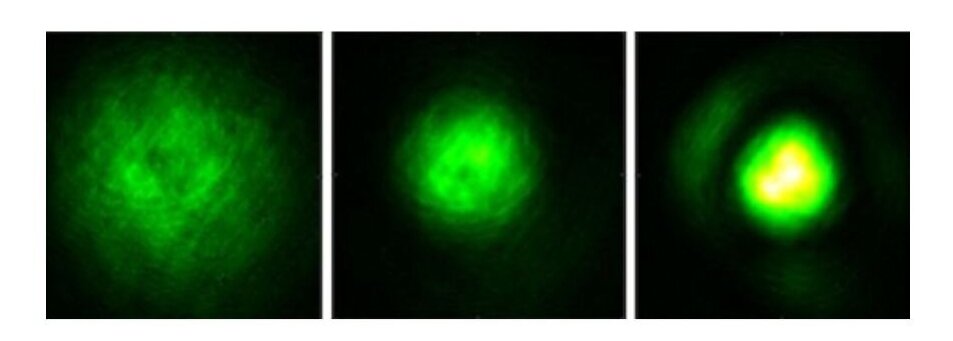 Laser beam propagating in the air(left) and transmitted over an optical airborne waveguide generated by a laser at 10 Hz (center) and 1,000 Hz (right). Image: University of Maryland
In a previous experiment, researchersused a laser that emitted a pulse every 100 ms (frequency - 10 Hz). In the new study, the scientists increased the frequency of the pulses to 1,000 Hz. This forms an air waveguide supported by heating that occurs faster than the surrounding air can cool it. The result is a continuously operating fiber that can guide the injected continuous laser beam. The researchers note that the technology is easy to scale to transmit a signal over a distance of 1 km or more.
Using air as a fibermanage very high average laser powers, the authors add. It can be used to collect remote optical signals, detect contamination and radioactive sources. At the same time, such a waveguide does not require preliminary laying of the cable in a certain direction, but can be "deployed" in any direction.
Read more:
Scientists first saw how a star devours the planet: this, in the end, is waiting for the Earth
Two super-Earths found on the edge of the habitable zone: one of them has a comfortable temperature
Scientists examined the dying brain and told what they found
</ p>