Biofinder analyzes fluorescence to detect minute traces of organic compounds. Device
Researchers explain that mostbiological materials have strong organic fluorescence signals that can be detected by special scanning cameras. This effect can detect amino acids, fossils, sediments, plants, microbes, proteins and lipids.
To confirm the performancedevice, the researchers analyzed fish fossils from the Green River Formation ranging in age from 34 to 56 million years. The study, published in the journal Nature Scientific Reports, found that all fish fossils studied, tens of millions of years later, still contain significant amounts of material that can be detected using biofluorescence.
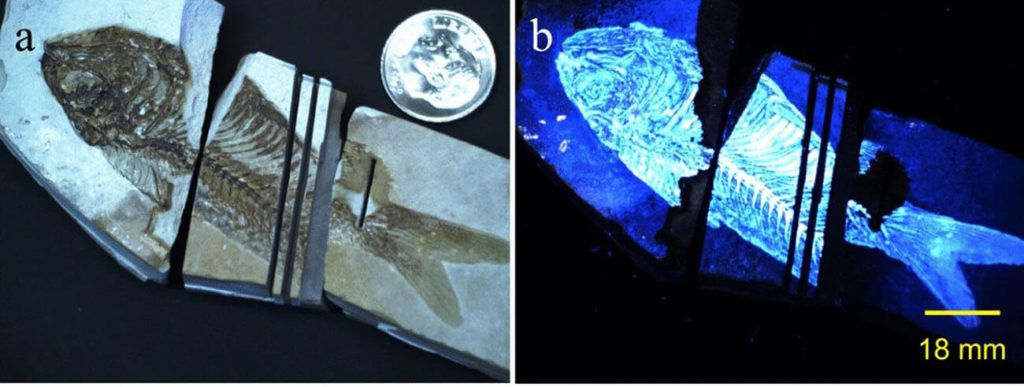 White light image of a fossil fish fromthe Green River Formation at 50 cm without laser excitation (left) and a fluorescence image using single laser excitation obtained with the Biofinder (right). Source: Misra et al, Nature Scientific Reports
Additional analysis using spectroscopy, scanning electron microscopy and fluorescence imaging microscopy confirmed the results obtained by Biofinder.
Biofinder is the first system of its kind. Now there is no other equipment that could detect the smallest amount of biological residues on the stone during the daytime.
Anupam Mishra, one of the developers of the device and co-author of the study
Scientists believe that the new device will help in the search for traces of existing or past organic life in future missions to Mars and in the study of other space objects.
Read more:
The space probe flew 200 km from Mercury. Look what he saw
The satellite of Jupiter was looked at in a new light: what scientists saw there
Scientists uncover how vitamins affect the incidence of cancer