A study by German scientists has clearly demonstrated the presence of a high level of intelligence in dogs.
“Our results represent importantpreliminary evidence that dogs have at least one aspect of intelligent behavior: the ability to recognize intent in the action being performed, ”the authors of the article write. They added that similar abilities are demonstrated by chimpanzees, talking gray parrots, and horses.
Previous studies have shown that dogscatch human intentions in order to understand, for example, when to take food, and whether it is worth reacting to certain gestures. However, it remained unclear whether animals interpreted inner human intentions.
The authors of the new study tried to solve thisproblem. They asked study participants to pass a treat to a dog through a screen slot. In the first case, the experimenter tried to offer the dog a treat, but "accidentally" dropped it from his side of the screen and said "oops." In another case, it was impossible to treat the dog because of the narrow gap. In the third case, the experimenter offered a treat, but then suddenly took it back and said "ha ha!"
 The dogs and the experimenter sat on opposite sides of the partition. The dogs were fed through a gap in the partition. Credit: Katarina Schulte.
In all three cases, dogs for some reasondid not receive the treat, but they had to understand whether they were being deprived of the treat on purpose or by accident. Scientists watched the video recording of 51 dogs' behavior and concluded that the animals stayed on their side of the screen the longest when a piece was suddenly taken from them. Also in the latter case, they often stopped wagging their tails, sat down or lay down, showing sadness.
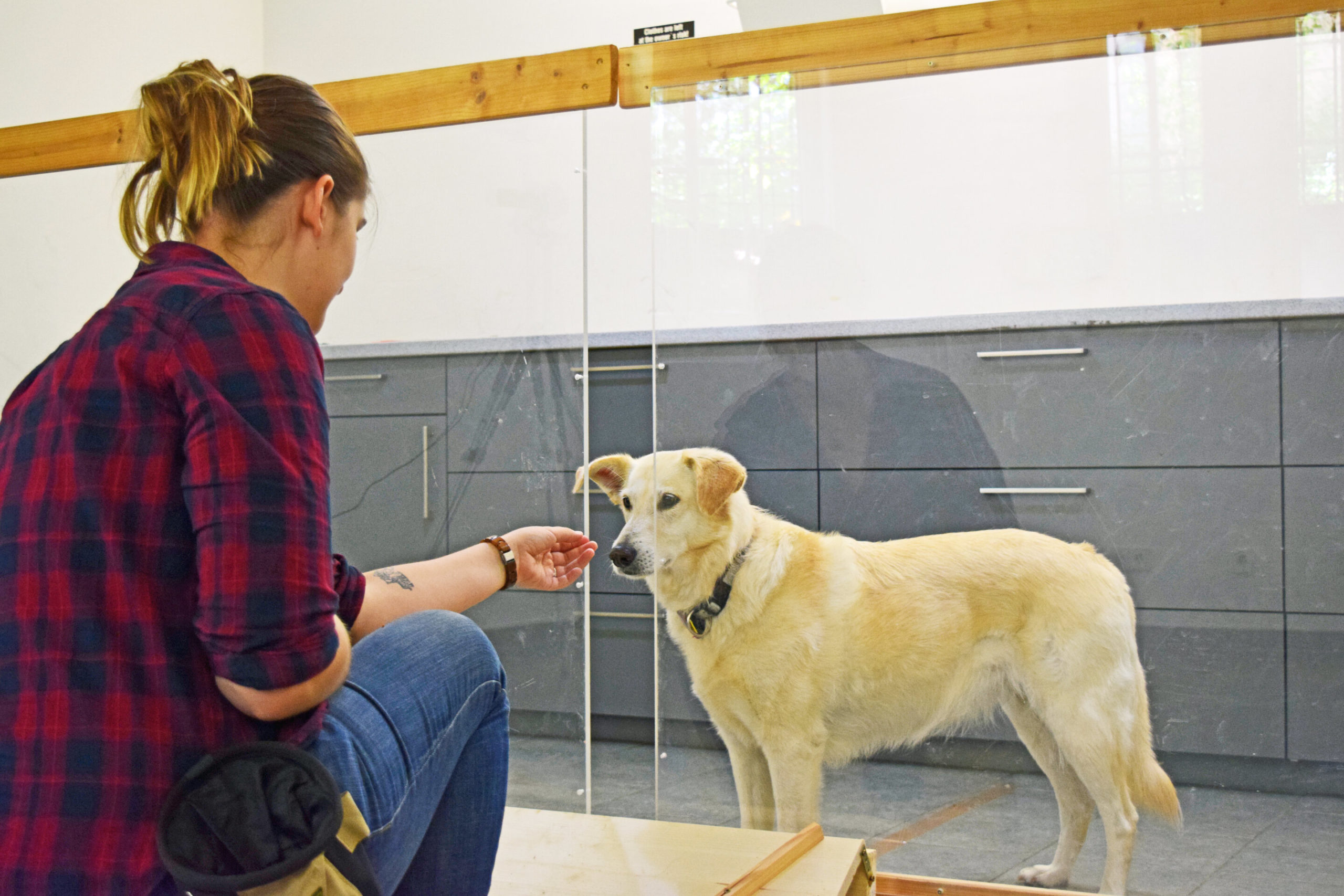 Credit: Joseph Erlacher
The ability to recognize other people's intentions - or,at least to imagine them—is a core component of theory of mind, the ability to attribute mental states to oneself and others. It was long considered uniquely human.
To read Further
See a heavy attack drone that carries a ton of weapons
Scientists have been unable to catch Rambo's fox for three years. It prevents rare animals from being released into the forest.
A spaceship several kilometers away: everything that is known about China's new project