In an experiment conducted at the Accelerator Laboratory of the University of Jyväskylä, Finland, scientist
Astatine is a fast-decomposing, and therefore rareelement. The entire earth's crust contains no more than one tablespoon of astatine. 190-astatine, a new isotope, was obtained by fusion of 84 Sr beam particles and silver target atoms. It was detected using the RITU return separator detectors.
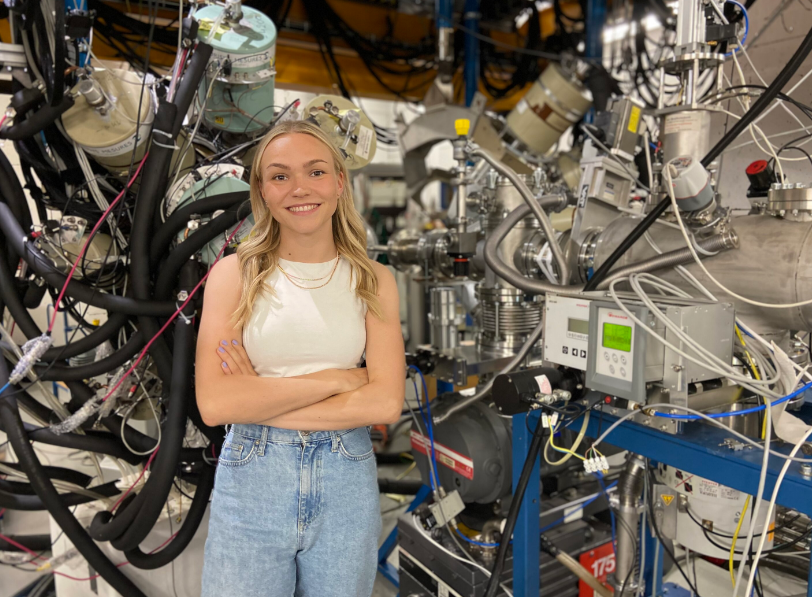 Henna Kokkonen. Courtesy: University of Jyväskylä
It also turned out that the new corealpha decays into more stable isotopes. Alpha decay is a common way for heavy nuclei to decay. “Research on new nuclei is important for understanding the structure of atomic nuclei and the limits of known matter,” explains Henna Kokkonen, PhD from the Faculty of Physics at the University of Jyväskylä.
She is the author of a new discovery and recently received her Master of Science degree. The study is part of her master's thesis and is published in the journal Physical Review C.
Read more:
A quasi-moon was found near the Earth: it has been traveling with our planet for more than 2,000 years
Researchers have shown what Pharaoh Tutankhamun looked like
Physicists first took x-rays of a single atom
Cover photo: MaxPixel's contributors | Source: https://www.maxpixel.net/photo-1222