Despite the pandemic, developments in the field of quantum computing did not stop: global IT giants
Research and development
Fastest random number generator
Random numbers are keycryptography and numerical modeling. A team of scientists from the Russian Quantum Center, together with colleagues from Oxford University, Goldsmiths College and the Free University of Berlin, announces the development of an ultra-fast optical device capable of generating a guaranteed random sequence at a speed of 8.05 GB per second, making it the fastest random number generator to date. day. Previously created prototypes of such devices had a speed several orders of magnitude lower.
The developed technology can form the basisproduction of commercial devices with a wide range of applications. Thus, Samsung recently introduced a mobile phone with a quantum random number generator, which indicates the demand for this technology in the mass market.
Drone-based quantum network
Entangled photons were previously successfully transferred tothe distance is more than a thousand kilometers between the satellite and ground stations, but now a team of scientists from Nanjing University has shown that secure communication can be established using fairly inexpensive equipment.
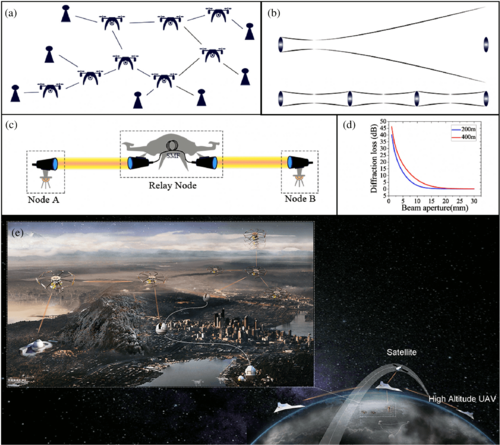
In this experiment, the quantum network wasimplemented using two free-flying drones in the air at a distance of 400 meters from each other and at a distance of 200 meters from their ground receiving stations. In total, taking into account the height of the drone flights, the quantum communication channel through the air had a total length of about a kilometer. Ground stations for receiving photons were armed with telescopes with a 26 mm aperture and single-photon receivers.
Such a solution will allow anywhere quicklydeploy secure operational communication channels. Going forward, the team plans to increase the size of the network using multiple drones that can transmit encrypted messages or data to a quantum computer over long distances.
Quantum teleportation
Research team consisting ofrepresentatives of American and Canadian universities and companies led by Panayotis Spenzouris (Fermi National Accelerator Laboratory) demonstrated a stable transfer of the quantum state of a qubit over a distance of 44 kilometers.
Quantum teleportation is necessary for manyquantum information applications, including the so-called quantum internet. Fermilab's experiment used conventional single-photon sensors and fiber-optic telecommunications networks.
The accuracy of the transfer of a quantum state inexperiment was 90%, which is considered an extremely high value. In future experiments, scientists are going to set a new record for teleportation distance and the number of coupled qubits by upgrading the system, which is planned for the second quarter of 2021. In the future, this will help to perform distributed quantum computing like cluster computing, but without a bottleneck in the form of network bandwidth limitations.
Lattice surgery
Existing methods of quantum error correction are complicated by the fact that their implementation requires hundreds or even thousands of physical qubits connected to each other.
The team of the University of Innsbruck under the leadershipProfessor Rainer Blatt first reported the creation of two single logical qubits, protected from the loss of quantum information, achieving their coupling and transferring logical information between them. This was achieved in a quantum processor based on ion traps, consisting of only ten physical qubits, and using so-called lattice surgery. This technique allows logical qubits to be combined or separated by performing certain logical operations on a portion of the physical qubits that underlie them.
The method used requires significantly lessmore operations to create qubit concatenation than traditional approaches, and demonstrating such operations - fundamental building blocks for quantum computing - is an important step towards the practical implementation of fault-tolerant quantum computing.
Quantum Industry
Molecular comparisons
The pharmaceutical industry is extremely interested in the emergence of new technologies for creating drugs, including using quantum molecular modeling and screening.
German pharmaceutical giant BoehringerIngelheim, known for its developments in computer-aided drug design and in silico modeling, has joined forces with Google in the field of quantum computing.
And the Swiss pharmaceutical company Rochebegins cooperation with the British Cambridge Quantum Computing, in which quantum computing methods will be used to find new methods of treating diseases.
Earlier it was reported that the Americanbiotech company Biogen is partnering with startup 1Qbit on a pilot project aimed at accelerating drug discovery by using quantum computers for molecular comparisons. Using quantum screening of large numbers of molecules, she plans to find new effective drugs for neurodegenerative diseases such as multiple sclerosis, Alzheimer's and Parkinson's.
Multiphase flows
Aker BP (a large independent oil exploration and production company in Europe - Hi-Tech) and CQC have created a quantum machine learning algorithm for classifying multiphase flows.
Multiphase flows in pipeline transportrequire fairly careful monitoring, tracking, analysis and management. The algorithm allows for polynomial time flow analysis and is implemented on an IBM quantum processor.
Classifier tested on Aker dataBP, requires only a few qubits to match the performance of a classical support vector machine (SVM) with nonlinear kernels. It is one of the very first applications of NISQ-era quantum machine learning solutions in the energy sector.
Parts for BMW
The German automaker has begun an experiment to optimize the procurement and supply system for production components using a quantum computer.
Usually within the production cycleautomakers are considering hundreds of supply options from a variety of vendors with varying delivery times and parts costs. Choosing the optimal circuit is a daunting computational task. BMW plans to carry out the first calculations on the Honeywell H0 computer, and later move to the more powerful H1 system. It is assumed that the computational advantage over classical computing systems will be achieved in one and a half to two years.
In October 2020, another major automaker, Toyota, announced the launch of a similar project to optimize its logistics network.
Dissolution cryostat
Pioneer in dissolution cryostats,Oxford Instruments NanoScience has announced a partnership with Oxford Quantum Circuits, which will be the first in the world to accept the delivery of the next generation Proteox Cryofree® cooling system.
Low temperatures are necessary to detectsubtle quantum effects hidden by the noise of thermal vibrations, but efficient cooling remains a serious problem in many implementations of quantum systems.
New dissolution cryostat from Oxford Instrumentsprovides high stability of temperature control in the mK range and supports a large number of electrical connections, which facilitates the integration of quantum processors.
Quantum computers with ion traps
Startup IonQ announced a three-year alliance withThe Quantum Information Research Support Center (Q Center) is an independent organization established at Sungkyunkwan University in South Korea to form a national research ecosystem in the field of quantum information science.
The collaboration will create quantumcomputers with IonQ ion traps available to researchers and students in South Korea. IonQ considers the high-tech South Korean market important for the expansion of its own technology.
South Korea's national quantum program started in 2019 and envisions the creation of a five-qubit quantum processor within five years.
National quantum programs
1.8 billion euros for the quantum industry
France officially announced the decisioninvest 1.8 billion euros in quantum technologies. According to the plan presented by French President Emmanuel Macron, the investment is planned for five years. The French government will increase funding for the quantum industry from the current 60 million euros to 200 million euros per year. Another €200 million will come from the European Union and €550 million is expected from the private sector.
Of these funds:
- about 780 million euros will be allocated for the creation of a quantum computer;
- € 250 million for quantum sensors;
- € 150 million for post-quantum cryptography;
- 320 million euros for quantum communications;
- €300 million for related technologies such as cryogenics.
With this volume of investment, France will become one of the leading countries investing in quantum technologies, along with the United States, China, India and Germany.
Bavarian Quantum Initiative
Munich Quantum will be created in Germanyvalley, for the operation of which Bavaria will allocate a total of 300 million euros. In the quantum valley there will be a technology park with well-equipped clean rooms, systems for the production of nano- and thin-film materials, as well as development and testing laboratories.
The main tasks of the valley will be to createquantum computers, quantum simulators for finding new materials, research in the field of quantum metrology for highly accurate measurements of electric or magnetic fields, and quantum cryptography.
Note that Germany already has the largestThe EU has a national program for the development of quantum technologies. In July 2020, the federal government announced its extension for the next 10 years with a budget of 2 billion euros in addition to the general EU quantum program.
Modular approach
When creating quantum computers, their keycomponents are usually designed and manufactured by one company, which is quite costly and time-consuming. To accelerate the development of a national quantum computer, several startups in the Netherlands have agreed to use a modular approach: independent companies will focus on developing certain elements of the quantum computer in order to integrate them into a single system in the future.
Members of the new consortium IMPAQT, createdFor this purpose, startups have become Orange QS - a supplier of integrated quantum systems, Qblox - a supplier of a quantum control stack, Delft Circuits - a developer of quantum equipment for cryogenic input-output, and Qu&Co - a developer of quantum algorithms and software.
2021 has begun for the global quantumcommunities are as active as possible: public investment in development has grown, the number of both industrial cases and international research has increased. The full version of the digest can be found on the website of the Russian Quantum Center.
See also:
Physicists have created an analogue of a black hole and confirmed Hawking's theory. Where it leads?
Abortion and science: what will happen to the children who will give birth
A nuclear rocket engine is being built for flights to Mars. How is it dangerous?