Chinese scientists presented the results of a study of underground geological formations of the Utopia Plain
The georadar of the rover explores the structure of internalgeological formations by sending electromagnetic pulses into the ground. They bounce back off any underground structures that the rover passes over. Zhuzhong scans the regolith at two frequencies: lower waves reach depths of up to 80 m, but do not differ in detail, higher waves show details of the internal structure, but penetrate only 4-5 m down.
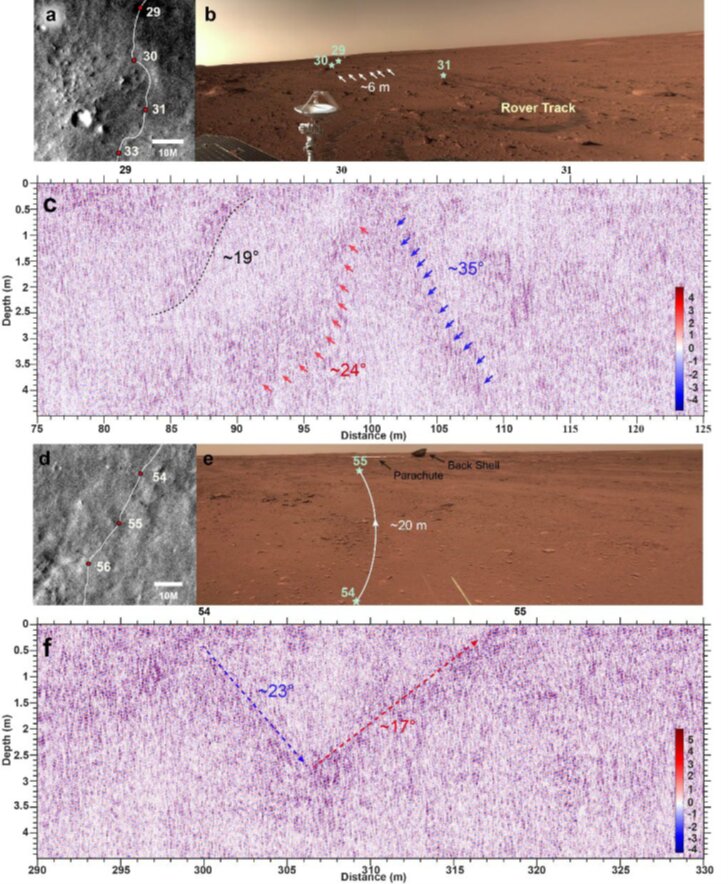 Motion map, photographs, and radar data obtained by the rover. Image: Chinese National Science Administration
In detailed "pictures" the researcherssaw several curved and inclined underground structures in the Martian soil. They believe that these are impact craters buried under a layer of alluvial sand. At this depth, no traces of water or ice are visible.
At greater depths, the radar showed sedimentaryrocks that scientists believe were formed under the influence of water flows. At the same time, at this depth there are also no signs that liquid water or ice has survived on the planet so far. At the same time, researchers do not exclude that the water layers can pass at a greater depth.
The researchers also note that the comparisondata collected on Mars and earlier on the Moon show significant differences in the internal structure of the upper rocks. Unlike the Red Planet, the upper regolith structure on the Earth's natural satellite does not hide impact craters. This, scientists believe, is due to the absence of an atmosphere on the Moon that would contribute to the occurrence of storms and the movement of dust.
Scientists believe that further analysis of the surface of Mars will help to learn more about the planet's geological past, previous climatic conditions and what happened to the water.
Read more:
Remains of 'delicacy' meal found in Neanderthal cave
Substance from the "grandfather's beard" improves memory and neuronal growth
It turned out that the drug for arthritis "reverses aging" and rejuvenates the body
Cover image: China News Service, CC BY 3.0, via Wikimedia Commons