“Our model offers a simple answer to a number of important but still unresolved scientific questions,” explains
It is well known that ultraviolet lightcapable of deactivating viruses and bacteria of various types. Therefore, the solar UV light that reaches the Earth should also have some disinfecting ability on the exposed parts of the planet. Of course, the effectiveness of UV decontamination depends on the type of virus or bacteria.
However, in temperate regions of the EarthDue to the climate in the northern and southern hemispheres, this process also depends on the time of year. Solar radiation (and, therefore, UV deactivation of viruses) is stronger in summer and lower in winter.
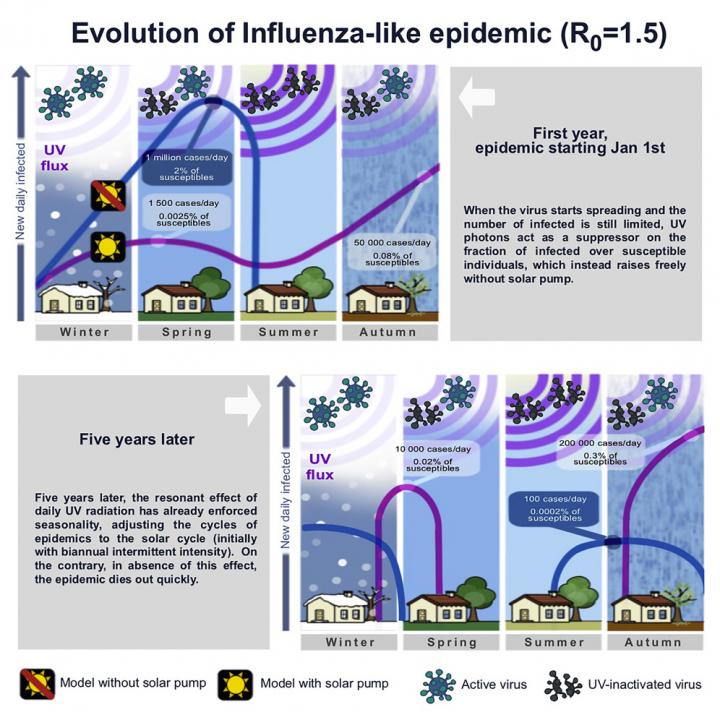
This is the “scheme” of solar disinfectioncorrelates with other cycles typical of epidemics. Namely, the loss of immunity of the host of the virus due to its antigenic drift. The combination of these two mechanisms causes the seasonality of epidemics, scientists are sure.
The model proposed by the Italianresearchers, accurately reproduces the seasonality observed in different parts of the Earth for epidemics with a reproductive number (R0) below two (for influenza, usually R0 ~ 1). In addition, the experts were able to simulate epidemics with a much higher R0. These include the current SARS-CoV-2 pandemic with a reproductive number in the region of 3-4. Ultimately, scientists predict high-intensity, intermittent initial COVID-19 cycles that will eventually stabilize at seasonally synchronized, moderate intensities.
In other words, the model of Italian scientists predicts the constant presence of the coronavirus with a seasonal flare-up in winter.
Read also
On the threatening Earth asteroid Apophis noticed a dangerous phenomenon. What's happening?
Scientists have found out why children are the most dangerous carriers of COVID-19
What the Parker Solar Probe discovered when it flew as close to the Sun as possible