Engineers from Singapore and the Massachusetts Institute of Technology have developed a tiny LED
The light in most photonic chips comes fromexternal sources, resulting in low overall energy efficiency and severely limits the scalability of these chips, the scientists explain. To solve this problem, they developed embedded sources using various materials such as rare earth doped glass, silicon-germanium materials (Ge-on-Si), and III-V semiconductor compounds.
The finished device isA sub-wavelength LED integrated with existing semiconductor technologies (CMOS), which can operate at room temperature, exhibits high spatial intensity (102 ± 48 mW/cm²) and has the smallest radiation area (0.09 ± 0.04 μm²) of all known silicon emitters.
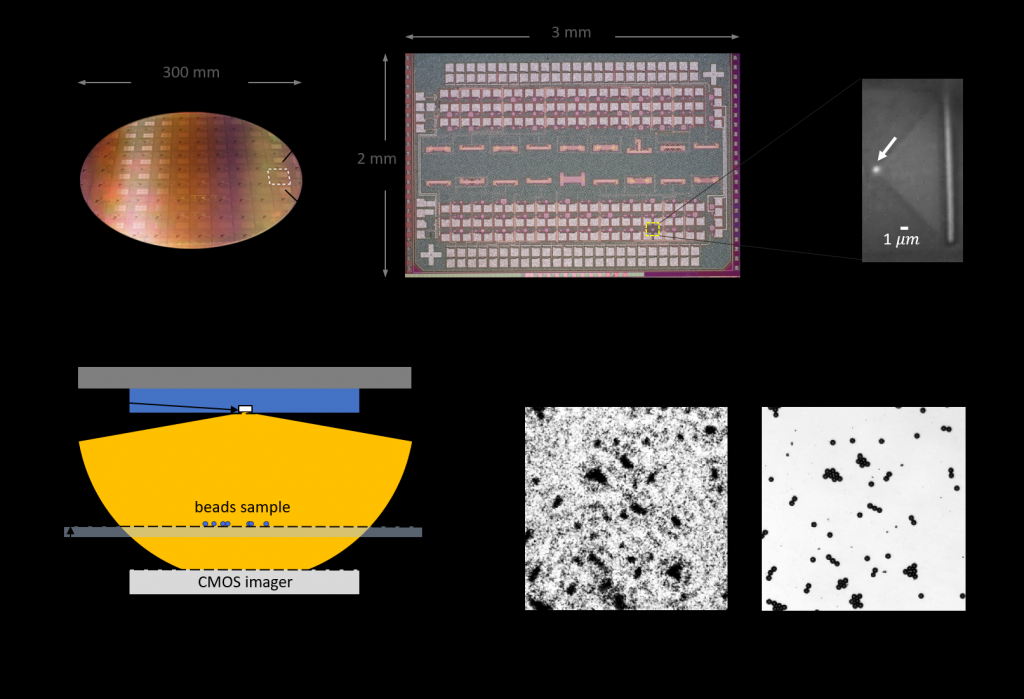 Semiconductor wafer (a) with increasedimage of the chip (b) and the LED (c). Holographic microscope device (d) and reconstructed image (f). Image: Singapore-MIT Alliance for Research and Technology (SMART)
To demonstrate potentialpractical application, the researchers integrated this LED into a centimeter-scale linear, all-silicon holographic microscope requiring neither a lens nor a hole.
A common obstacle in lenslessholography - computational reconstruction of the displayed object. Traditional image processing methods require detailed knowledge of the experimental setup for accurate reconstruction and are sensitive to difficult-to-control variables.
 Illustration of the reconstruction of images obtained with a holographic microscope. Image: Singapore-MIT Alliance for Research and Technology (SMART)
Engineers have developed a neural network thatovercomes this obstacle. It does not require prior training and allows you to process images from new light sources without prior knowledge of the source spectrum or beam profile. The researchers note that the technology makes it possible to turn cameras in everyday devices such as mobile phones into microscopes only by modifying a silicon chip and software.
Due to low cost and scalabilityCMOS microelectronics processes can do this without increasing complexity, cost, or system form factor. This allows us to convert, with relative ease, a mobile phone camera into a holographic microscope of this type.
Iksung Kang, study co-author
Read more:
Scientists first saw how a star devours the planet: this, in the end, is waiting for the Earth
Two super-Earths found on the edge of the habitable zone: one of them has a comfortable temperature
Modern humans migrated to Europe differently than previously thought
On the cover: Image by svstudioart on Freepik