Chemists from Sri Sathya Sai University in India and the American University of Clemson used
Researchers note that thanks to the uniquestructure, this substance stabilized gold particles about 2 nm in size, forming a porous network around them. According to the authors of the work, electrolytic deposition required a hundred times lower current than previously.
Researchers note high stability(more than 200 electro-oxidation cycles), ease of electron transfer and high catalytic activity of the fuel cell they developed. In addition, the electrode showed a low activation energy in the electrooxidation of both ethanol and methyl alcohols.
The scientists add that without the curcumin coating, the gold nanoparticles coarsen, reducing the surface area exposed to the chemical reaction.
Without that curcumin coatingperformance will be poor. We need this coating to stabilize the particles and create a porous environment around them, after which the gold does a great job of oxidizing the alcohol.
Apparao Rao, study co-author, professor of physics and director of the Nanomaterials Institute at Clemson University
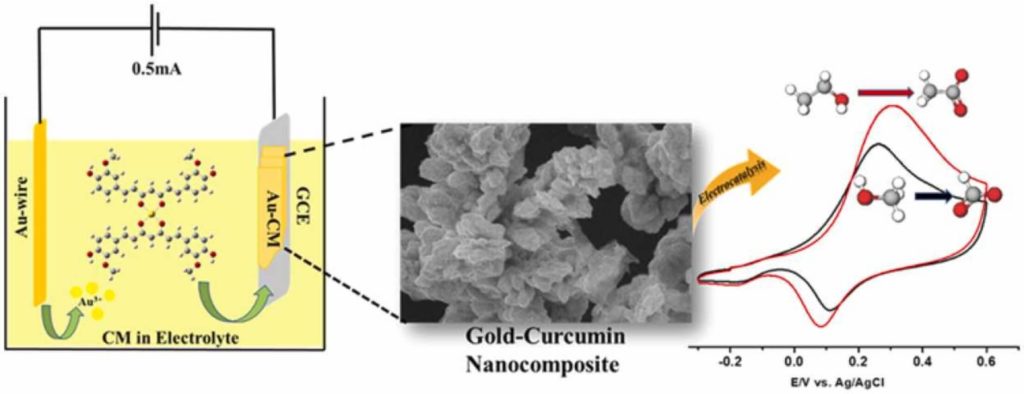 Source: Sai Prasad Nayak et al., Nano Energy
Fuel cells generate electricity inthe result of a chemical reaction, not combustion. Today they are used in many industries, such as vehicles, portable electronic devices and backup power systems.
Hydrogen fuel cells are very efficient anddo not produce greenhouse gases. However, as the researchers note, producing hydrogen requires energy, costs and has an environmental impact. Additionally, the hydrogen used in fuel cells is a compressed gas, which creates storage and transportation challenges.
One possible alternative is to usealcohol. Ethanol, derived from corn or other agricultural feed, is safer and easier to transport than hydrogen because it is liquid. To create alcohol fuel cells, as a rule, platinum is used, scientists emphasize. But it is quite expensive and is heavily attacked by by-products of the chemical reaction, such as carbon dioxide.
“Of all the catalysts for the oxidation of alcohol in an alkaline environment, the one we have created is the best to date,” notes Rao.
The researchers believe that the created by themThere may be other applications of the method, for example, as a sensor or a supercapacitor. Now scientists are testing their electrode to diagnose changes in dopamine levels in the urine.
Read more:
Belarusian physicist working on quantum internet: this is the first step towards teleportation
One of the largest ice shelves collapsed due to water flows
Is the standard model of physics no longer relevant? The main thing about the new work of scientists at the collider