Astronomers have explored the massive Mammoth 1 nebula, which is a cloud of gas and dust from which
The Mammoth 1 Nebula was first discovered indistant universe in 2017 by a team of scientists from Tsinghua University in Beijing. Telescope observations have shown unusual behavior: the galaxy was absorbing material from its surroundings through at least three gas streams.
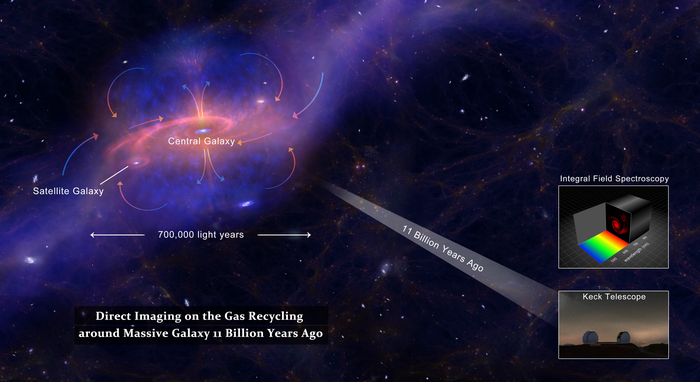 An illustration of the study. Images: Tsinghua University
To get a more accurate picture,The researchers used spectral instruments mounted on telescopes to study the composition of the gas surrounding the nebula. There was a lot of carbon in the gas streams surrounding the nebula. But previous models have shown that it should be mostly made up of hydrogen left over from the Big Bang.
Using simulations, the researchers showedthat the abundance of carbon indicates an active galactic circulation system that appears to fuel the formation of new stars. This metal-rich gas cooled faster, leading to the birth of a new generation of stars.
Researchers believe that metal-poor(elements heavier than hydrogen and helium), the gas left after the Big Bang is drawn into the galaxy from the intergalactic medium. There, it is enriched in heavier elements during stellar processes and thrown out during supernova explosions. This material can subsequently be recycled: accreting back into galaxies, it prolongs the period of active star formation.
Read more:
Scientists first saw how a star devours the planet: this, in the end, is waiting for the Earth
Two super-Earths found on the edge of the habitable zone: one of them has a comfortable temperature
Modern humans migrated to Europe differently than previously thought
On the cover: an artistic illustration of an emerging protocluster in the early universe. Image: ESO/M. Kornmesser