With the growing popularity of smartphones, the volume of application development is also increasing. Currently in the App Store
It is for this purpose that in app storesa rating system has been introduced. Once you've downloaded and tried the app, you can rate it out of 5 and write a review to share your impressions. These reviews and ratings form the average rating for the app. So, the more users who say they like an app, the better it is. At least that's how it ismustwork.
Advertising
Advertising
In practice, many reviews do not help at all.to a potential buyer, and some are completely fake. One star and a one-line comment that the app crashes, or that the program is not worth the money, does not always guarantee that the app is truly bad. But what about the other side of the App Store – a solid wall of “5 star” ratings and the same type of laudatory reviews?
Bypassing the system
Good grades and reviews are vital toevery developer who wants to bring their application to the top. They also increase the chances of appearing in the Recommended and other lists that contribute to sales growth. So it is not surprising that many developers are trying by all means to look for loopholes in the rules in order to get closer to the treasured high rating.
Paul Barnes, Head of App Annie, says:
Advertising
Advertising
While we haven't yet completed an analysis to find out the extent of the problem, fake reviews do exist and do impact overall app ratings.
The very fact that many developers are tryingbypass the rules – has been an open secret for the industry for several years now. You just need to enter “paid app reviews” or something like that into a search engine to find many services offering to add the required number of positive reviews to your app. The cost of a review varies, as a rule, the more you order, the less you pay for each review.
And yes, it's against the rules.Under the terms of publishing applications on both Google Play and the App Store, this practice is prohibited. Violation can lead to the removal of suspicious reviews, removal of the application itself from the store, or even the developer being banned from further publication of applications.
Advertising
Advertising
Bots or people?

Both Apple and Google demonstrate that they take this problem seriously and constantly check the reviews published on their respective platforms.
The problem is to distinguishfake reviews from real ones – an extremely difficult task. Most of the services we talked about hire real users to download apps and then write reviews. If earlier this led to the fact that developers bought a bunch of positive reviews of the same type, which could easily be calculated, now the scheme has become more complicated.
Now the developer can give out independentlywritten texts for published reviews or discuss their tone when ordering a wrapping, set the frequency of paid reviews in the store so that they do not go one after another, ask to add several 4-star reviews so as not to attract attention with solid fives. Some of these services even guarantee that they will replace the ad for free if it is suddenly removed by verification.
Instant failure
Andrew Ahn, Product Manager for Google Play, said:
We want reviews to be a true reflectionuser opinions. Spam in reviews – including comments unrelated to the application, incitement, reviews with obscene language, – not everything you have to deal with when filtering. We also block fake and incentivized reviews.
It is interesting to note that they do not always pay for laudatory odes. Reviews can also be used to spoil the reputation of competitors. An continued:
There are two types of feedback stimulation.The first – buying good reviews about your product to promote it, and the second – buying negative reviews to harm competing apps. We remove both to keep the ecosystem transparent and fair.
Sudden success (as was the case, for example, with FlappyBird) is as suspicious as the sudden failure – similar to what happened with the CNN iOS app. In July 2017, a “bombardment of reviews” began on its page in the App Store – The app received exclusively negative reviews for a whole week. If previously the application received about 30 reviews per day, then from July 5 to 11 the number of only negative (!) reviews amounted to several thousand.
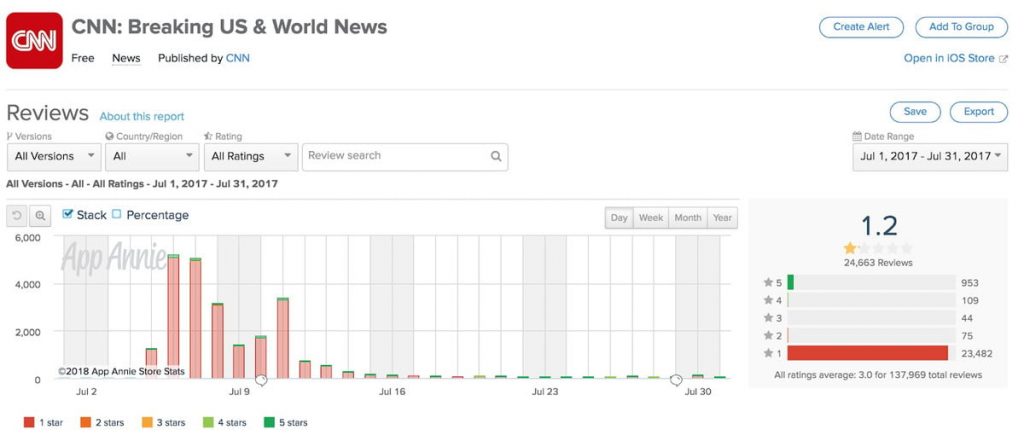

It is unclear whether this attack was carried out using bots, or whether it was a planned action from competitors of the channel.
Crime and Punishment
Note that although reviews are deleted all the time, it is extremely rare for moderators to resort to removing applications from stores or banning developers.
Advertising
Advertising
Easily remove suspicious reviews moresimilar to a police officer wagging his finger instead of making an arrest or issuing a ticket. However, this is quite understandable: if in fact the creators did not use the services for promotion, it will be extremely difficult to prove this for unblocking. Apple and Google don't want to be too harsh on developers. In addition, with more stringent measures, there is a high probability that instead of bombarding them with negative reviews, competitors will simply buy other people’s applications a thousand or two positive reviews so that they are blocked in the store. This will lead not only to chaos, but also to distrust of the sites.
Advertising
Advertising
Here you can recall the history of deletion from the AppStore application for developers called Dash and blocking the account of its creator. This is a rare case when the moderators' decision was challenged – and, moreover, successfully. Apple said the developer paid for reviews of the app, but the situation turned out to be much more complicated. Here's what the developer himself said under the nickname Kapeli:
In fact, the following happened. 3-4 years ago, I decided to help my relative in promotion by paying her membership in the Apple Developer Program from my credit card. I also handed her a piece of testing equipment that I no longer used. Since then, Apple has considered our accounts to be linked. As soon as her account was caught manipulating with reviews, my account was blocked.
I had no idea that my account was tied toto another, until Apple contacted me 2 days after account closure. I have never received warnings about any violations before this happened.
The story eventually resolved in favor of Kapeli.
Loophole in the rules
Although it is becoming increasingly difficult for developers to buy reviewsTo discover, there is a more popular and obvious strategy that app (and especially game) creators have been using for many years. You've probably encountered something like this: you're playing something, and suddenly a tempting offer pops up on the screen: write a positive review and receive as a gift something that can usually only be bought with real money, or a certain amount of rare in-game currency. If a developer directly asks for a “5 star” rating, then this, again, violates the rules of use of Google Play and the App Store, but here you can use a trick.
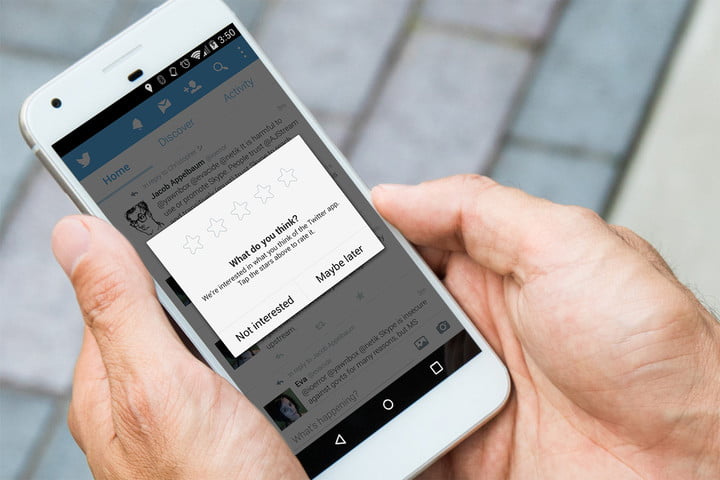

Applications typically request an estimate in the formpop-up window that appears after a few minutes of use. These windows can appear with annoying regularity, so sooner or later you will end up clicking the rating button just to keep them from appearing. But this is where this scheme comes into play. If you select a good rating, you will be taken to the store to write a review. But if you click a low rating – for some apps it's anything below 5 stars, – then you will be redirected to the developer’s website, where you can describe what you didn’t like. Technically, this trick doesn't violate anything, but Google Play is aware of it, and it's quite possible that it will be banned as well.
What to do?
There are no statistics on how muchapps are being removed from stores due to fake reviews, but in 2017 alone, Google removed over 700,000 apps from the Play Store. The reasons are different: most of them were fakes on popular games and programs, contained inappropriate content or were recognized as potentially malicious, but moderators also take seriously the feedback markup.
Android developers can reportSuspicious reviews through the Play Console. Such applications are submitted to a specialist who decides whether the rule is revoked or not. Regular users can use this form if you think that some review contains spam or does not correspond to the application. Unfortunately, this can only be done in English. But in Google Play itself, you can click on the icon in the form of three dots next to the review and select "Spam" in the context menu. If you notice the cheat reviews, you can do the following:
- Open the app or game page in the Play Store.
- Scroll it down.
- SelectComplain.
- Indicate the reason.
- ClickTo send.
In the case of the App Store, we recommend contacting iTunes technical support.
Considering everything that was said above, no onewill blame you for not trusting the ratings. The only way to honest app stores – Report detected cases of fraud to moderators. As for how to find apps and games that won't disappoint you – you can always use our selections. Here, for example, are the best games of last year, divided by genre: Part 1 | Part 2 | Part 3.