On July 11, 2020, the Parker Solar Probe, which travels through the inner solar system to catch
“The campaign resulted in many tieredobservations straight from the surface to the top of the clouds and airglow phenomena that gave us a unique view of the atmosphere of Venus, ”said Ricardo Ueso, former ESA Venus Express mission member and one of the project coordinators. “Being able to observe Venus with so many instruments, using such a massive collaboration means we can add scientific value to these short visits by the Parker Solar Probe and BepiColombo to Venus.”
Venus is the brightest object that mansees in the night sky besides the moon. And, although this is the closest planet in size to Earth, it is a radically different world. Venus's dense atmosphere, made up mostly of the greenhouse gas carbon dioxide, maintains a surface temperature of 460 degrees Celsius and pressures comparable to those found in the depths of Earth's oceans. Spacecraft passing close to Venus as they travel through the inner solar system can collect valuable data that will help us understand the properties of the planet and its evolution.
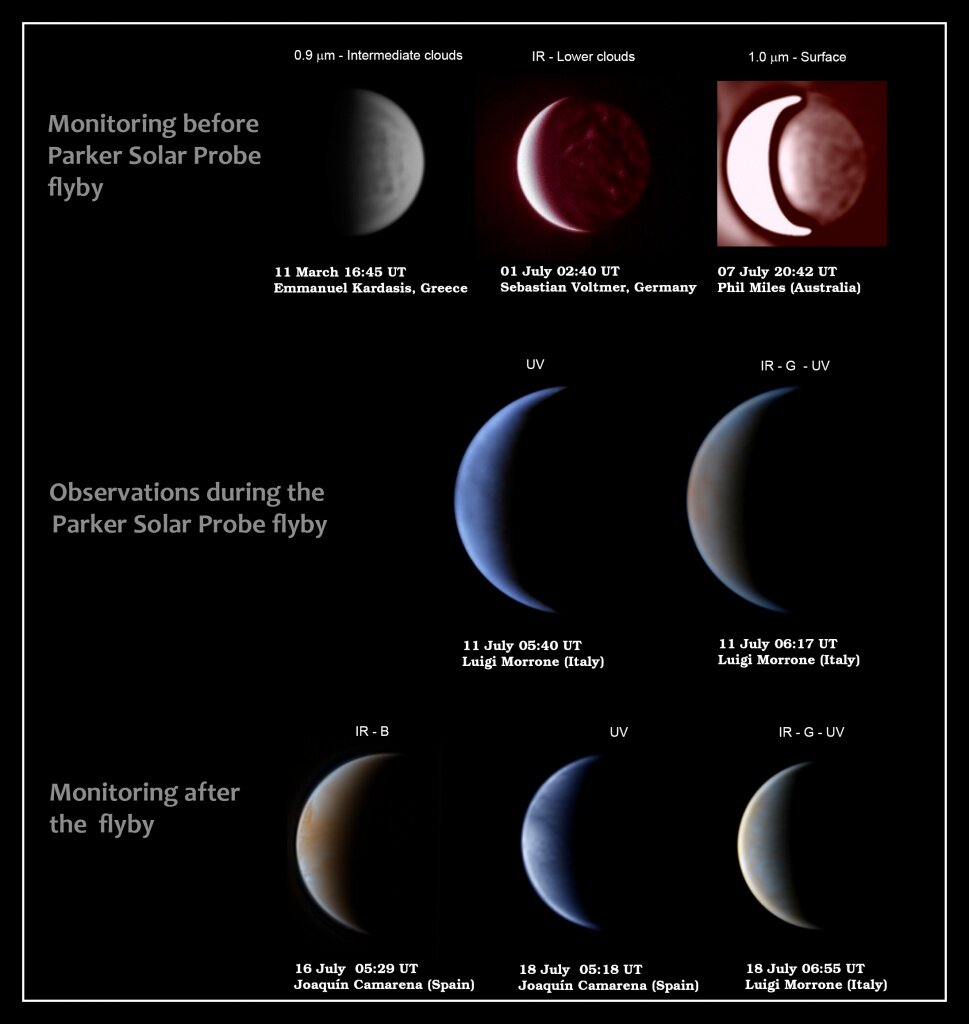 A selection of amateur observations of Venus before, duringtime and after the passage of the Parker solar probe. These observations made it possible to obtain samples of the atmosphere of Venus from the surface to the upper clouds. These and many other amateur images are available in the PVOL database http://pvol2.ehu.eus. Credit: Emmanuelle Cardasis / Sebastian Woltmer / Phil Miles / Joaquin Camarena / Luigi Morrone
During the Parker Solar Probe Campaignobserved the night side of the planet from the surface to the upper atmosphere, and Akatsuki received data on the upper clouds. Back on Earth, the researchers used the Infrared Telescope (IRTF) in Hawaii and the Northern Optical Telescope (NOT) in La Palma to probe the deeper clouds of Venus on the night side of the planet. Additional observations of deeper clouds and the surface of Venus were obtained at the Pic du Midi in France.
Citizen astronomers observed the upperand middle clouds in ultraviolet, violet and near-infrared wavelengths. Some amateur observers have also been able to observe the surface of Venus through the warm radiation escaping from the planet through the clouds of Venus.
 Akatsuki's observations of Venus duringflyby of the Parker solar probe. These observations took samples of the upper atmosphere at an altitude of approximately 70 km above the surface. Credit: JAXA, Planet-C.
Global ground support fromThe professional telescopes are led by Javier Peralta, an astronomer who has coordinated similar campaigns in support of past missions. The amateur ground support campaign was coordinated through the Europlanet 2024 Research Infrastructure.
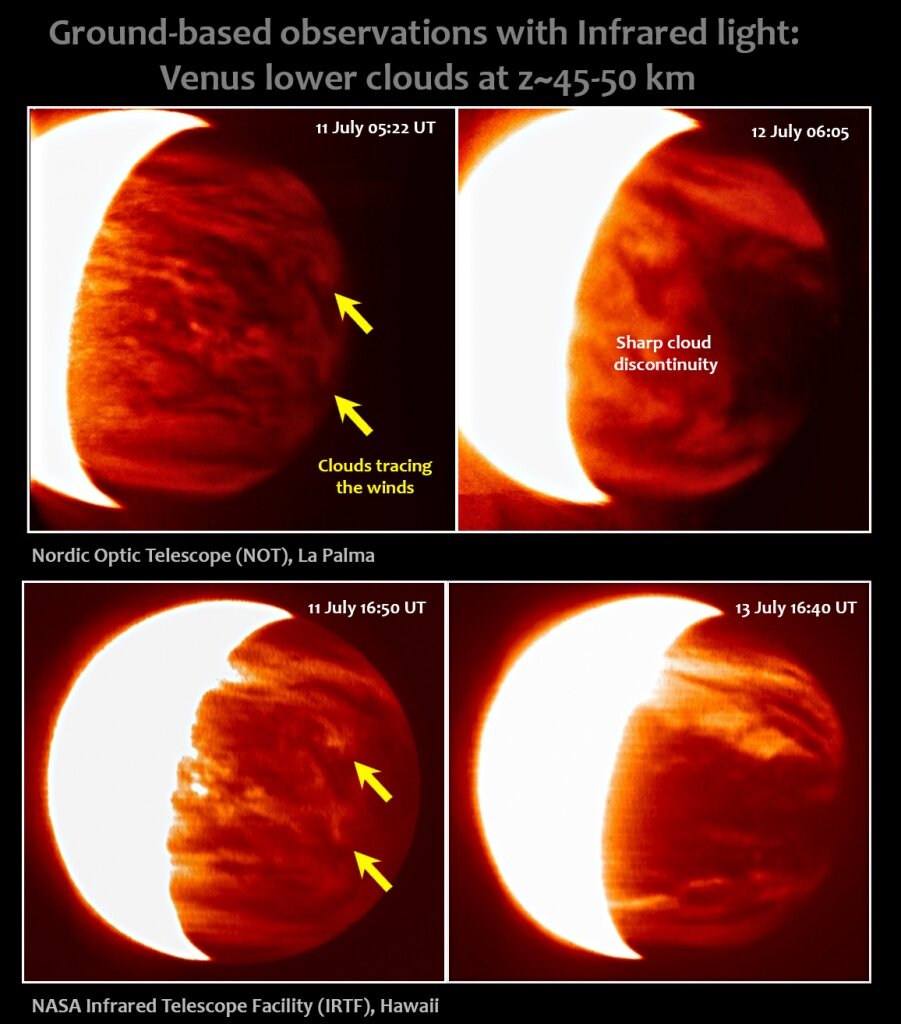 Observing the lower clouds of Venus at nightside of the planet. Images from NOT by J. Peralta (JAXA) and R. Baena (IAC). Images from IRTF by E. Young (SwRI). In these observations, samples of the middle atmosphere were taken at an altitude of about 45-50 km above the surface. Credit: NON / NASA, IRTF.
The observations continued and intensified duringAugust, when Venus was best observed from Earth, and culminates in October when the BepiColombo mission orbits Venus on its way to Mercury.
There are clear signs of change over timein the clouds of Venus if we compare the observations of the Venus Express mission in 2006-2014 with the later Akatsuki observations from 2015. The data obtained by amateur and professional observers in these campaigns in the summer and fall will expand knowledge about the weather on Venus and its variability, scientists conclude.
Read also
In the era of ecosystems: how IT giants are turning into interfaces of our everyday life
The Doomsday glacier turned out to be more dangerous than scientists thought. We tell the main thing
GitHub has replaced the term "master" with a neutral equivalent