What is this satellite?
Triton is the only moon in the solar system that orbits the planet in


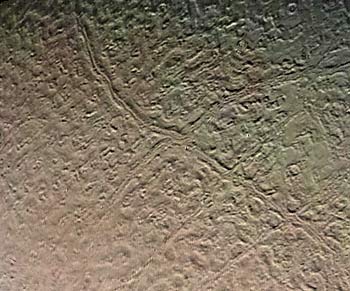 Image Credit: NASA / JPL.
It is noteworthy that the mass of Triton is 99.5%the total mass of all the satellites of Neptune. Despite the fact that it was discovered back in 1846, they could not receive any information about Triton for a long time. The Voyager 2 spacecraft has shown that everlasting volcanoes are operating on Triton. Only they spew not lava, as on Earth, but ammonia and water.
 Image Credit: NASA / JPL.
Why fly specifically to Triton?
30 years have passed since the spacecraftNASA's Voyager 2 flew past Neptune and its largest moon, Triton. After this flight of questions there were more than answers. One of the main ones is where the mysterious trains on the surface of Triton come from. In addition, the satellite has an active ionosphere and a thick layer of ice, under which there can be anything, for example, oceans. NASA scientists suggest that the satellite may have liquid water that hides under the ice crust on the surface of the planet, which is hinted at by frozen wave-like prints.
 Scientists will test whether liquid water is hidden under a layer of ice. Image Credit: NASA/JPL-Caltech
How will the mission go?
NASA's next mission is planned as part of“Discovery Program”. It will include four tasks: a mission to study the atmosphere of Venus, observation of volcanic activity on the Jovian moon, it also includes mapping of the surface of Venus and the study of its geology, and finally, the study of the moon of Neptune - Triton.
 Trident will carry a wide range of scientific tools for studying Triton.
Image Credit: NASA / JPL.
It is no coincidence that the mission is called “spear”; it will includeA three-stage approach to the study of Triton was used. The first is observing the jets of fountains ejected from the surface. They were first spotted by Voyager 2. They were thought to be composed of nitrogen gas that escaped from deposits of nitrogen ice. This occurs when nitrogen ice is heated by the Sun. It is unknown where they come from, perhaps, by analogy with Saturn’s moon Enceladus, they appear from the subsurface ocean. This is unknown at this time. Trident will study this possibility and help scientists determine how these jets are created. It will also specifically look for signs of a subsurface ocean. Such oceans are known to exist on several small icy moons in the outer solar system.
Another task that will facemission results, explore and map parts of Triton that no one has ever seen. At the moment we know what 40% of the satellite's surface looks like. Trident will also re-image those areas on Triton that had jets detected during the full "Neptune aurora" - a situation where light from the Sun reflected from Neptune illuminates Triton's dark side. Based on the results, the images will be compared and it will be determined what changes have occurred since the previous mission.
In addition, scientists want to understand howThe relatively young surface of this moon continues to renew itself over time. There were almost no craters in previously photographed areas of Triton's surface. It is unknown why they disappear. Experts estimate that Triton's surface is only about 10 million years old, which is very young compared to the 4.6 billion years of the Solar System itself.
What dates is the mission planned for?
The Trident mission is supposed to begin inOctober 2025 A spacecraft sent to Neptune will be able to use the gravitational pull of Jupiter to get closer to Triton. If everything goes according to plan, then it will approach the satellite by 2038 for only 13 days. The ideal window to launch into the Neptune-Triton system appears once every 13 years, when the Earth aligns with Neptune so that the spacecraft can use Jupiter for gravitational maneuver.