Why are they afraid of autumn?
Please note that any statements and opinions are a subjective assessment
For example, a virologist, Professor Anatoly Altstein predicted the beginning of the second wave of the coronavirus epidemic in Russia in October-November.
In an interview with the newspaper Komsomolskaya Pravda, the scientistsaid that the seasonality of the coronavirus is not as pronounced as the experts hoped for it, and the hopes that the infection would subside with the onset of the heat did not come true.
But we were wrong. Yes, a slight decrease is noticeable, but, apparently, in October-November, when it becomes cool and damp, the coronavirus will raise its head.
Anatoly Altshtein, virologist and professor
According to Altstein, according to the theory over timethe virus begins to adapt to the human population. It is not beneficial for the coronavirus to kill its owner; it is in its interests that people continue to communicate with each other and the virus can be transmitted to more and more new owners.
In other words, there are suggestions that in the secondthe wave of COVID-19 will become a more widespread disease, but the number of severe cases will decrease. Although the viruses that are widespread in Russia, and today have a low mortality rate at the level of 1.5-2%.
Another concern is the case of Australia. It is now winter in the country, and the second wave of the disease has begun there. Experts note that it is even worse than the first.
The second wave of coronavirus in Australia is becomingstronger than the first: authorities are reporting new records for daily growth, including the period of the first wave, which began in March. It's winter in Australia, and the rise in the number of cases in the country shows a "worrying trend" that subsequent waves of COVID-19 may be stronger than previous ones, especially when conditions are favorable for infection, Bloomberg writes. Such favorable conditions can include cold weather, when people hide from bad weather in enclosed spaces.
- Moscow
Another reason why concerns aboutabout spring: a publication in the Octagon media, which said that Sobyanin was preparing Moscow for the second wave of coronavirus. The journalists relied on a “source familiar with the situation,” who said that the mayor of Moscow issued “a closed order to prepare for the second wave of coronavirus cases.”
The text stated that from September 20 in Moscowquarantine will be reintroduced with self-isolation, electronic passes and the closure of shops and restaurants. The authors of the material associated this with the City Day on September 5 (the Moscow authorities are preparing for it, but are not sure that the holiday will take place anyway) and with the Single Election Day on September 13 (although in Moscow elections will be only in two districts - Babushkinsky and Maryino).
Moscow Mayor Sergei Sobyanin in late July in an interview with "Russia 24" commented on rumors about the resumption of quarantine - and denied everything.
The second wave is when people get caught for the second timeat risk of being infected. There is practically nothing like this here, or anywhere in the world. Why is there such rapid growth in a number of regions? Because they haven't even gone through the first wave yet.
Sergei Sobyanin, mayor of Moscow
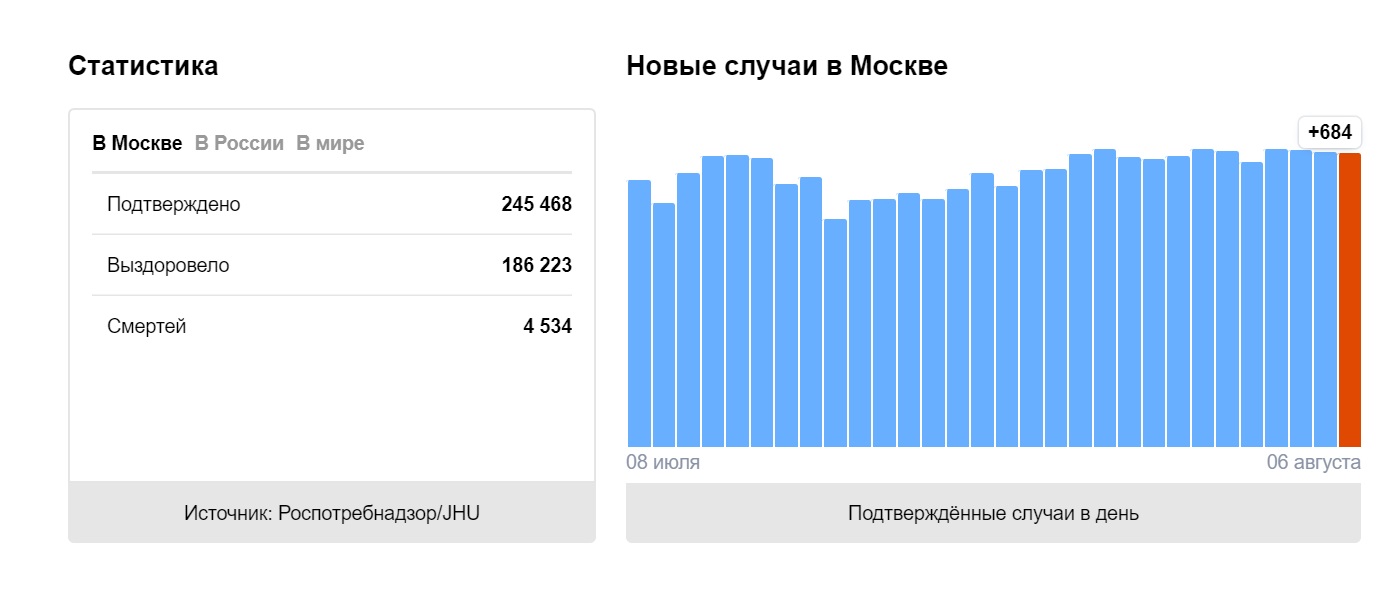
Let us note that there is currently no uniform dynamics in the capital regarding identified cases of the disease.
If in mid-July every day in the capitalWhen about 550 infected people were identified, then in early August there were already about 650. But, most likely, these data do not reflect an increase in the number of infections, but a new strategy for testing for coronavirus, which makes it possible to identify more infected people.
The official explanation looks like this: in the city on July 16, a program of free testing in polyclinics was launched, which is why now 5 thousand more PCR tests are performed daily. According to Meduza's model, if at the beginning of July 10% of cases were detected, then at the end of the month - 13%.
- St. Petersburg
At the end of July it became known that InIn St. Petersburg, an almost tenfold increase in community-acquired pneumonia was recorded. The largest increase in their number, according to city statistics, occurred in May 2020.
In May 2020, 9560 cases of community-acquired pneumonia, which is 9.9 times more than in the same period last year. Such data are contained in the report of Petrostat "Socio-economic situation of St. Petersburg in January-June 2020".
For the first five months of 2020 in St. Petersburgdied 27,878 people, which is 2,148 more than in the same period last year. Due to the smaller number of births, the natural decline in the city was 5,356 in 2020 against 2,083 in the past.
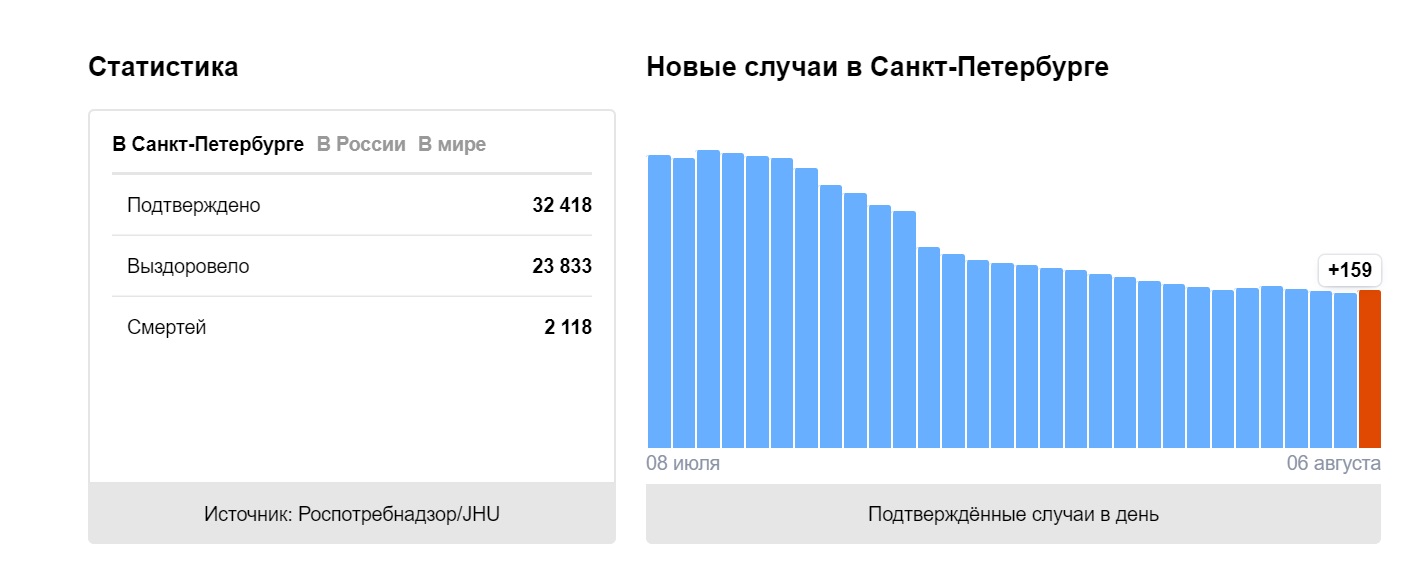
Yesterday, August 5, the authorities of St. Petersburgreceived a letter from Rospotrebnadzor, in which chief sanitary doctor Anna Popova proposes to ease a number of coronavirus restrictions in the city. This was announced by Vice Governor Oleg Ergashev.
According to the official, this is favored asa decrease in the prevalence of COVID-19, and a decrease in the number of hospitalizations of patients. And the number of patients in intensive care beds is decreasing.
Some measures of relaxation have already been taken in the city,typical for the second stage of lifting restrictions, in particular, kindergartens, shops, shopping centers, swimming pools, fitness centers operate, albeit with some nuances. But Smolny will certainly add new concessions to this.
- Yekaterinburg
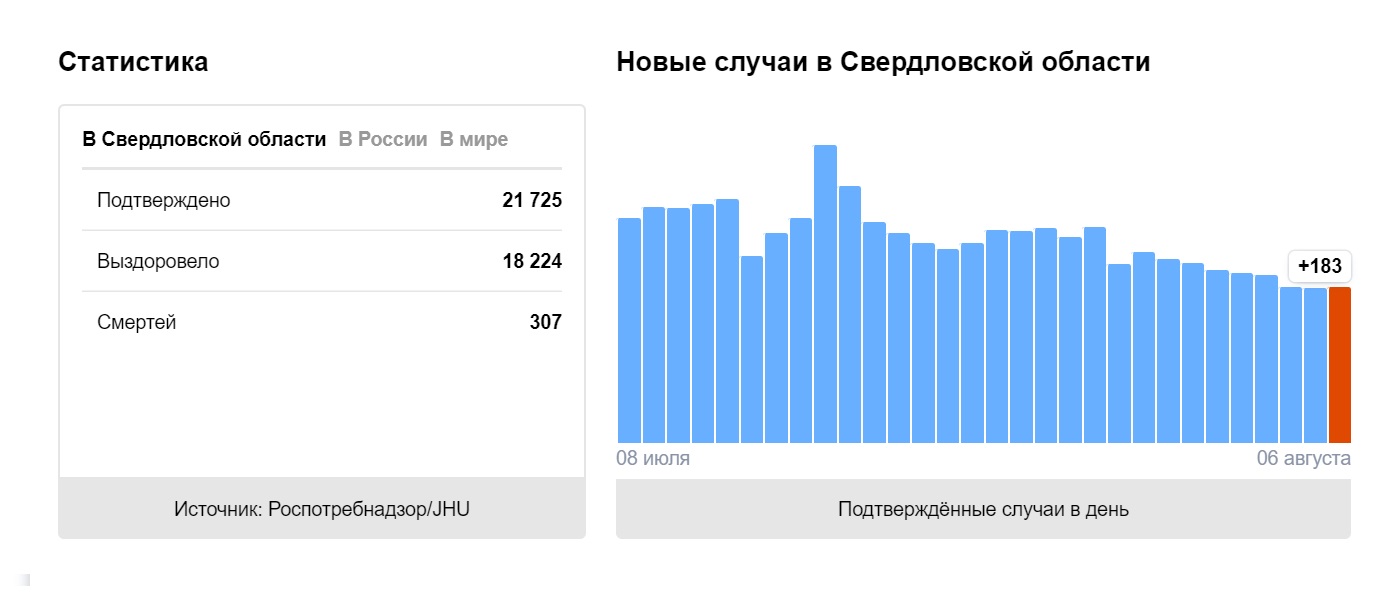
Epidemiologists and doctors say that in Sverdlovskthe region, the number of new cases of COVID-19 infection is decreasing, more and more people are being discharged from hospitals. But such a situation will not last long, says Alexander Soloviev, an expert in laboratory diagnostics.
We should expect an inevitable increase in the incidence of COVID-19 and a new increase in the burden on the healthcare system at the end of August and September, Soloviev said.
And there are several reasons for this: mass vacations of residents of the region in the conditions of overcrowded resort areas, international tourism, lack of control measures for compliance with the requirements for preventing infection in public places, in transport, when returning to work in collectives, the beginning of the school year in schools and universities.
If everyone goes to shopping centers en masse and returns from the Krasnodar Territory, we may not go down from the current incidence rates of COVID-19.
Doctor-epidemiologist
On August 4 it became known that in Sverdlovskregion canceled regional fines for violating the self-isolation and mask regime. Changes to the regional code of administrative offenses were adopted by deputies of the Legislative Assembly.
- Kazan
On August 1, it became known that the governmentTatarstan has made a decision on another easing of restrictions previously imposed due to the pandemic of the new coronavirus infection. It was allowed to hold leisure, sports and entertainment events in the open air with the number of participants not more than 50;
At the same time, a prerequisite for such events is a prior written notification of the Rospotrebnadzor administration for Tatarstan at least 7 days in advance.
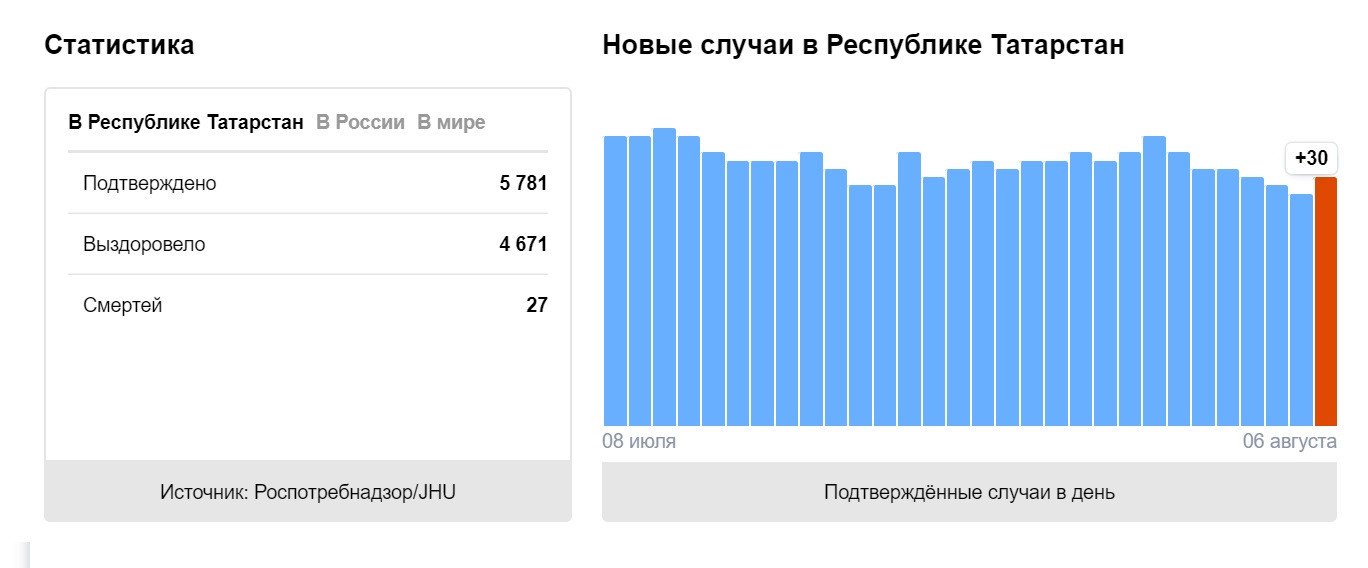
It is important to note that among other major citiesKazan has the lowest increase in cases. Local residents note that the city observes safety precautions well: sellers and establishment owners make sure that customers do not accumulate in one place and wear personal protective equipment.
- Sochi
In early August, an increase in the number of people infected with the virus was recorded in Sochi. This follows from official data published on the website of the Krasnodar Territory administration.
Earlier, the governor of the Krasnodar Territory, Veniamin Kondratyev, announced a stable epidemiological situation in the resorts of the Krasnodar Territory, despite the increase in infection cases.
Doctors say that it is not tourists sunbathing in the open air that are susceptible to illness, but office workers. Coronavirus spreads better in unventilated areas.
Now all the services in the region are trying to extinguish againflames of infection flared up until autumn. But, if the epidemiological situation worsens, quarantine restrictions may be reintroduced in the Kuban. Let's remind, now in the region there is a high alert mode.
According to the latest data, today, August 6, VSochi revealed the most positive results for coronavirus - 46. In total, during the pandemic in the Krasnodar Territory, the virus was confirmed in 8,946 people, including 673 children.
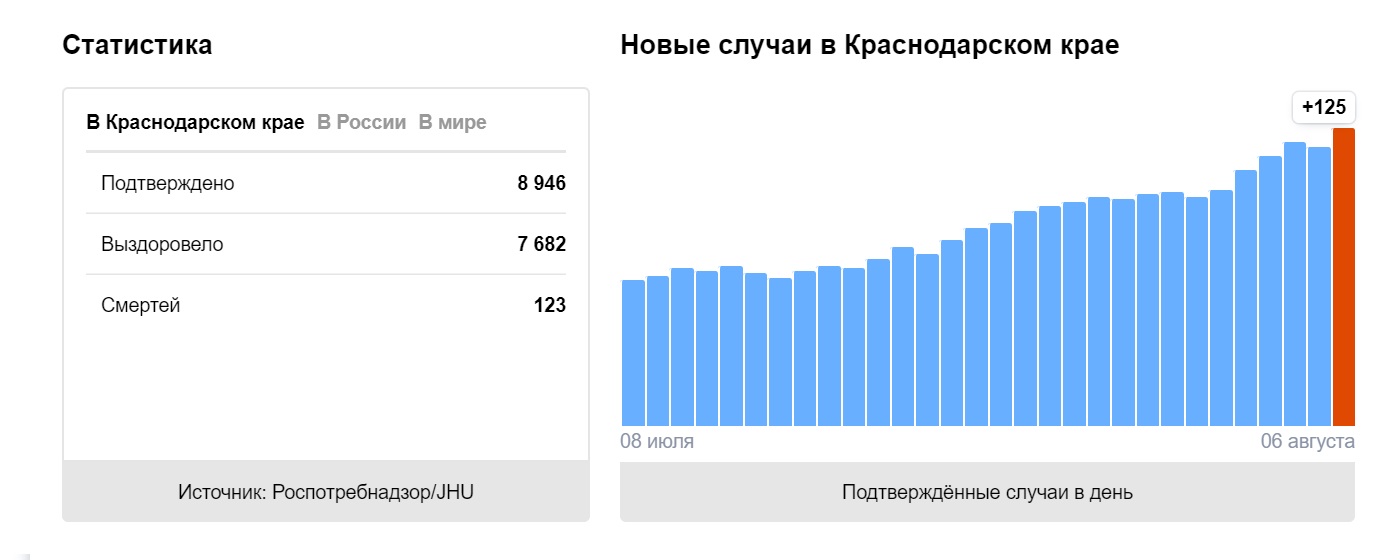
Until August 21 in the Krasnodar Territoryhigh alert mode. In July, local authorities lifted most of the restrictions imposed during the pandemic, including on passenger travel and the operation of catering establishments, hotels, shops, as well as fitness centers, swimming pools and water parks.
What's the bottom line?
The situation in large cities is completely different,Some are easing measures, while others, on the contrary, are presumably preparing to tighten them. In a pandemic, we cannot talk about a second wave for the entire country, because the situation is individual. However, there are general patterns: in cities where for some reason the circulation of local residents and city guests is not controlled, multiple outbreaks occur; we can see this in the example of the resort Sochi.
Now is the period when the sun is both in Crimea andin the middle zone it warms, and the amount of vitamins B and A, which are absolutely necessary and greatly contribute to the production of interferons of our innate immunity, <…> our interferon [was] higher than in winter. Vitamins help the formation in our body of those proteins that the coronavirus RNA directly grabbed and destroyed. Therefore, there is some certain protection, and the number of severe cases [of coronavirus infection] is less, and the epidemiological process is not as severe as in the winter or autumn periods.
Alexander Ginzburg Director of the National Research Center for Epidemiology and Microbiology named after N. F. Gamaleya, Ministry of Health of Russia
However, it is unknown what awaits us in the autumn-winter period; we can be guided by the experience of Australia and recommendations for protecting our body.
Read also
See what happens if the black hole does not interfere with the formation of stars
Researchers find out how parasites learned to live without oxygen
Putin has authorized clear cutting of forests on Lake Baikal. What will happen now?