Photos and videos are typically created by capturing photons— the building blocks of light —with digital
3D images can be generatedeither by placing two or more cameras around an object when it is filmed from different angles, or by using streams of photons to scan a scene and reconstruct it in three dimensions. In any case, the image is created only by collecting spatial information about the scene.
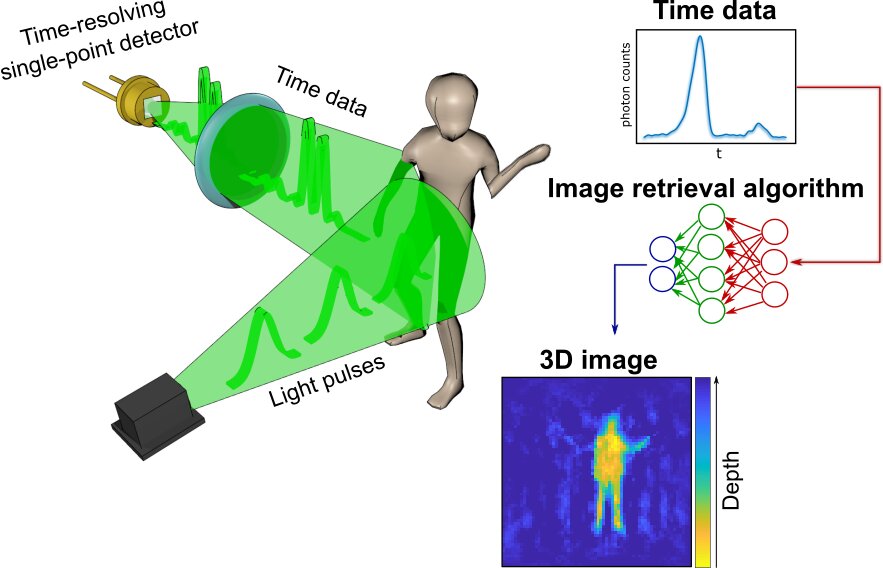 Image: University of Glasgow
Researchers from the UK, Italy andThe Netherlands describe a completely new way of creating animated 3D images: they capture temporal information about photons instead of their spatial coordinates.
Information about the time of each photon reflectedin the scene —what researchers call time data —is compiled into a very simple graph. These graphs are then converted into a 3D image using a complex neural network algorithm. The researchers trained the algorithm by showing it thousands of ordinary photographs of people moving and carrying objects around the laboratory.
Eventually the AI understood how temporary datacorrespond to photographs. During the experiment, the team was able to construct moving images at approximately 10 frames per second from temporal data, although the hardware and algorithm used can produce thousands of images per second.
Read also:
Vaccine, school year and cold season. We tell the main thing from the President's meeting
The most important organ: how the liver is examined today and why a biopsy is outdated
Research: the butterfly effect does not exist in the quantum model