What plans does China have?
Beijing has poured billions into its military space program, hoping to create a
China's space program must convey a clear message to the world - Beijing intends to strengthen its position in the world community by demonstrating growing technological power.
How did China's space program develop?
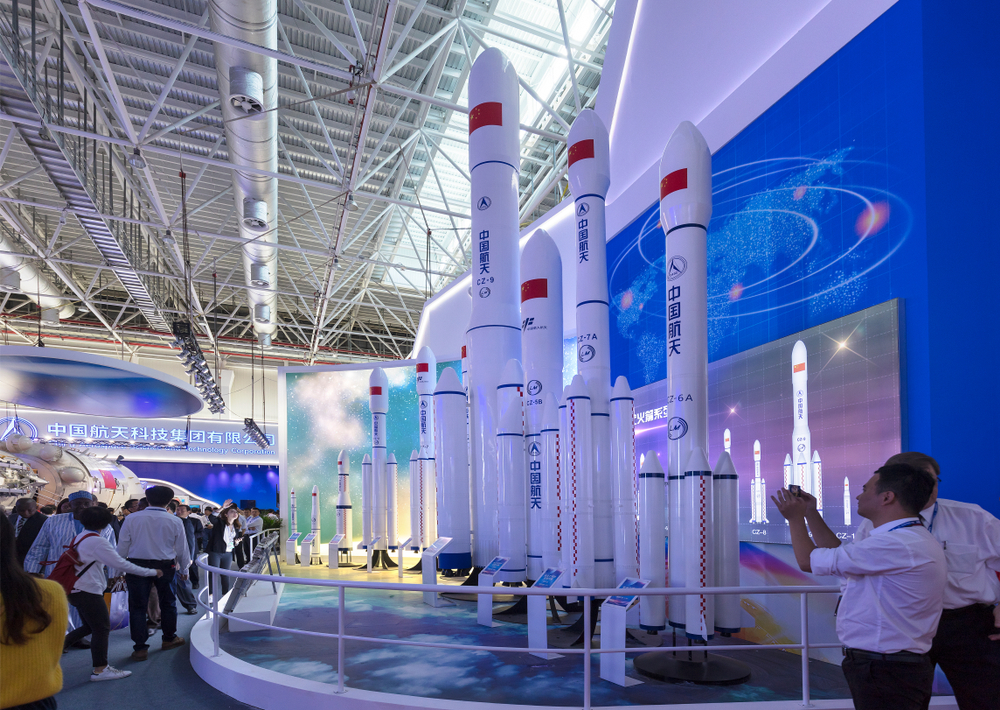
Soon after in 1957 the Soviet Unionlaunched the first satellite into Earth's orbit, Mao Zedong - at that time, the Chairman of the People's Republic of China said that "we will also make satellites." It took more than ten years to fulfill the promise, but in 1970 China's first satellite was still launched into space based on the Changzheng rocket.
However, the flight into space was still too far away. More than 30 years passed before Yang Liwei became the first Chinese astronaut to go into space in 2003.
As launch approaches due to concerns aboutover the viability of the mission, Beijing canceled nationwide live television at the last minute. It is unlikely that the authorities wanted hopes to dash along with the ship on the air.
And yet, despite the fears, the launch went aheadsmooth: Yang Liwei completed 14 orbits around the Earth during the 21-hour flight aboard Shenzhou 5. By the way, despite the communist system, the name of the ship is translated as “Magic Boat”, “Sacred Shuttle”.
The first female astronaut, Liu Yang, flewJune 16-29, 2012. On June 18, the Shenzhou-9 spacecraft was docked to the Tiangong-1 orbital module. For ten days, the Chinese astronauts performed various scientific experiments on board.
Since that successful flight, China has increasingly sent men and women into space. But Beijing was not going to stop there.
Advances in space exploration
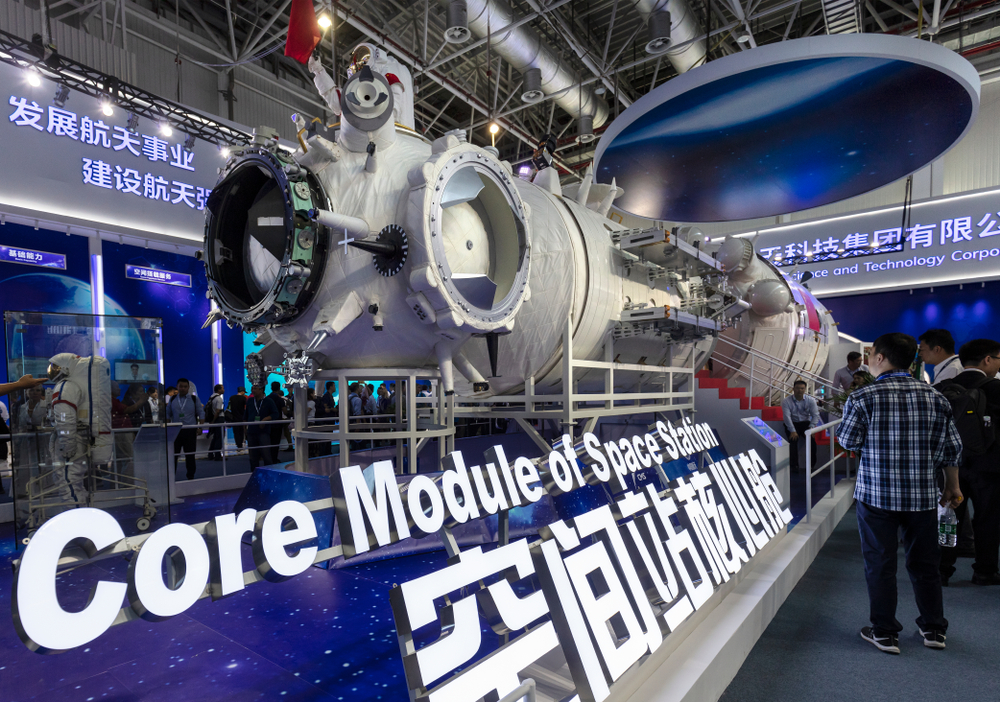
Following in the footsteps of the United States and Russia, China has long sought to open a space station orbiting Earth.
The Tiangong-1 spacecraft was launchedinto orbit in September 2011. The space module "Tiangong-1" ("Heavenly Palace-1") is a target module designed to test technologies for rendezvous and docking of spacecraft.
Launch of the crashed Chinese space station Tiangong-1 in 2011
In 2016 he stopped working,having served, at the same time, 2.5 years longer than the guaranteed period. In 2018 after entering the Earth's atmosphere, it burned up and fell into the Pacific Ocean.
NW of Tahiti – it managed to miss the ‘spacecraft graveyard’ which is further south! pic.twitter.com/Sj4e42O7Dc
- Jonathan McDowell (@ planet4589) April 2, 2018
The place where Tiangong-1 fell
“Goodbye, Tiangong-1. You are our hero, ”wrote one user on the Chinese microblog Weibo. Chinese news agencies have released photos and words in tribute to the 10.4-meter space station as it re-entered Earth's atmosphere over the South Pacific.
“Let's take a moment to applaud and cheer her up. This time it is really goodbye, ”the Beijing-based Toutiao News wrote at the time.
Tiangong 1 was a symbol of China's emergence as a space power and a key part of the country's ambitious space program to establish a permanent station in orbit by 2023.
However, even before the death of the “Heavenly Palace”In 2013, the second female astronaut, Wang Yaping, gave a video lesson from the Tiangong-1 module, which was broadcast to children in the world's most populous country. The module's laboratory was also used for medical experiments and, most importantly, for tests designed to prepare for the construction of the space station.
The laboratory was followed in 2013 bythe Yutu lunar rover - the "Jade Rabbit" - which was perceived around the world as a useless machine when it stopped sending signals to Earth. However, the rover recovered dramatically and ultimately surveyed the lunar surface for 31 months. This, again, greatly exceeded its expected service life.
In 2016, China launched its second station,the Tiangong 2 laboratory, to orbit 393 kilometers above Earth, which analysts say is likely to be the last building block before China's launch of a manned space station. Astronauts who visited the station carried out experiments on growing rice and other plants, as well as on the docking of spaceships.
China's "space dream"
When in 2013 the cosmonauts workingaboard Shenzhou 10, landed safely and took part in a press conference, astronaut Ne Haisheng said: “I’m glad to be back home. Space is our dream, which we have successfully realized. At the same time, China will always be our home.”
Since then, the rapid development of the Chinese space program in the PRC has been called a “space dream.”
After China was expelled from workInternational Space Station, Beijing is working to build its own space station. Assembly of the elements in space should begin this year, and human use around 2022.
China also plans to build a base on the moon: the head of the country's National Space Administration, Zhang Kejian, said the country aims to launch a lunar mission by 2029.
But lunar efforts failed in 2017.when the Long March-5 Y2, a powerful, heavy-lift rocket, failed to launch a mission to send communications satellites into orbit. The failure forced the postponement of the Chang’e-5 launch, which was originally planned to collect lunar samples in the second half of 2017.
Another robot, Chang'e-4, landed on the far side of the Moon in January 2019 for the first time in history.
China's space ambitions are strong todaycontrasts with US ambitions, where policymakers are considering withdrawing funding from the ISS by 2024. If the station is decommissioned, China could become the only country keeping people in Earth orbit.
What else is China planning?Next up is not only our own space station and lunar settlement, but also manned flights to Mars. Beijing is seriously striving to become a global space power. And so far they have managed to grow in this direction. Ultimately, the rocket launch of China's Chang'e-5 lunar probe underscores just how far Beijing has come in realizing its "space dream."
Read also
Scientists have identified the cause of the explosion in Beirut on social networks
Scientists have studied how COVID-19 is transmitted indoors
From January 1, all smartphones must have 16 Russian applications