What is organic electronics?
Это отрасль электроники, которая использует органические материалы
Traditional electronics are based on solidsilicon, which is used to create semiconductors. They are inorganic (i.e. they do not contain carbon). In contrast, organic electronics uses carbon-based molecules - either small molecules or polymers, which are long chains of molecules. Almost all biological molecules are organic compounds, but also substances derived from hydrocarbons such as petrochemicals, oils and plastics. Many people may think of polymers, in particular, as non-conductive - for example, plastic polymers are used to insulate copper wires. But some organic polymers and molecules can conduct electricity.
How are they different from traditional silicon based electronics?
Organic compounds have someadvantages over inorganic compounds. They are lightweight, flexible and transparent - all of which are significantly different from the classic silicon technology. They can also be cheaper to manufacture.
Why is organic electronics causing so much excitement?
There are so many organic compounds and a wide variety of functional groups (clusters of atoms with their own distinctive properties).Their electronic properties become very easy to customize by adding functional groups.Some functional groups divert electrons, and some donate electrons, so by combining them, scientists canFor example, you can adjust the fluorescence for light-emitting diodes.
How did a new kind of electronics appear?
Organic electronics began in the 1950syears, when H. Inokuchi and his colleagues discovered the first conducting organic molecule. From this discovery, it was determined that organic molecules could be semiconductors, a term commonly used for silicon, germanium, and other similar elements. It turns out that organic semiconductors have several advantages over traditional semiconductors.
Organic semiconductors
W. Helfrich and V.G. Schneider discovered that organic molecules can emit light. For the first time such a property was found in the anthracene molecule. The only drawback was that this effect required a high voltage, which made the discovery and possible further development extremely ineffective. Then, in the 1980s, three scientists - Heeger, McDiarmid, and Shirakawa - made conductive polymers, for which they received the Nobel Prize in Chemistry in 2000. Several years later, it was discovered that perylene tetracarboxylic dianhydride - PTCDA, an organic dye molecule still used in car paints, has semiconducting properties.
The next important milestone was the discovery of organic light-emitting diodes (OLEDs), semiconductor devices made of organic compounds that efficiently emit lightThis device was invented in 1987 by Ching Tang and Steven Van Slyke of Kodak.The device could emit light with a voltage of just 5 volts, forever changing the display industry.
Where is such electronics used now and what is its future?
According to Professor Andreas Hirsch, head ofDepartment of Organic Chemistry at Friedrich-Alexander University in Erlangen-Nuremberg in Germany, electronics made from carbon rather than silicon could lead to a new generation of medical devices, sensors, and perhaps even robots.
"Most people will probably usescreen technologies. Organic light-emitting diodes (OLEDs) are now quite common in mobile phones, and you can also buy TVs with them. But even before that, liquid crystal displays (LCDs), which can be considered a type of organic electronics, have been used in many applications for years,” Hirsch explains in an interview with Richard Gray of Horizon.
“I am convinced that in 50 years or so youyou will see many more robots that look organic, that can perform functions that metal-based robots cannot, ”says the scientist.
Spectrum of applications of organic electronics
Organic electronics have a wide variety of uses. Four of them can be called the most promising: displays, photovoltaic and transistor technologies, and biomedicine.
Displays
OLED (Organic Light Emitting Diodes) —it is a pioneering technology developed by Ching Tang and Stephen Van Slyke. OLEDs consist of an organic film that uses the property of phosphorescence to generate its own light instead of using a backlight. Phosphorescence is emission due to the excitation of electrons that lasts for a long period of time. You may have noticed this in wristwatches and dials that glow in the dark.
 Namsan Seoul Tower 1F— OLED Tunnel
Phosphorescence is a special type of photoluminescence. Unlike a fluorescent substance, a phosphorescent substance does not emit absorbed energy immediately. Longer reemission times are associated with “forbidden” energy transitions in quantum mechanics.
OLED operation is pretty straightforward. An organic film consists of two layers: emitting and conductive. There are holes on the border between the two layers. The emitting layer emits electrons, and the recombination of electrons and holes results in the generation of photons that make up light.
There are basically two types of OLEDs - passive and active matrix.
- Passive matrix OLED (PMOLED) has stripescathode and anode strips, they are located perpendicular to each other. The intersections and form the pixels from which light is emitted. External circuits supply current to selected strips of the anode and cathode, determining which pixels will be on and which will remain off. The brightness depends on the magnitude of the applied current. Their disadvantage is that they consume a lot of power and are therefore used in small screens such as PDAs (Personal Digital Assistant) and MP3 players.
- The second type of OLED is an active matrix OLED(AMOLED). AMOLEDs also have full layers of cathode, organic material, and anode, but the anode layer overlaps the matrix of a thin film transistor (TFT) array. A TFT array is a circuit that determines which pixels are turned on to form an image.
AMOLEDs consume much less power thanPMOLED because the TFT array requires less power than external circuits. As a result, they are suitable for large displays such as computer monitors, televisions, and electronic billboards.
In turn, OLED LEDs have manyadvantages over LCDs (liquid crystal displays). Traditional LCD displays are made up of many parts. Liquid crystals do not have their own backlight, so they use a backlight. In addition The display designs have reflector sheets to improve brightness, diffuser sheets to separate and distribute light evenly, a bottom polarizer and a top polarizer, a color filter to create colored light, and of course liquid crystals, which are the key elements. This dramatically increases the thickness of the screen.
Quantum Light Emitting Diodes (QLED) - Otherdirection. They contain polarizers and color filters. They also need a backlight because quantum dots cannot emit their own light. As a result, these displays become too thick. OLED LEDs are sleek, produce more absolute blacks than QLEDs, and perform better in dim light because each pixel is individually illuminated. OLED screens can be very thin. And yet, most companies and consumers choose OLED displays for their smartphones.
Photovoltaic applications
Organic photovoltaic devices are inmostly organic solar cells. Polymers are commonly used as the photovoltaic material. One of the main advantages of using organic materials to make solar cells is that the "optical absorption coefficient" of organic molecules is high, so a large amount of light can be absorbed by a small amount of material, usually on the order of hundreds of nanometers. They are also very flexible and much thinner than their silicon counterparts. While current OPV (Organic Photovoltaic) technology boasts conversion efficiency in excess of 10%, reaching even 12%, some researchers predict that organic solar cells will achieve 15-20% efficiency. They can also be rolled up and even composted.

And although we live in an increasingly electronic world,access to this world is limited. An estimated 1.3 billion people lack access to electricity, with many relying on kerosene, batteries or diesel generators. Due to cheaper manufacturing costs, organic electronics promises not only to change the way people use technology, but also to expand their use to populations without access to the grid.
The main disadvantage of organicphotovoltaic cells are low efficiency compared to inorganic photovoltaic cells such as silicon solar cells. But research is being done to solve this problem, and new materials are being discovered every day that could revolutionize the solar energy industry.
Flexible Printed Organic Transistors
Transistors are fundamental building blocksblocks of modern electronic devices that either amplify signals or act as switches. An organic field effect transistor (OFET) is a field effect transistor that contains conductive electrodes, an organic semiconductor, and a dielectric. Its peculiarity is that it uses very little power to patrol a very large current and also acts as a good switch. These transistors are manufactured in printed circuits using flexible organic dyes. Special care is taken to ensure that no contaminants enter the material, as this can adversely affect the conductivity of the material.
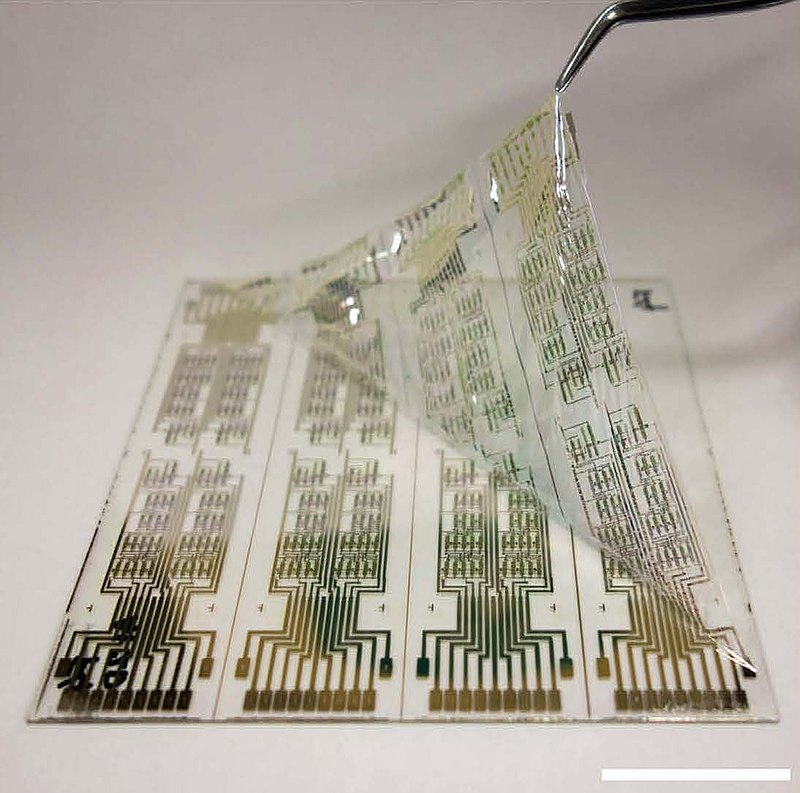 Printed circuit using OFET
Yasunori Takeda et al/Wikimedia, licensed under CC BY 4.0
Over the past few years, interest in OFEThas grown enormously and for good reason. In terms of its characteristics, OFET can compete with amorphous silicon(a-Si). As a result, there is now increased interest in the industrial use of OFETs for applications that are currently incompatible with the use of a-Si or other inorganic transistor technologies. One of their main technological advantages is that all OFET layers can be deposited and structured at room temperature, making them ideal for realizing low-cost, large-area electronic devices on flexible substrates. Silicon must be heated to high temperatures in excess of 40°C to be cast into a mold. However, it is too early to talk about the widespread use of OFET due to the imperfection of technology.
Biomedicine
Another important use of organicelectronics is medicine. For example, to treat blindness using a retinal chip that is implanted in the eye. The device detects light signals entering the eye and converts them into electrical signals that are sent to the brain. Electrodes coated with organic dyes transmit electrical signals to the receptor cells of the eye.
The composition must be biocompatible. The selection of the right materials and blend of components is critical. Right now, it has allowed blind patients to perceive light and darkness, outlines of objects, sometimes even letters and facial expressions. The goal of the scientists is that the device not only has high resolution, but also good performance. This is a great example of how technology and medicine work together to improve people's lives.
The future of new electronics
The field of organic electronics in the future will becontinue to evolve in ways that today cannot even be imagined. Some ideas have already been implemented, such as OLED smartphones, televisions and inexpensive solar panels that are installed on rooftops in rural areas. In the future, foldable smartphones will become more common, and, for example, electronic skin, which mimics human skin in its tactile sensitivity, will take more time to develop. Other predictions are not yet possible, as the applications are varied and cover many areas - medicine and biomedical research, energy and the environment, communications and entertainment, home and office furniture, clothing and personal accessories, and much more.
Organic electronics can also doproducing, using and recycling electronics more environmentally friendly. Scientists and engineers are looking for ways to make new electronics more energy efficient than today's silicon-based designs.
What are the benefits of using organics for electronic production?
- New opportunities
Organic materials have uniqueproperties that cannot be achieved with silicon-based electronics. Their properties include sensitivity, biocompatibility and flexibility. Sensing is the use of electronic devices to detect chemical or biological substances in the environment or on the human body.
Scientists envision biosensors that don'tnot only detect glucose levels in people with diabetes, but also actually distribute the appropriate dose of insulin at the right time. Organic electronic materials are not only more chemically compatible with biological systems than silicon-based devices; they give the substance flexibility, extensibility and mechanical “softness”.
Together, these properties create the potential for innovative bioelectronic sensors that can match the curvature and moving parts of the human body.
- Energy efficiency
As scientists and engineers continueimprove the synthesis and characterization of organic materials for use in electronics, they hope that the use of such materials will lead to more energy-efficient electronic displays, lighting and other devices.
For example, it is necessary to make organicsolar cells are more efficient so that they can be used in places like Northern Europe and much of Russia, where the nights are very long and there are only short periods of sunlight, especially in winter.
Engineers are trying to create devices fromorganic materials that last longer are recyclable, or perhaps even biodegradable. Organic electronics manufacturing methods will also become more energy efficient, leading to fewer steps and less waste heat recovery methods.
- Less waste, more safety
Using organic materials forthe creation of electronic devices offers hope that future methods of manufacturing electronics will rely on fewer raw materials, and it will also be safer.
Materials can be saved by relying on lesswasteful processes such as printing. Materials are added to structures or devices layer by layer as they are created, as opposed to centrifugation, which involves removing materials and disposing of excess.
Besides using lessmaterials, chemists are looking for ways to use safer materials. For example, many polymers require carcinogenic solvents. Some solvents are not even allowed in the printing industry in the EU due to their toxicity.
- Stable electronics
Creating greener electronic products- it is not only about creating more “green” solar panels or other devices, but also using more “green” production methods. Environmental sustainability must be applied at every stage of the production cycle, from the acquisition of raw materials to the disposal of waste. Organic materials can propel electronics into the future in a more sustainable way than is possible in today's electronic world.
Finally, “green electronics” meansthat the electronics themselves are durable. The versatility of organic electronics, coupled with the promise of the field for environmental and social sustainability, points the way towards a very long-lived technology suite.
Market situation
According to Allied Market Research, by 2027The organic electronics market will reach $159.1 billion at a CAGR of 21.0%. Increasing demand due to the adoption of technologies supporting sustainable development and the need for organic electronics to develop latest technologies has fueled the growth of the global organic electronics market. Based on the materials, the semiconductor segment accounted for the largest share in 2019. Based on region, the Asia Pacific market held the lion's share in 2019.
In addition, this week it was releasedlarge report "Organic electronics market volume, share, growth and report until 2020-2028 ". According to it, in the forecast period, the global organic electronics market will only grow. This research report examines the market landscape and its development prospects in the near future. After examining the key companies, the report focuses on new entrants driving the growth of the market. Most companies in the global organic electronics market are currently embracing new technological trends in the market.
Finally, the researchers throw light on various ways to identify the strengths, weaknesses, opportunities, and threats affecting the growth of the global Organic Electronics Market.
Some of the key players working on thismarket, include companies such as Fujifilm Dimatix, AU Optronics, BASF, Bayer MaterialScience, H.C. STARCK, DuPont, Koninklijke Philips, LG Display, Sumitomo, Merck, AGC Seimi Chemical, Novaled, Samsung Display, Sony, Universal Display, Heliatek, Evonik.
What's the bottom line?
Over the past few decades, the regionorganic electronics has clearly made tremendous strides: many devices are already on the market, and many prototypes are in the pipeline. This field will continue to grow, changing the way society interacts with technology as chemists, physicists and other scientists and engineers tackle research challenges. Interdisciplinary research and training programs that bring together scientists and engineers from different fields of knowledge, as well as from different sectors of activity (e.g. academia, industry, government) will contribute to the collaborative efforts needed to address these challenges
Read also
Researchers have developed clean energy from graphene for the first time
On day 3 of illness, most COVID-19 patients lose their sense of smell and often suffer from a runny nose
The Doomsday glacier turned out to be more dangerous than scientists thought. We tell the main thing