Ecologists from the German Alfred Wegener Institute collected and analyzed garbage washed up on the beaches.
The study is the result of a five-year project withattracting volunteers. From 2016 to 2021, tourists collected marine litter on 14 remote arctic beaches in Svalbard. During this time, volunteers have collected more than 23 thousand different objects, with a total weight of over 1.6 tons. The study showed that more than 80% of the total amount of garbage is plastic.
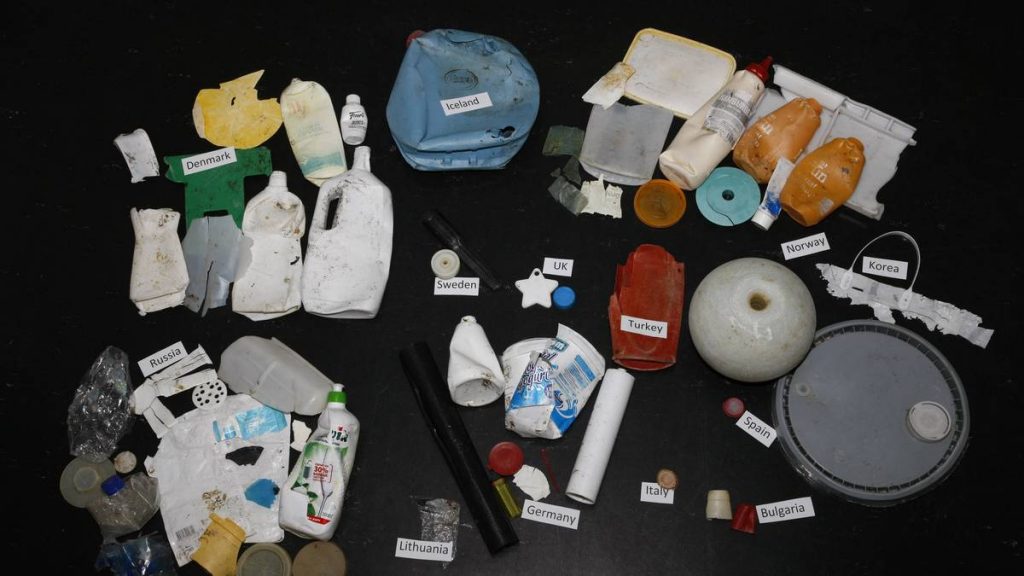 Part of the garbage, sorted by country. Image: Alfred Wegener Institute
To determine the sources of waste,scientists studied objects that retained traces of labels, manufacturer's imprints or other signs that made it possible to determine the country of origin.
Due to geographical proximity, mostitems found on the island were from Russia (32%), Norway (16%) and Germany (8%). At the same time, a relatively small but noticeable amount of garbage comes from such distant countries as Spain, the USA, China, Brazil and Argentina.
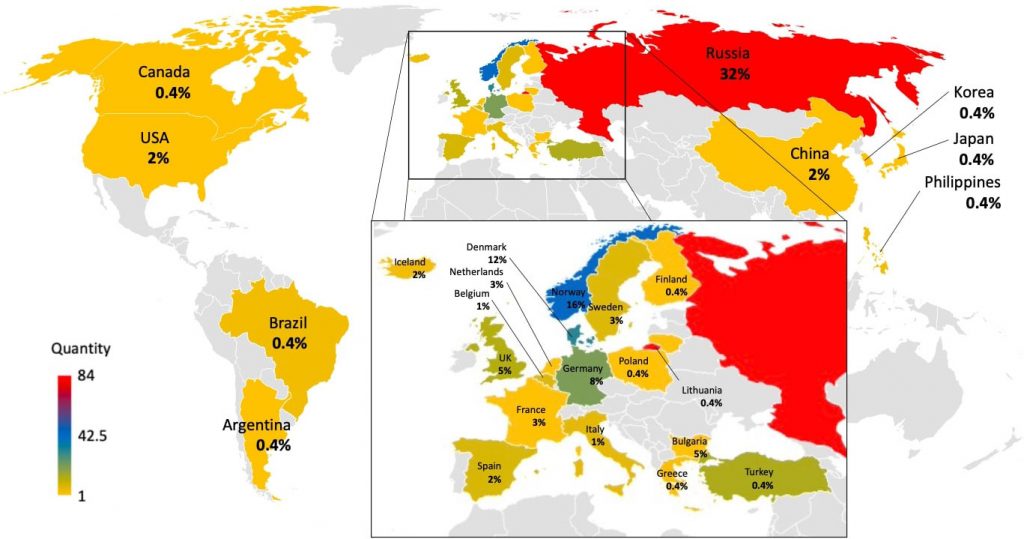 Distribution of identified plastic waste by country of origin. Image: Anna Natalie Meyer et al., Frontiers in Marine Science
Ecologists note that the study confirmstheoretical estimates and results of computer simulation. Plastic debris and microplastics are carried into the Arctic Ocean from the Atlantic, North Sea and North Pacific by various rivers and ocean currents.
However, new data show thatMuch more debris accumulates on Arctic coastlines, making them a sort of last resort. This plastic waste creates additional problems for Arctic ecosystems, which are already under severe pressure due to climate change - the Arctic is warming four times faster than the global average.
Ecologists believe that in order to solve the problempollution of the Arctic, the actions of the countries of the northern region and the regulation of the fishing industry (the main local source of pollution) at the local level are not enough. To restore and preserve the environment, joint action by industrialized countries around the world is required, the authors of the work conclude.
Read more:
Scientists transplanted human “brain” into rats and told what happened in the end
Two photos of the Earth with a difference of 50 years were compared at NASA: what scientists found
Found a rare planet, very similar to the Earth. She is close to us