July 4, 2020 NASA Space Telescope. Hubble took a picture of Saturn. This photo clearly shows two
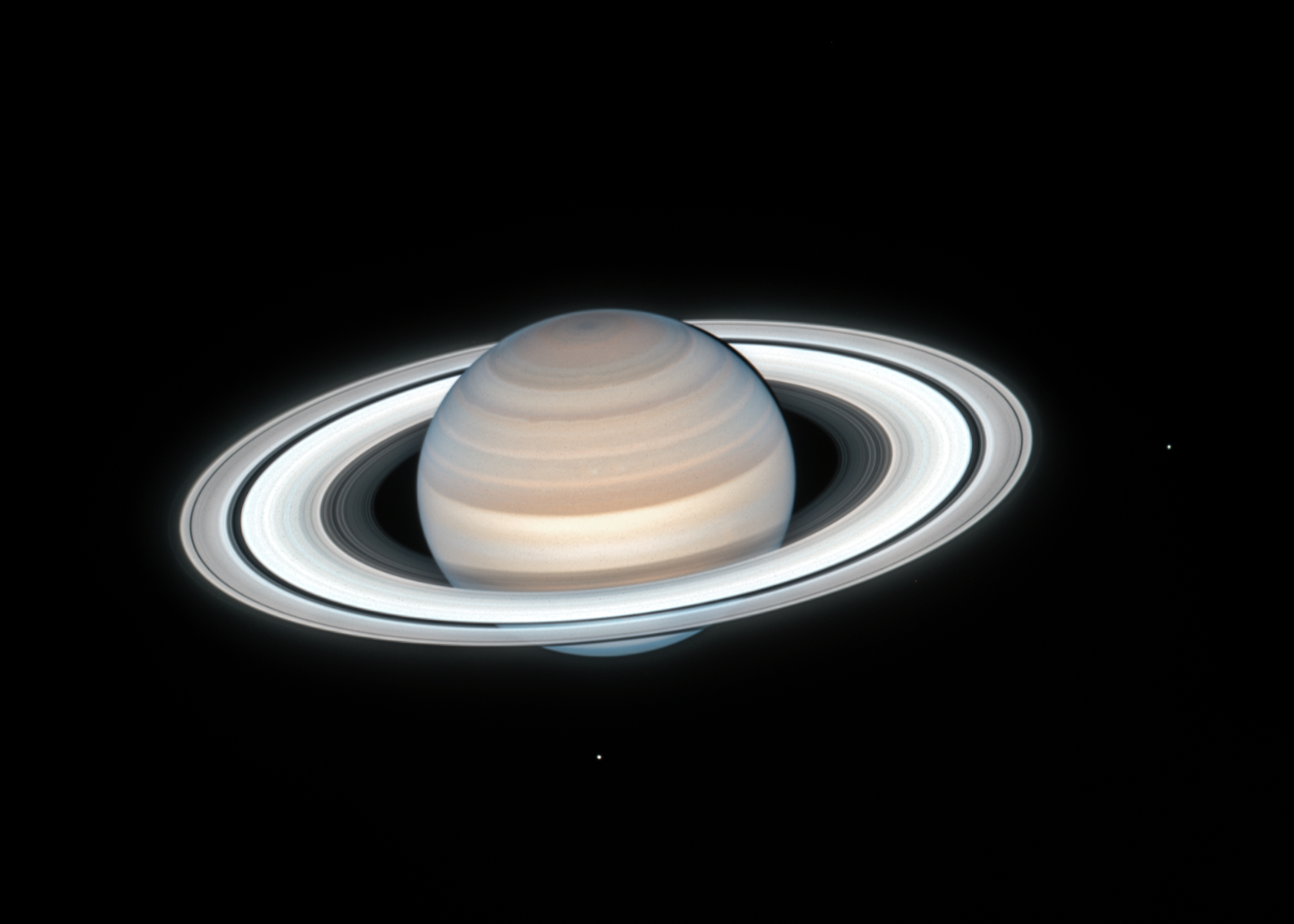
Image Credits: NASA, ESA, A. Simon (Goddard Space Flight Center), M. H. Wong (University of California, Berkeley) and the OPAL team.
The Hubble Telescope detected a number of smallatmospheric storms. These are temporary features that appear and disappear with every annual Hubble sighting. The northern hemisphere stripe remains strong, as seen from the 2019 telescope observations, with several stripes changing slightly in color from year to year. The ring planet's atmosphere is mostly hydrogen and helium, with traces of ammonia, methane, water vapor, and hydrocarbons that give it a yellowish brown color.
Hubble photographed a light reddish hazeover the northern hemisphere in this color composition. This may be due to heating from sunlight, which can either change atmospheric circulation or possibly remove ice from the atmosphere.
Another theory is that increased sunlight during the summer months changes the amount of photochemical fog produced.
It's amazing that even after a few years we are seeing seasonal changes on Saturn.
Amy Simon of NASA's Goddard Space Flight Center in Greenbelt
Hubble's clear image resolves accuratelyetched concentric ring structure. The rings are mostly made of pieces of ice ranging in size from tiny grains to giant boulders. How and when the rings formed remains one of the biggest mysteries of our solar system. It is generally accepted that they are of the same age as the planet, i.e. they are more than 4 billion years old. But because the rings are as bright as freshly fallen snow, a competing theory is that they may have formed during the age of dinosaurs. Many astronomers agree that there is no satisfactory theory to explain how the rings could have formed within the last few hundred million years.
The new image clearly shows two icy moons of Saturn: Mimas on the right and Enceladus below.
The Hubble Space Telescope is a projectinternational cooperation between NASA and the European Space Agency. NASA's Goddard Space Flight Center in Greenbelt, Maryland operates the telescope. The Space Telescope Science Institute (STScI) in Baltimore conducts Hubble scientific research. STScI is operated for NASA by the Association of Universities for the Study of Astronomy in Washington, DC.
Read also
Look at the 3D map of the Universe: it was compiled for 20 years and it has already surprised scientists
Comet NEOWISE is visible in Russia. Where to see her, where to look and how to take a photo
July parade of planets: where and where to watch in Russia?