NASA's Mars Atmosphere and Volatile EvolutioN (MAVEN) satellite has taken two images of Mars that show the electromagnetic
Two photos taken at different times:in 2022 and 2023, when the Red Planet was at opposite ends of its elliptical orbit. The researchers used data from the IUVS instrument installed on a satellite orbiting Mars. It captures radiation with a wavelength from 110 to 340 nm. For visualization, the researchers modified the data obtained by using red, blue and green colors for different areas of ultraviolet radiation.
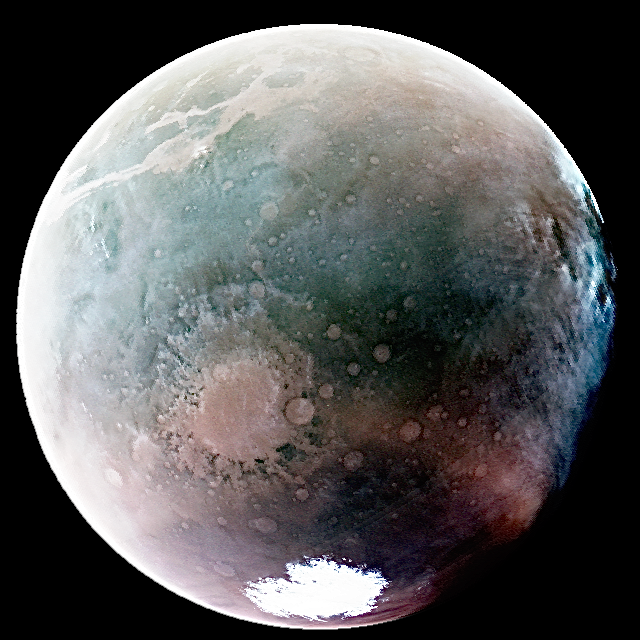 The southern hemisphere of Mars in ultraviolet light. Image: NASA/LASP/CU Boulder
The first image was taken in July 2022.At this time, it was summer in the southern hemisphere of Mars. The Argyr Plain, one of the deepest craters on Mars, stands out in the image and seems to be filled with atmospheric haze. It is shown in pink in the picture. The deep canyons of the Mariner Valley are visible in the upper left of the image. The south polar ice cap is visible at the bottom of the image.
The second image was taken in January 2023,when Mars passed the farthest point of its orbit from the Sun. Due to the change of seasons in the northern hemisphere, a large number of clouds are visible. In this image, the deep canyons of the Mariner Valley can be found in the lower left along with many craters.
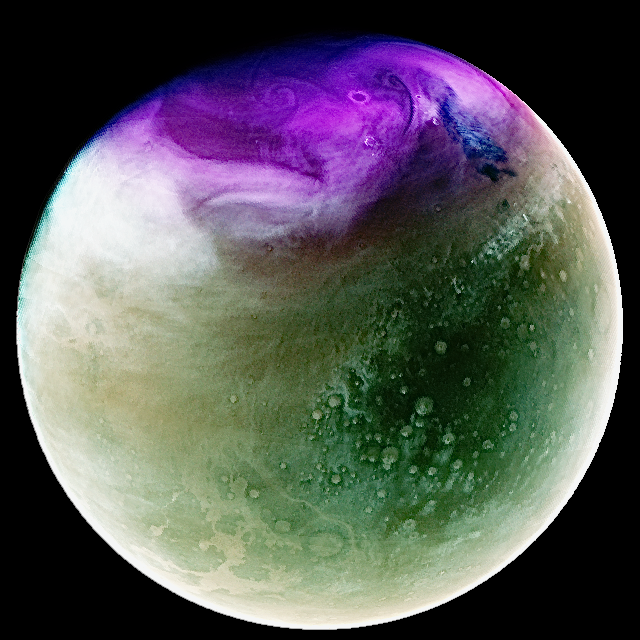 The northern hemisphere of Mars in ultraviolet light. Image: NASA/LASP/CU Boulder
During polar nights in the atmosphere of the planet innear the north pole, a large amount of ozone is formed, which shines in the pictures with a violet light. With the advent of spring, it begins to interact with water vapor rising higher in the atmosphere, and quickly collapses.
Read more:
See 100 lightning bolts that hit the ground and water during a thunderstorm in Turkey
An artifact resembling a phallus was found in Mongolia: it is about 42,000 years old
Found the tallest tree in Asia: show how it looks
Cover: Artistic illustration of the MAVEN satellite orbiting Mars. Image: NASA