Study co-author Carlos Frenk, an Ogden professor of fundamental physics at the Institute for Computational
Most of the matter in the Universe is dark (forexcluding gamma radiation, which they emit in exceptional circumstances) and is completely different in nature from the substance of which stars, planets and even humans are made.
The universe is about 27% darkmatter, and the rest is made up mostly of the equally mysterious dark energy. Ordinary matter such as planets and stars make up a relatively small 5% of the universe.
 Projected dark matter density map,created by simulation, measuring 2.4 billion light years on each side. The nested square (bottom left) is the deepest magnification in the model, at just 783 light years across, 500 times the size of the solar system. In the inserted square, the smallest clearly visible dark matter halos have a mass comparable to that of the Earth (0.000003 solar masses). Credit: Dr. Sonak Bose, Center for Astrophysics, Harvard University.
Galaxies formed and grew when gascooled and condensed in the center of huge clumps of this dark matter - the so-called dark matter halos. Astronomers can infer the structure of large dark matter halos from the properties of galaxies and the gas inside them.
The largest halos contain huge clustershundreds of bright galaxies that weigh 1,000 trillion times more than our Sun. However, scientists have no direct information on smaller dark matter halos, which are too small to contain the galaxy. They can only be studied by simulating the evolution of the universe on a large supercomputer.
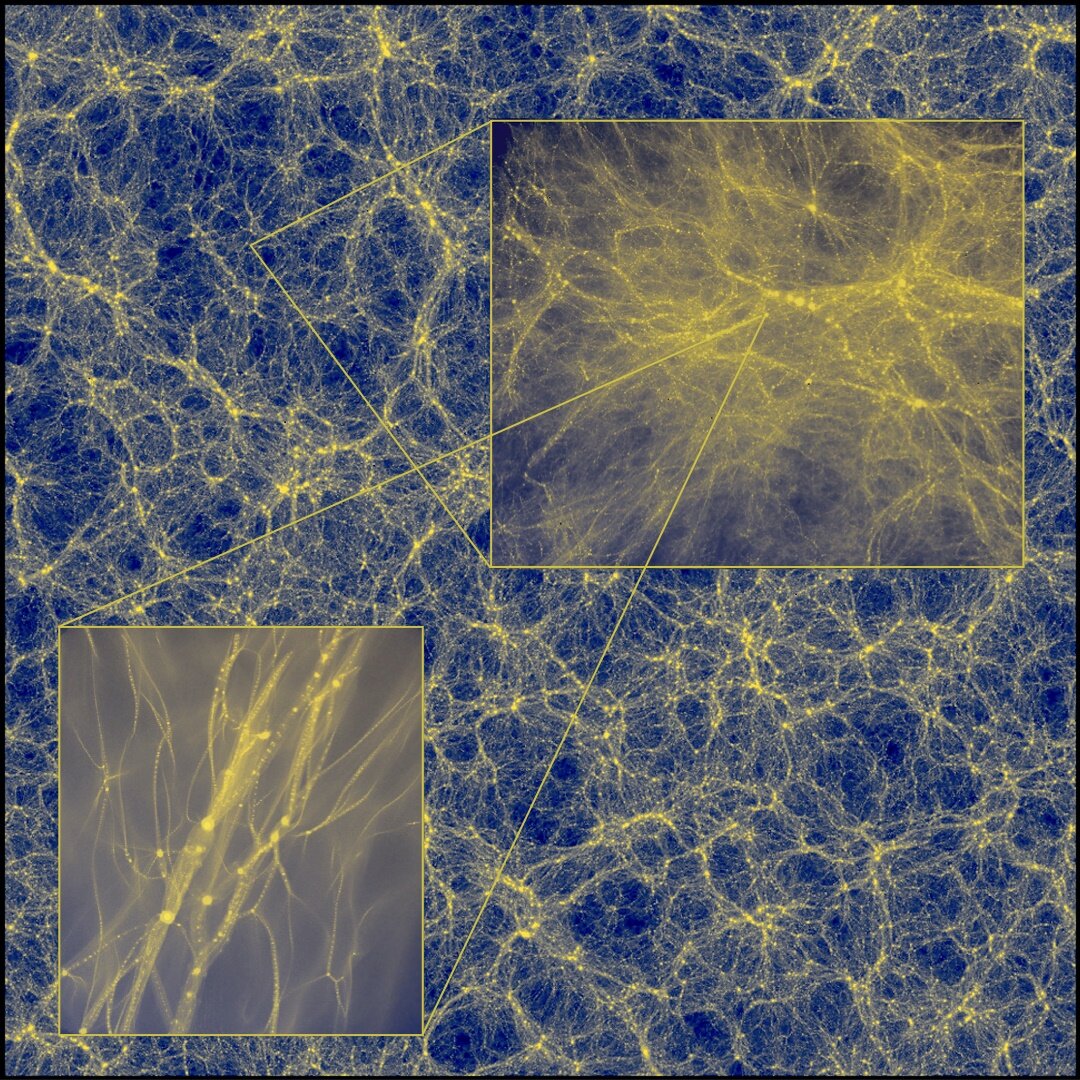 Projected dark matter density map,created by simulation, measuring 2.4 billion light years on each side. . The middle square (top right) has a diameter of just under a million light years. Smallest square (bottom left) — it's the deepest magnification: it's only 783 light-years across, 500 times the size of the solar system. In the intermediate square (top right), the largest dark matter halos have a mass similar to that of a rich galaxy cluster (a million trillion times the mass of the Sun). In the smallest square (bottom right), the smallest clearly visible halos have a mass comparable to that of the Earth (0.000003 the mass of the Sun). Credit: Dr. Sonak Bose, Center for Astrophysics, Harvard University.
The smallest are believed to have the same mass as Earth, according to current popular science theories about dark matter, which are at the heart of the new study.
Modeling was carried out usingthe supercomputer Cosmology Machine, part of the DiRAC high-performance computing system in Durham, funded by the Science and Technology Council (STFC); and computers from the Chinese Academy of Sciences.
By enlarging the virtual universe with such microscopic details, the researchers were able to study the structure of dark matter halos, whose masses range from Earth to a large cluster of galaxies.
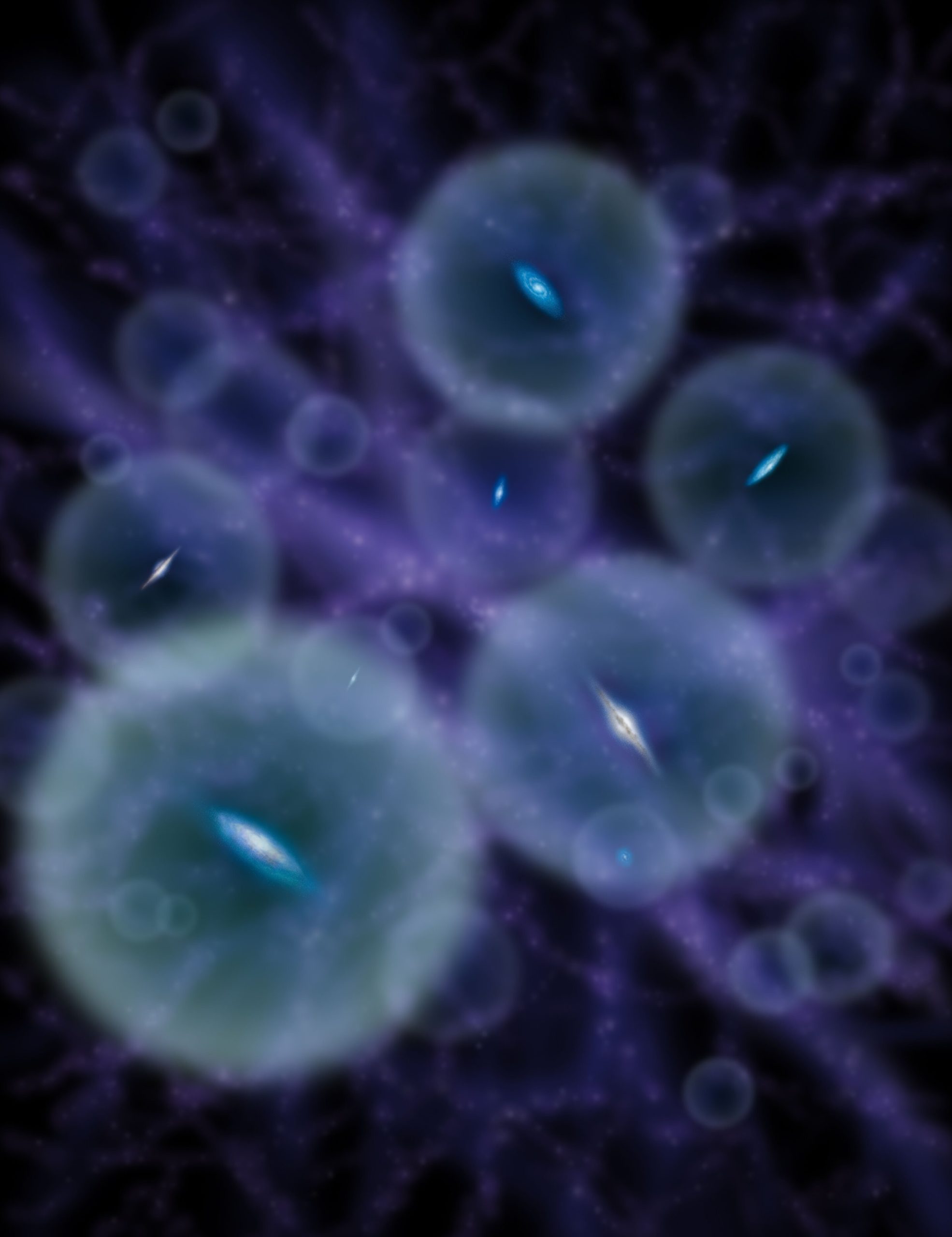 The artist's impression of the halos of dark matter of various masses in the Universe. Credit: Yu Jingchuan, Beijing Planetarium
To their surprise, they found that the halos of allsizes have a very similar internal structure and are extremely dense in the center, becoming more common, with smaller clumps orbiting in the outer regions. The researchers said that without a measurement scale, it was nearly impossible to distinguish an image of a dark matter halo in a massive galaxy from a halo with a mass that is a fraction of the sun.
We expect small dark matter haloswill be extremely abundant, they will contain a significant portion of all the dark matter in the Universe, but they will mostly remain dark throughout cosmic history because stars and galaxies grow only in halos that are more than a million times more massive than the Sun.
Professor Simon White of the Max Planck Institute for Astrophysics, Germany
“Our research sheds light on these little halos as we strive to learn more about what dark matter is and what role it plays in the evolution of the universe,” the scientists conclude.
Read also
The Andromeda halo is approaching our galaxy. We tell you why it is important
Symptoms of coronavirus in children. What you should pay attention to?
Unique molecule developed to store solar energy