Today, 35% of companies use artificial intelligence, and another 42% plan to implement it in the future. Algorithm
4 benefits of Python for AI work
Python is one of the most popular languagesprogramming in the world: it is used by 48% of IT specialists. At the end of 2022, he became a leader in the IEEE Spectrum ranking and the TIOBE index and took second place in the JetBrains survey.
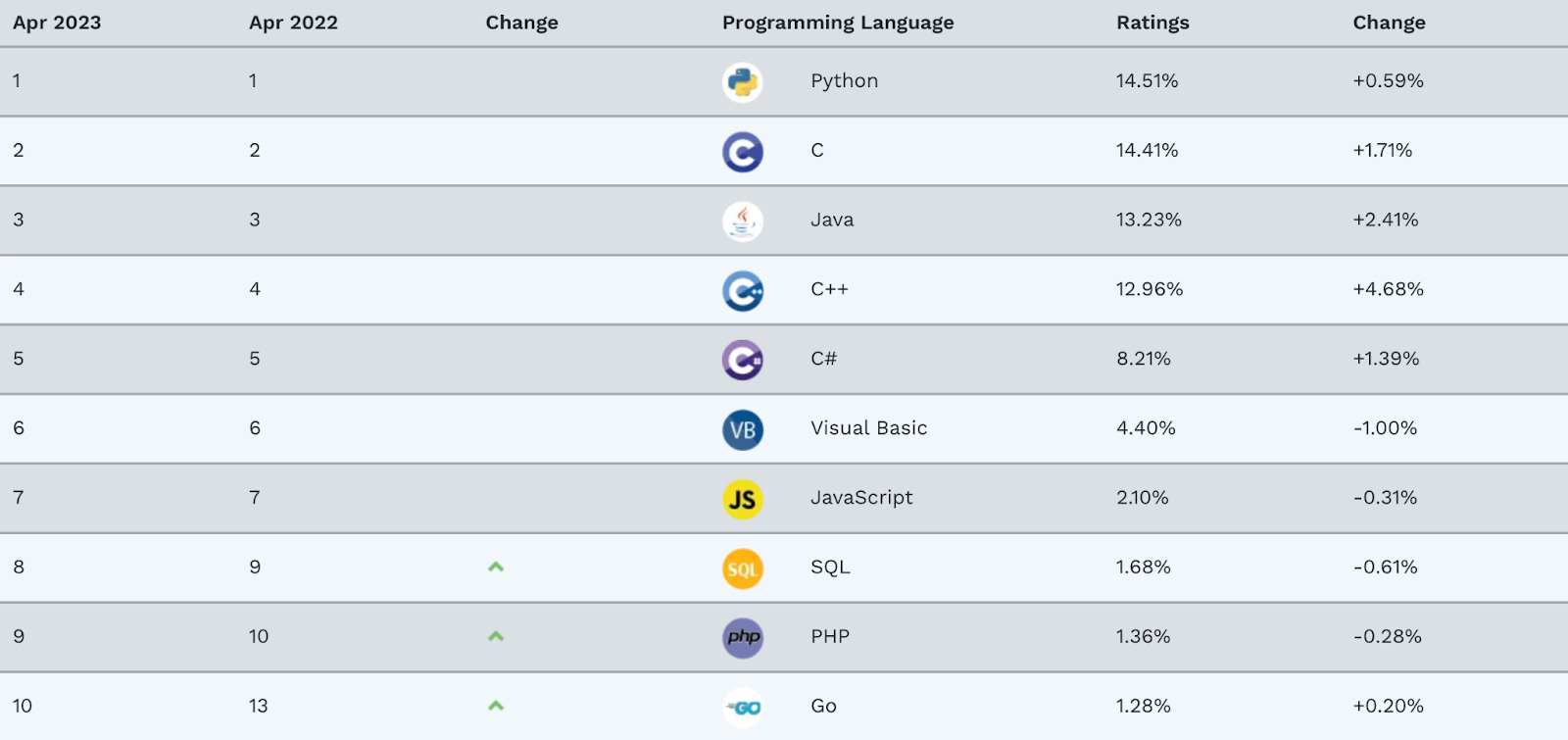
Python has topped the top popular languages in the TIOBE index for the second year.
There are several features for which Python is chosen by ML specialists:
1. Simple syntax
This principle is reflected in the philosophy of the language "Zen Python":
- Beautiful is better than ugly.
- Explicit is better than implicit.
- Simple is better than complex.
- Readability matters.
- If the implementation is difficult to explain, the idea is bad.
- If the implementation is easy to explain, the idea is most likely a good one.
The clear syntax of the language helps to test hypotheses, develop programs and debug them faster, and the simple readable code contributes to the rapid dissemination of ideas and the exchange of experience.
2. Ready libraries
In one of the most popular catalogssoftware written in Python, PyPI now has over 400 projects. Among them, for example, there are those that significantly simplify and speed up complex calculations, development of ML algorithms and work with data:

Example projects in PyPI
- TensorFlow is an open source machine learning library from Google that allows you to create and train neural networks.
- PyTorch is a competitor to Facebook's TensorFlow. This library is easier to use for users due to the easy-to-use API.
- Scikit-learn provides functionality that allows you to scale and encode data for machine learning models, as well as build and evaluate them.
- Pandas helps process and analyze tabular data, as well as prepare it for further training of algorithms.
- NumPy is designed to work with multidimensional arrays and matrices, which are widely used in data analysis.
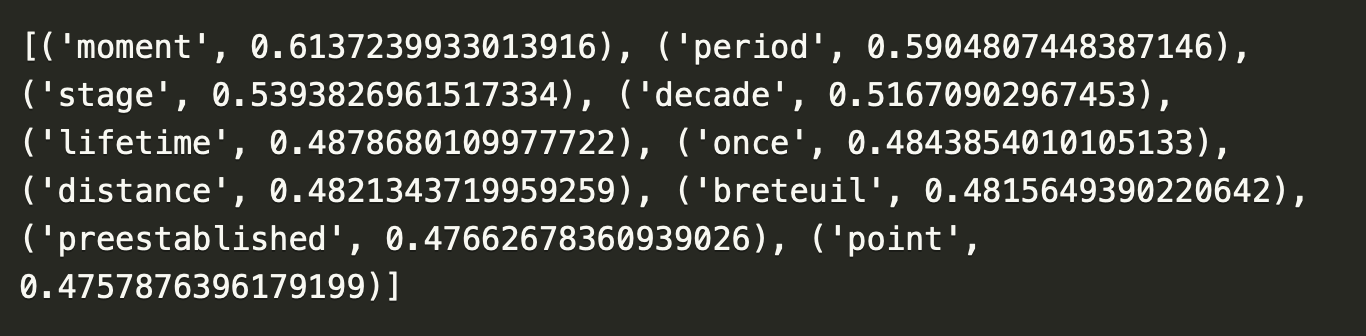
- Gensim - library for uncontrolledthematic modeling and similarity analysis of documents. It is widely used for tasks such as text summarization and document clustering. For example, if you train an AI and use the most_similar() function, you can find words that are similar to what you typed.

3. Cross-platform
The same code written in Python will bework equally well on different operating systems. This significantly speeds up the development process, since there is no need to create separate versions for Windows, Linux, macOS and, accordingly, later test each of them.
Also, programmers who write AI in Python on different operating systems can easily collaborate on a project, which helps reduce the cost of cross-platform development for businesses.
4. Community of developers
Developers who use Pythonunite in communities around the world, where they exchange knowledge in various areas of using a programming language, including machine learning. For example, MoscowPython regularly hosts meetups where programmers share their cases and best practices.
What you need to know besides Python to implement AI-based solutions
Unlike open solutions based on machinelearning and neural networks, such as ChatGPT and Midjourney, only developers with a certain technical background can develop and implement artificial intelligence technologies. Such specialists, for example, are trained in Netology on the Data Scientist course. In addition to Python, they should know:
- Higher mathematics.Solving mathematical problems helpsdevelopment of algorithmic thinking - a skill that underlies the work of any developer in the field of machine learning. To create AI tools, you need to relearn or brush up on topics from a university course:
- linear algebra (the concept of scalar, vector, matrix, tensor and actions on them);
- mathematical analysis (derivatives, vector/matrix calculus/gradient algorithms);
- probability theory and statistics (basics of statistics, basics of working with probabilities, random variables, Bayes' theorem, distributions).
- English language.Without knowledge of this foreign language, it is impossible to become a sought-after specialist in the field of AI: all new articles and developments first appear in foreign sources.
- Databases (DB)that are used to store and organizedata, on which machine learning models and neural networks are subsequently trained. To correctly retrieve information from the database, it is also important to know the basics of SQL (Structured Query Language).
What AI-based technologies can any business use
Most enterprise solutions based onartificial intelligence - internal expensive developments, the creation of which requires a team of IT specialists and managers. For example, in banks, AI is used in loan products for scoring: thanks to this, it is possible to automatically make a decision on issuing a loan. Such tools are also being implemented in production, for example, in BMW, AI is used to evaluate images of components and identify deviations from the standard in them in real time.
However, there are also technologies that any business can use: for this, they take a ready-made solution and modify it to suit their own needs.
1. Computer vision
This is a set of technologies that allowshelping neural networks process visual information from cameras. Thanks to machine vision, you can recognize barcodes, text, images, etc. people, as well as specifically their faces and movements. For example, a biometric system allows you to verify your identity for access to the office or to pay for goods and services, and at Pyaterochka it is used to “recognize” regular customers in order to automatically offer them discounts, and to identify serial shoplifters. Using the gesture recognition system, you can wave your hand to ask to switch music or change the volume of a track. Thus, Google has implemented it in mobile devices and smart speakers, and Huawei has implemented it in its flagship smartphone.
Such tools increase security and the level of service, because a person does not have to enter additional data for verification or press buttons to control equipment.
2. RPA (robotics of business processes)
According to ICT.Moscow, every second representative of medium business and 40% of small businesses use AI-based programs to automate a variety of tasks. For example, the Russian service Directum RX helps to classify incoming emails and documents by type in order to reduce their processing time, while another domestic RPA Sherpa checks counterparties before concluding an agreement.
3. Predictive models
Such tools can be used in absolutelydifferent areas: from retail (to predict sales in supermarkets, as X5 Retail Group does for each of its 16,000 stores) to logistics to plan deliveries. Thanks to the use of such technologies, it is possible to predict the demand for resources, raw materials, labor, as well as create more effective business development strategies, adjust marketing and financial operations, and improve user experience.
4. Generative models
Companies are actively implementing AI algorithms forgenerating images, text and videos into your services to improve user experience. Thus, Duolingo announced new functions in the application based on GPT-4: in one of them, the user can practice a foreign language in dialogue with the characters of the service, and in another, learn more about his answer in the lesson in order to understand, for example, why a person does one and the same error. And in modern architectural bureaus they use services for generative design, which help optimize the solutions they have come up with, for example, replacing an assembly of several parts in a drawing with the same one with one component.
Prospects for the development of AI
According to an American research companyGartner, almost all of the disruptive digital technologies planned to be released in the next 6-8 years are related to artificial intelligence, so the need to use such technologies will increase. In her research, she identified three main technological trends:
1.Self-learning algorithms,that allow you to use large arraysdata without their preliminary preparation (the so-called "markup"). This approach is most relevant for tasks related to computer vision, for example, when you need to verify hand signatures or determine the distance to an object on a video, and natural language processing tasks in which text documents are fed to the models and then the following sentences can be predicted using AI or automatically detect "toxic" phrases.
2.Neuromorphic Computingwill allow us to more accurately simulate the work of humanbrain by creating more artificial neurons in one network. For example, the OpenWorm project has already developed a copy of the nervous system of the roundworm Caenorhabditis elegans, consisting of 302 neurons. This will improve the accuracy of AI products and optimize their performance.
3.Human-Centric Artificial Intelligence(Human-centered AI, HCAI).Unlike the technologies described above, the goal of this product is not to replace people, but to make them friends with AI in the maximum number of industries and applications through collaboration. Global IT corporations such as Google are developing AI, which by default leaves a place for a person. Thanks to HCAI, specialists will be able to make better and faster decisions, and artificial intelligence will work safer and more efficiently.
In the coming years, the volume of technologies based onmachine learning and neural networks will multiply. If in 2022 the size of the global market was estimated at $136.6 million, by 2030 it is predicted to grow to $1.811.8 billion. Already today, companies that do not focus on the development and implementation of AI are not only starting to lag behind more technological organizations, but and risk their customers leaving for AI-powered competitors: Google could lose a $23 billion contract with Samsung as the latter considers replacing the corporation's search engine with Microsoft's Bing product, which integrates a chatbot. Therefore, it is desirable for a business to determine which artificial intelligence technologies it can implement in order to optimize internal processes and increase its attractiveness in the market.
Read more:
Biologists explain the evolutionary significance of masturbation in primates
Archaeologists have studied the ancient Romans buried in plaster "sarcophagi"
Named a popular sweetener that damages human DNA
Cover photo: Image by pressfoto on Freepik