Scientists have created a temperature map of dust drifting inside one of the oldest and most distant spiral
In a new study, researchers observedambiguous change in temperature in a distant galaxy. This points to two distinct sources of heat - a supermassive black hole at the center and heat given off by newly formed stars in the surrounding spinning disk.
"The temperature of galactic dust can be veryvary depending on the region in which it is located, ”the scientists explain. But most dust temperature measurements for distant galaxies in the past have been taken for the cluster as a whole, due to the instrument's limited resolution.
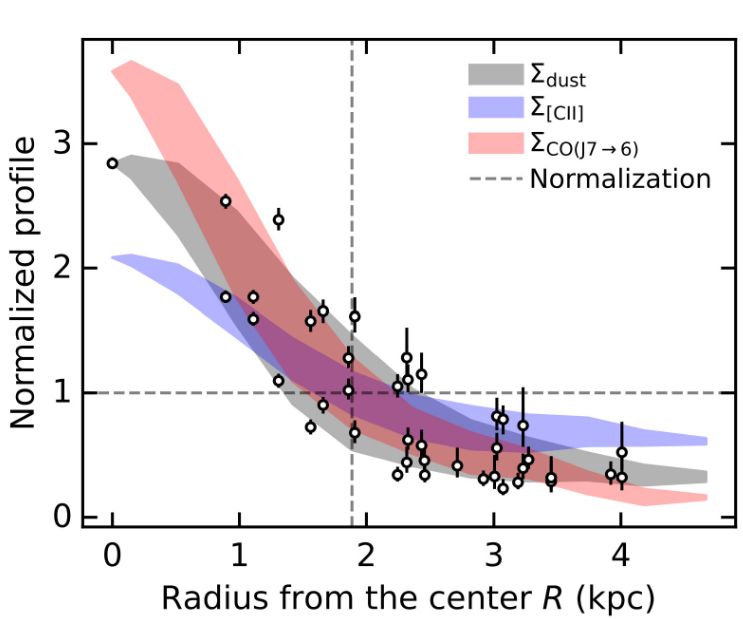 Radial profile of normalized mass surface densities of gas BRI 1335-0417.
Black dots with error bars and a black shadow show the surface density of the gas at a constant gas-to-dust ratio. All profiles are normalized to 1 at a radius of ∼2 kpc. Provided by:
Monthly Notices of the Royal Astronomical Society (2023). DOI: 10.1093/mnras/stad1464
“We were able to measure temperatures from region toregion to determine how much heat comes from individual sources. Previously, such mapping was mainly limited to nearby galaxies, ”explain the authors of the study.
Astronomers have observed a clear distinction between warmdust in the central region (from the supermassive black hole), and colder in the outer region, which is probably heated by star formation.
Most galaxies have a supermassive blacka hole in the center, the mass of which is believed to increase with the galaxy. As gas accretes towards a black hole, it is heated by collisions of fast-moving particles in the vicinity of the black hole and sometimes glows brighter than the stellar body of the galaxy itself.
The study is published in the Monthly Notices of the Royal Astronomical Society.
Read more:
A quasi-moon was found near the Earth: it has been traveling with our planet for more than 2,000 years
Researchers have shown what Pharaoh Tutankhamun looked like
Physicists first took x-rays of a single atom
Cover photo: galaxy UGC 2885, NASA