Radio relics are diffuse elongated radio sources of synchrotron origin. They meet in
SPT-CL 2023-5535 (abbreviated CL2023) presentsis a massive merging galaxy cluster with a redshift of 0.23 and a size of about 727,000 light years. The presence of diffuse radio emission in this cluster was assumed in previous studies. However, due to the insufficient spatial resolution of these observations and the presence of several bright neighboring radio point sources, this hypothesis has not yet been confirmed.
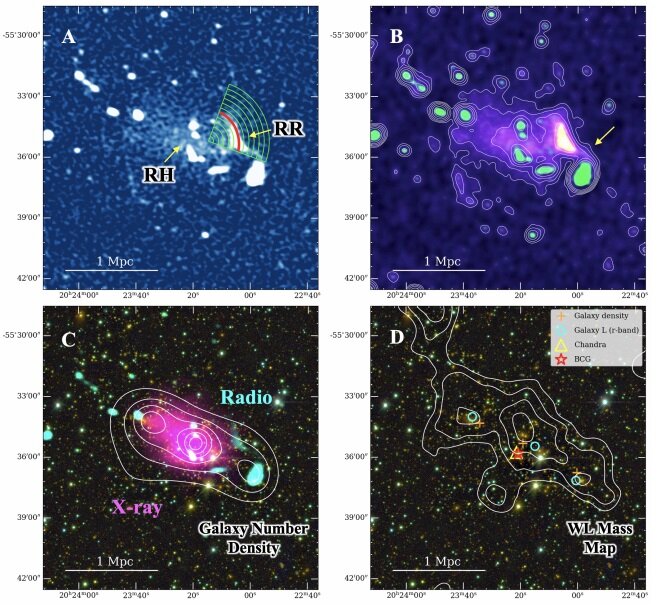 Multi-wavelength observations CL2023. Credit: Hyeong Han et al., 2020.
Recently confirmed by the groupastronomers led by Kim Hyun Han of Yonsei University in Seoul, Republic of Korea. Scientists report the discovery of a radio relic in CL2023 as a result of analysis of deep, high-resolution radio imagery "ASCAP" - Evolutionary Map of the Universe (EMU). The study was complemented by data from the 4-meter Blanco telescope at the Cerro Tololo Inter-American Observatory and NASA's Chandra X-ray spacecraft.
We report the detection of a radio relic in the merging cluster SPT-CL 2023-5535 at z = 0.23 from the ASKAP-EMU 300 sq. pilot study. Hail (800−1.088 MHz).
Extract from the original study
According to research, the relic in CL2023extends over approximately 1.6 million light years. Scientists have discovered that the source of the radiation is located at the western edge of the radio halo. Radio halos are large-scale sources of diffuse radio emission located in the centers of some galaxy clusters.
The radio flux density of the relic was calculated forlevel of about 16.2 mJ, while its extrapolated radio flux density at a frequency of 1.4 GHz was measured at about 12.0 mJ. It was found that the integrated spectral index of the relic is at the level of -0.76.
In addition, studies have confirmed that CL2023is indeed a massive system, as its total mass was estimated at about 1040 trillion solar masses. It was also found that CL2023 consists of at least three subclusters.
Astronomers have concluded that CL2023 is a post-merger system in which two of its subclusters may have suffered a major collision between 200 and 300 million years ago.
Read also
Look at the 3D map of the Universe: it was compiled for 20 years and it has already surprised scientists
Look at beetle larvae: they can save the planet from plastic by destroying it
How do we age? Scientists have a new explanation