Researchers from the Massachusetts Institute of Technology have developed elastic artificial muscles,
Tiny rectangular robots designedengineers, move with the help of wings. They are driven by dielectric elastomer actuators, which are soft artificial muscles. They are made from layers of elastomer that are sandwiched between two razor-thin electrodes and then rolled into a soft tube. When voltage is applied, the electrodes compress the elastomer and, as a result, the robot flaps its wing.
Microscopic defects can cause sparks,which will burn the elastomer and cause the device to fail. To avoid such a problem, engineers use "self-cleaning". The impact of high voltage on the damaged area of the dielectric elastomer leads to disconnection of the electrode section located near the defect. As a result, the problem area is separated from the rest of the electrode, and the artificial muscle continues to work.
Restoring the ability to fly after being damaged. Video: Suhan Kim et al., Science Robotics
To improve the efficiency of this process,engineers have optimized the concentration of carbon nanotubes that make up the electrodes. Fewer carbon nanotubes improve self-cleaning as it reaches higher temperatures and burns more easily. But this also reduces the power density of the drive. The researchers determined that the right balance facilitates self-cleaning and preserves the mobility of the device.
In addition, researchers have shown that largedefects can be eliminated with a laser. The laser accurately cuts out more damage along the outer contours. Engineers can then use self-cleaning to burn out the slightly damaged electrode, isolating the problem area and restoring the wing's flight characteristics.
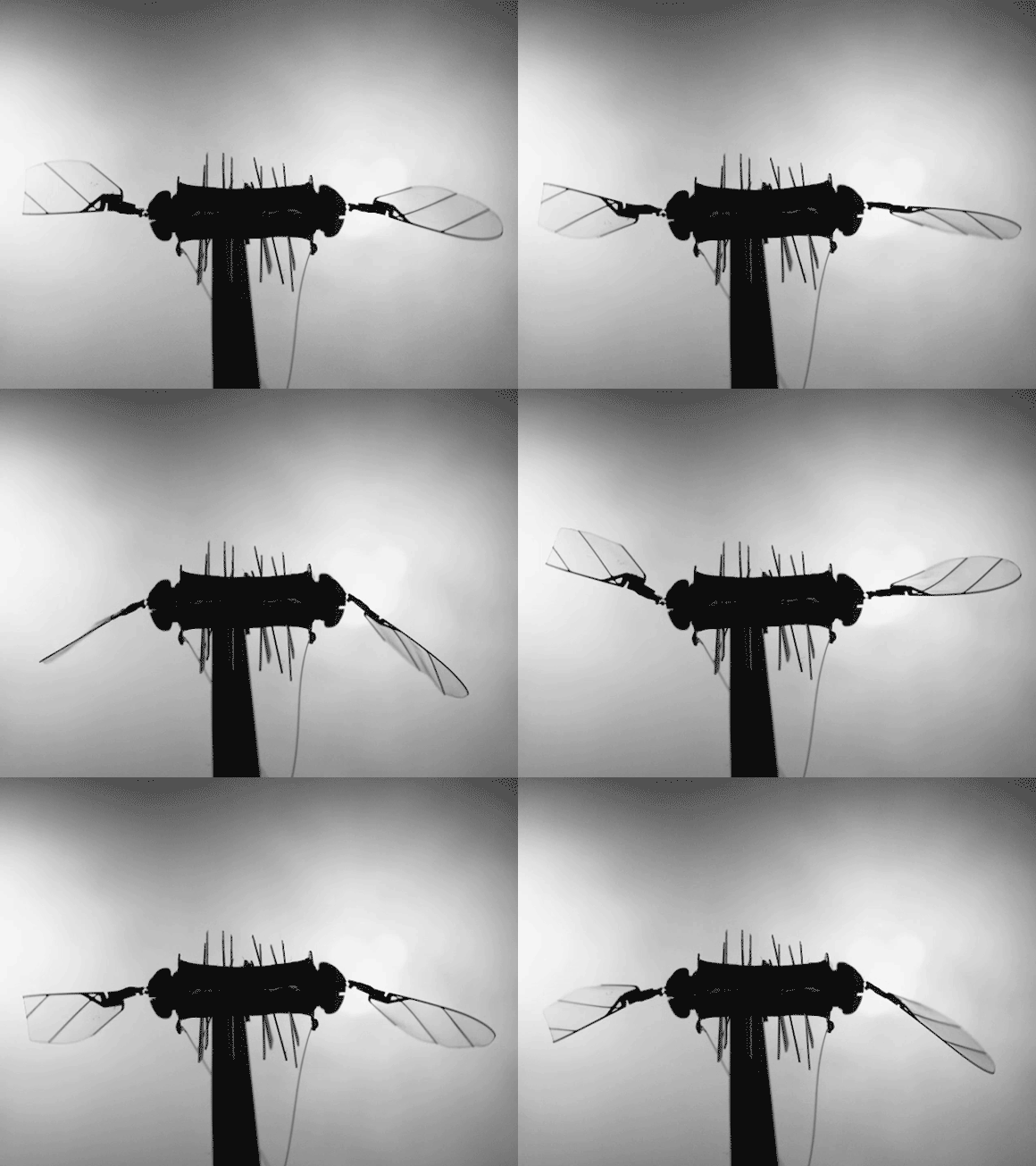 Flight of a robot with a damaged wing. Image: MIT
In a series of experiments, the engineers showed that withUsing this technology, you can restore the ability to fly after various injuries. The robot, which had 20% of one wing cut off and 10 punctures made in the other, successfully continued flying after self-cleaning. The new technology will increase the "endurance" of robots in real conditions. Swarms of such devices can be used, for example, to inspect a collapsing building during a fire.
Read more:
The secret of longevity is revealed: scientists have figured out how to start the necessary mechanism in the human body
Named a new cause of autism
2,700-year-old temple found in Sudan He surprised scientists
On the cover: a robot with a damaged wing. Image: MIT