Researchers from Heriot-Watt University and the University of Edinburgh demonstrate a prototype
Engineers have developed a lidar system thatuses a green pulsed laser source to illuminate the shooting area. Reflected pulsed illumination is detected by an array of single photon detectors, providing ultra-fast detection in low light and greatly reducing measurement time in low light environments.
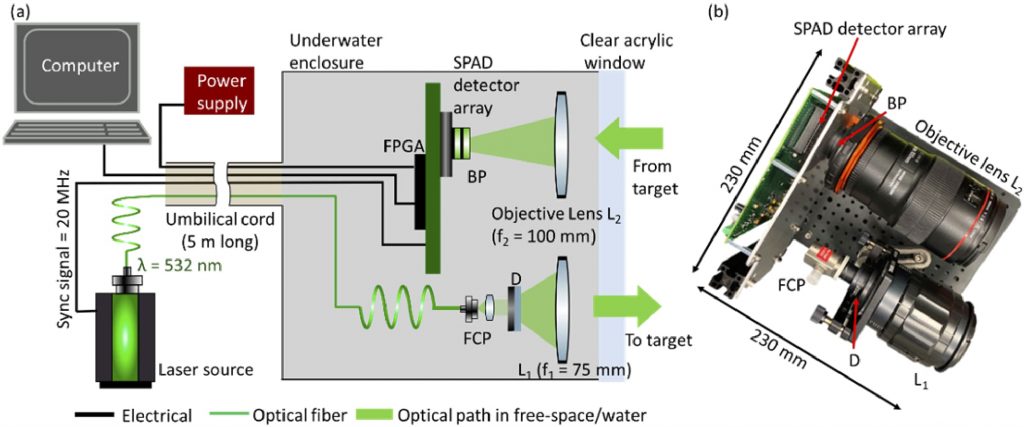 The principle of the device and the prototype of the lidar system for underwater photography. Image: Aurora Maccarone et al., Optics Express
This approach requires thousands of single-photondetectors, each generating hundreds of events per second. This makes it extremely difficult to acquire and process the data needed to quickly restore a 3D image, especially for real-time applications. To solve this problem, the researchers developed algorithms for imaging under strong scattering conditions. They can run on regular graphics processing units (GPUs).
Acquisition of 3D images through ocean water -difficult task. The devices use reflected light, and any particles in the water will scatter the light and distort the image. But the detection of single photons, based on quantum technology, provides very high penetration and works even in low light conditions.
 A 3D image obtained during testing of a prototype device. Animation: Aurora Maccarone, Heriot-Watt University
The researchers tested the system ina tank to which a dispersing agent has been added to make the water cloudier. Experiments with three different levels of turbidity have demonstrated successful lidar imaging at distances of up to 3 m. Engineers are working to reduce the size of the system so that it can be integrated into a submersible.
Read more:
Scientists first saw how a star devours the planet: this, in the end, is waiting for the Earth
Two super-Earths found on the edge of the habitable zone: one of them has a comfortable temperature
Modern humans migrated to Europe differently than previously thought
On the cover: Image from wirestock on Freepik