Authors of a new, potentially controversial study suggest that the expansion of the universe couldbe
The new new approach is described in detail in an article published in the journal Classical and Quantum Gravity and Lucas Lombreiser, Professor of Theoretical Physics at the University of Geneva.
What is the expansion of the universe?
According to the generally accepted theory, the universe was bornalong with the Big Bang and looked like a very hot and dense point. After unimaginably small fractions of a fraction of a second, the expansion of the Universe (or inflation) began. Space itself expanded faster than the speed of light. During this period, the universe has grown in size at least 90 times.
According to NASA, after inflation, the growth of the universecontinued, but at a slower pace. As space expanded, it cooled and matter formed. A second after the Big Bang, it was filled with neutrons, protons, electrons, antielectrons, photons, and neutrinos.
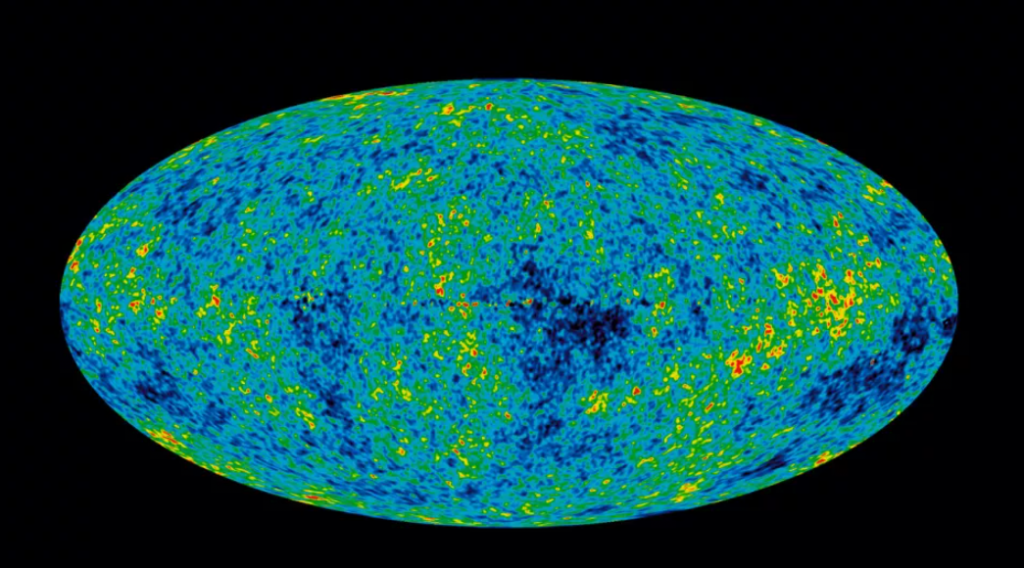 This image of the entire sky shows the nascent universe. It shows temperature fluctuations that are 13.7 billion years old. Image courtesy of NASA
Approximately 380,000 years after the Big Bangmatter cooled down enough to form atoms in the era of recombination, which led to the formation of a transparent, electrically neutral gas. However, after that moment, the universe plunged into darkness, since neither stars nor any other bright objects had yet formed.
Approximately 400 million years later, the Universe beganemerge from the cosmic dark ages into the era of reionization. During this time of more than half a billion years, enough clumps of gas collapsed to form the first stars and galaxies, whose energetic ultraviolet light ionized and destroyed most of the neutral hydrogen.
Although the expansion of the universe has gradually slowed downas matter was attracted to each other under the influence of gravity, about 5 or 6 billion years after the Big Bang, according to NASA, a mysterious force (dark energy) began to accelerate the expansion of the universe. It is believed that this process continues today.
Evidence for expansion and the cosmological constant
Scientists know that the universe is expanding due toredshift, stretching the wavelength of light towards the redder end of the spectrum as the object emitting it moves away from us. Distant galaxies have a greater redshift than those closest to Earth. This suggests that these galaxies are moving further and further away from us.
More recently, scientists have found evidence thatthat the expansion of the universe is not fixed, but is actually accelerating. There is a term for this phenomenon known as the cosmological constant or lambda.
What is the problem?
The cosmological constant was a headachefor cosmologists, because particle physics predictions of its value differ from actual observations by 120 orders of magnitude. Therefore, the cosmological constant is called "the worst prediction in the history of physics."
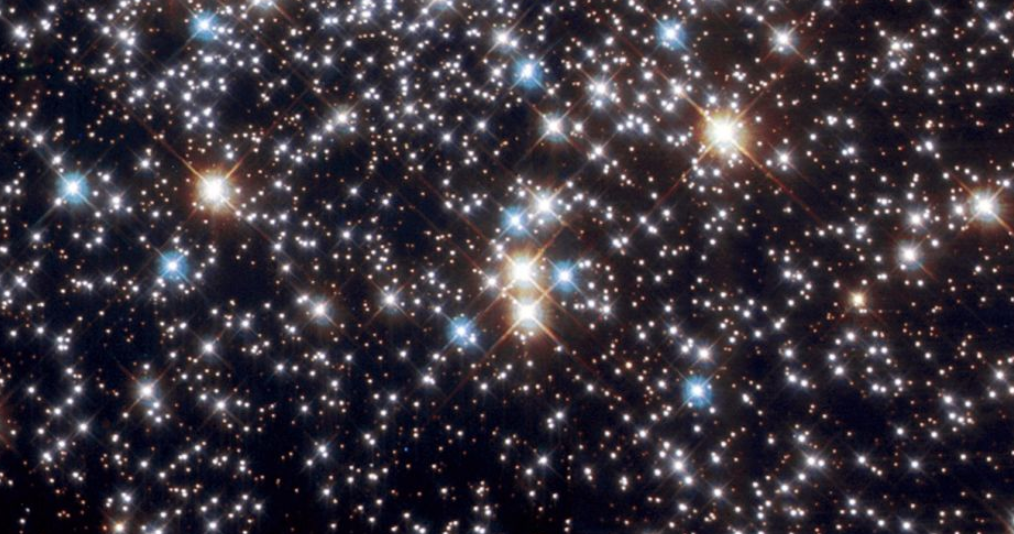 Globular cluster NGC 6397. Image courtesy of NASA/Francesco Ferraro/Bologna Observatory
Cosmologists often try to resolve the discrepancybetween different lambda values, suggesting new particles or physical forces. But the authors of the new study solved this problem by rethinking the existing versions.
What does the new study suggest?
In the mathematical interpretation of LombreatherThe universe is not expanding, but is flat and static, as Einstein once believed. The observed effects that indicate expansion can be explained by the evolution of the masses of particles such as protons and electrons over time.
In this interpretation, the particles arise from the field,pervading space-time. The cosmological constant is determined by the mass of the field. Since this field fluctuates, the masses of the particles generated by it behave in the same way. The cosmological constant still changes with time, but in this model, this process is due to the change in the mass of particles over time, and not to the expansion of the universe.
Field fluctuations lead to large reddisplacements of distant clusters of galaxies than traditional cosmological models predict. Thus, the cosmological constant remains true to the model's predictions.
Dark Universe Recipe
The new structure of the Lombreather also solves someother pressing problems of cosmology, including the nature of dark matter. This invisible material outnumbers ordinary particles of matter by a ratio of 5 to 1, but remains incomprehensible because it does not interact with light.
The physicist suggested that field fluctuations alsocan behave like an axion field. In this case, axions are hypothetical particles, which are considered one of the proposed candidates for the role of dark matter.
These fluctuations can also "do away" with the darkenergy, a hypothetical force that is stretching the fabric of space and thus pulling galaxies apart faster and faster. In the new model, the effect of dark energy will be explained by the masses of particles, which at later times in the Universe chose a different evolutionary path.
Read more:
A quasi-moon was found near the Earth: it has been traveling with our planet for more than 2,000 years
Researchers have shown what Pharaoh Tutankhamun looked like
Physicists first took x-rays of a single atom
</ p>