What is the problem?
From year to year the world does not become more secure and stable. The COVID-19 pandemic is a direct result
AI is ubiquitous today.Humans have robots for cleaning, playing, making drinks with simple voice commands. Modern high-tech gadgets perform everyday tasks of varying complexity in order to facilitate a person's daily life. And sometimes robots are even better at these tasks than humans.
In 2020, we have robot baristas and robot cleaners. Is it time for robot therapists?
According to a recent study by technologicalof Oracle and HR consultancy Workplace Intelligence, 82% of people surveyed in 11 countries believe robots can support their mental health better than humans. It also found that the COVID-19 pandemic has exacerbated work-related stress in many people. This negatively affected the mental health of 78% of those surveyed.
Previous research has also noted an increase in mental health problems, especially among young people. Most of the problems were related to the use of social media.
Due to the lack of specialists in the fieldmental health and social workers in many countries, some experts believe that the use of robots can help clinics diagnose people, giving psychiatrists and psychologists more time to consult more patients.
For example, Singapore remains one of the mostoverworked cities in the world and needs to improve mental health services. The government plans to take action to address the mental health crisis, and Prime Minister Li Hsien Loong raised the issue in a recent speech.
How can AI help?
“AI will definitely help with the automation of routinetasks such as psychometric assessments or IQ tests, which will give us the opportunity to do other things, ”Desmond So, a practicing psychologist at Singapore-based Annabelle Psychology, told VICE News.
In addition to diagnostics, the AustralianCenter for Robotic Vision and the Queensland University of Technology has shown that social robots have tremendous potential to help people cope with depression, drug and alcohol abuse, and eating disorders.
“The beauty of social robot intervention isthat they can help bypass the potential negative effects of personal therapy with the practitioner, such as perceived judgment or stigma, ”said Dr. Nicole Robinson, co-author of the study.
As the study of MunichUniversity of Technology, robots can also pave the way for new therapies, opportunities to interact with hard-to-reach populations and improve patient response.
Why do people prefer robots?
According to an Oracle survey, only 18% of peoplewould prefer humans to robots to support their mental health, as they believe robots provide a judgment-free zone, an unbiased opportunity to share concerns and quickly answer health-related questions.
Scientists have used technology to make it easierhuman life and make the world a better place. The question remains: how far can artificial intelligence go? Can he influence people in the mental aspect? Can AI technology treat anxiety and depression?
The neural network helps to understand if a person has depression
Researchers at Massachusetts Institute of TechnologyInstitute has developed a neural network model that can detect depression in speech patterns in recorded text and audio conversations. In the future, the model could be added to mobile apps that track the user's text and voice for mental health problems. This can be especially helpful for people who are unable to go to a psychiatric clinic for a correct diagnosis due to distance, cost, or even anxiety due to being vulnerable to a therapist.
In the future, such technology may helpmany people with depression. However, at the moment, AI is not yet accurate enough, since the process depends on the specific answers of a person to specific questions. Therefore, this limits how and on whom this model can be used.
On the other hand, the researchers discussed the modela neural network that can be implemented in the future, for example, in mobile applications. The model can now indicate depression through speech patterns and typing. However, scientists hope that the modified model will be able to distinguish between depression during casual conversation.
If the AI model is successful, it will help those people with depression who cannot get help due to distance, high cost of medical care, or other circumstances.
What robots can help cope with anxiety, depression, and loneliness?
Research has shown that hugging and showingCaring for pets stimulates high levels of dopamine and oxytocin. Scientists claim that caring for a pet reduces anxiety, depression, and loneliness. In addition, pets help develop a healthy lifestyle, such as increasing physical activity, meeting new people, etc. All these help in the treatment of mental disorders. But animals do not experience human emotions, although they sometimes feel human depression and anxiety. They help their owners cope with their anxiety by simply playing, being nearby and communicating in a unique way. Can a robot to do the same?
- Robot Vector communicates with the user
Take, for example, the Vector robot. This gadget with AI technology is a small robot. Really small - the size of a palm.
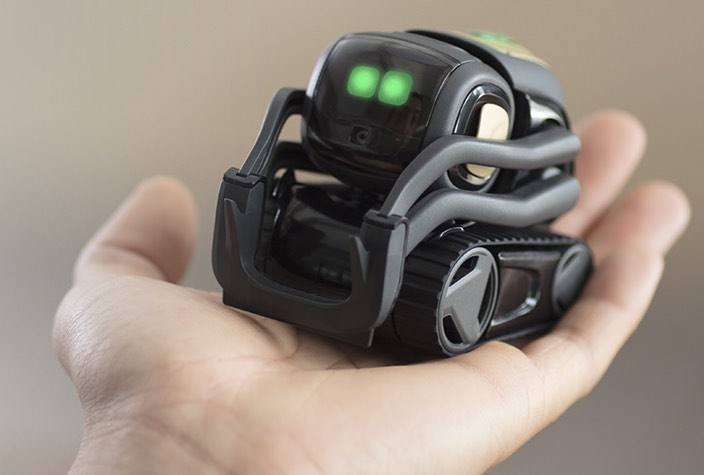
You can say that this robot has a curiousand an attentive nature that makes him think and act like a pet. He gets sad when ignored, angry when he loses in games, and excited when he sees his owner.
Vector is a companion designed to communicateand help. Featuring artificial intelligence and advanced robotics, the robot is voice activated and answers questions, takes photos for you, sets dinner times, shows you the weather and much more. Voice features are currently only available in English. By the way, the robot can move and charge independently. He recognizes people and avoids obstacles.
While the robot has not been proven to reduce depression and anxiety, it can act like a pet, but with a more intelligent background.
- EMAR robot inspired by teens and built for teens
EMAR V1 robot prototype based onteenage drawings and ideas, is a small, square, tabletop robot. After a series of studies, a team of scientists led by Elin Björling, Ph.D., from the University of Washington, created EMAR V6.
EMAR is a fully customized program,developed by Maya Cakmak, Ph.D. She created a simple visual programming tool for users. This means that our teenagers themselves can customize the robot to their needs. It is able to measure stress and mood levels using a touch screen and communicating with users through dialogue.
Also, the robot has a "Hug" function,users can literally hug the robot. In the process, EMAR's tactile sensors provide a pleasing audible response and visual pattern via LED indicators. There are many known physiological benefits of cuddling, including the release of endorphins, oxytocin activation, and the positive aspects of social bonding through touch. Scientists have tried to replicate this process with a robot.
The EMAR robot is still in the processdevelopment, but can already help a teenager complete a short exercise. It will tell the young user how to identify and understand their emotions. It is the understanding of emotions that leads to “liberation” from it. This, in turn, reduces stress levels.
- Compassionate robot Buddyfor children and elderly people in hospitals. And not only
Advances in research and healthcare deliveryaid have reduced mortality from disease and increased life expectancy in developed countries. However, chronic illness, long-term treatment and hospitalization are still associated with emotional stress. Patients who have undergone more than one hospitalization often experience physical and emotional stress, as well as a sense of powerlessness.
Research shows that children and older peoplecan benefit psychologically and socially from the reliable and friendly assistance of a smart robot. This allows them to better cope and live in emotionally challenging circumstances. Blue Frog Robotics' Buddy robot can help with this.
Company representatives claim thatBuddy's emotional range creates an empathetic connection with patients, making it the perfect companion to support hospitalized children and aging patients with chronic or recurrent conditions. However, why not use it to help middle-aged people too?
What is the problem of using AI in the treatment of mental disorders?
Researchers from the Technical UniversityMunich (TUM) studied the ethical implications of robotic therapists and found that robots can manipulate people more easily. Then comes the question of empathy, a quality that will be difficult to replicate as it cannot be fully automated or programmed, at least not right now.
In an interview with VICE News, a 20-year-old residentSingaporean Jolene Pan said she is seeing a psychologist because of her anxiety. She admitted that while she understands the mental health benefits of robots, she still needs "human connection."
“When I go to counseling, I need someone towho has emotions and who can sympathize. Robots or artificial intelligence systems, of course, help to a certain extent… But when it comes to more complex problems, such as deep-seated family problems or complex conflicts in relationships, I feel that AI will not be able to meet my needs.”
Sokh said this human connection is critical to effectively tackling mental health problems.
“Although the robot can be programmed tosay certain things, everything is different when you get feedback from another person who may have their own difficulties, ”the scientist concludes.
Read also
The Doomsday glacier turned out to be more dangerous than scientists thought. We tell the main thing
Found the alleged kingdom of the disappeared Hittites. What have archaeologists found?
An enzyme was discovered that reverses cell aging