Researchers at Washington State University have created a way to 3D print two types of steel in one circular
Engineers "borrowed" the idea for printing fromnature: they noticed that trees and bones get additional strength from the fact that multi-layered rings of different materials interact with each other. To mimic this property with metals, the researchers used common, relatively inexpensive welding equipment used in automotive and machine shops.
Для 3D-печати исследователи интегрировали welding machines with computer numerical control. The finished machine creates parts using precise computer programming and two welding heads.
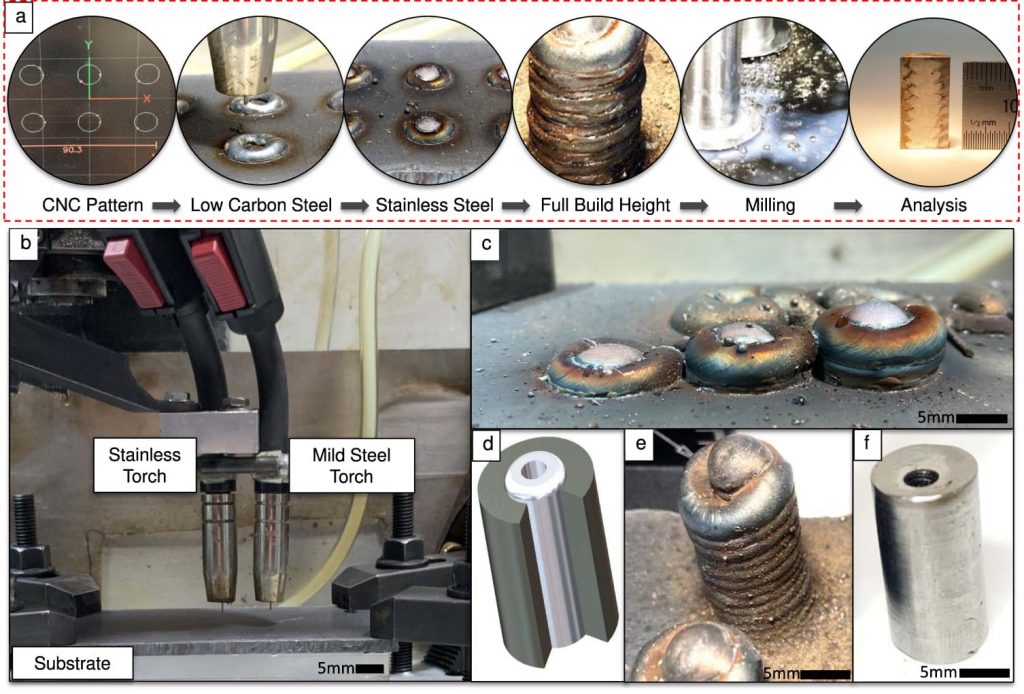 The principle of operation of the installation and finished products. Image: Lile Squires et al., Nature Communications
During the demonstration, two welding headsworked one after the other on a circular layer to print two metals, each with specific advantages. A corrosion-resistant stainless steel core was created within an outer casing of cheaper "mild" steel, similar to that used in bridges or railroads.
Since metals are compressed at different rates whencooling, an internal pressure is created that pulls the metals together. Performance tests showed greater strength than stainless steel or mild steel alone.
3D printing using two types of metal. Video: Washington State University
Modern 3D printing methods by severalmetals require stopping the welding installation and replacing the metal wires. The new method eliminates this pause and places two or more metals in the same layer while the metals are still hot. It is this feature that allows for simultaneous cooling of materials.
This method deposits metals in a circle, not justalong the line. Thus, he departs fundamentally from what was possible. The circular movement essentially allows one material to sit tightly against another material, which cannot happen when printing in a straight line or in multi-layers.
Lyle Squires, doctoral student in mechanical engineering at the University of Washington and study co-author
Read more:
See 100 lightning bolts that hit the ground and water during a thunderstorm in Turkey
An artifact resembling a phallus was found in Mongolia: it is about 42,000 years old
Found the tallest tree in Asia: show how it looks