What assessments are we talking about?
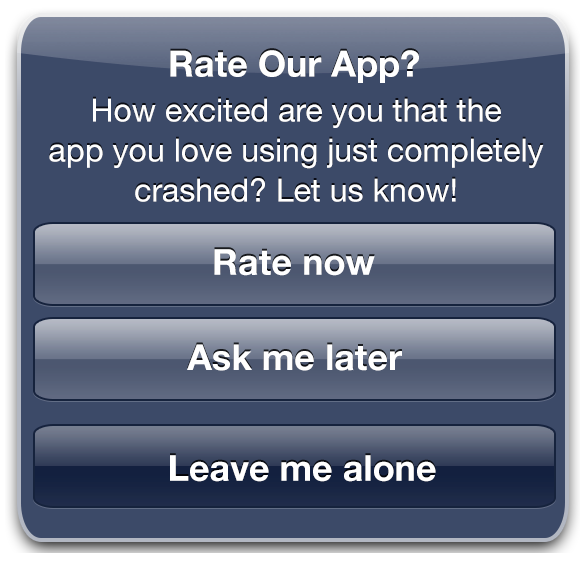
It's about rating the apps you've downloaded from the App Store. Any time
What do grades affect?
App rating can positively or negatively affect aspects of how users find apps.
- In the App Store, ranking affects search results and ranking. Apps that have a large number of positive reviews are in the top above and keep this position longer.
- Apps with positive reviews are higher in the search results.
- Personal observation - seeing an app's 3.5 star rating makes users less likely to open it.
What did the FT journalists find out about the manipulation of the developers?
Apple's official policy prohibitsdevelopers get high user ratings and rise higher in the App Store ratings by fraudulent means. However, companies use more sophisticated manipulation methods that rely on behavioral psychology, the Financial Times found.
For example, gaming applications will askranking immediately after a player earns a high score. Banking applications can ask for an estimate on payday. The sports app will ask you to rate it when the user's team wins.
Developers know when not to ask: for example, a news application will not ask for a review after a user has read a material about someone's death, the newspaper points out.
The competition between apps is great, sogetting a high score is critical, FT stresses. According to Apptentive, a service that helps businesses measure user feedback, a rating upgrade from two to three stars can increase downloads by 306%, and from three to four stars by 92%.
According to Gummicube, four out of five users don't trust apps with ratings below four stars.
With the advent of iOS 11, Apple provideddevelopers are able to offer to rate the application. Users no longer need to specifically go to the App Store to rate the application - such a system attracted mainly disappointed users, the publication notes.
Instead, the company offered "tips inapplication ”, which gave the result. According to Apptentive, the average number of ratings per app has increased from 19,000 in 2017 to over 100,000 in 2019. For comparison, on Google Play, ratings have climbed from 33,000 to 43,000 on average.
This update allows developersexploit loopholes and push users to inflate ratings, critics say. However, Apple is fighting unfair practices and threatening developers with blocking for this, adds FT. In an interview with the publication, the company said that it removed applications from the App Store and developers from the Apple Developer Program for violating the rules.
 Icon: FT
Are there any examples of how rating abuse works?
Subway, diner chain, fought the bad onesapp ratings for years. But literally in the first two weeks of 2018, his score jumped from 1.7 to 4 stars. A note to the software update said it fixed a few minor bugs, while the main new feature was "making it easier to evaluate the application and provide feedback."
On August 5, Android developers began to offer rating tips in the app. And app ratings on Google Play began to grow in the first week, although before that they had remained stable for years.
How did Apple react to the accusations?
Apple claims that developers whotry to deceive the system, for example, by manipulating ratings, they will be removed from the App Store. But companies have found legal loopholes in the rules and even pointed to Apple's own recommendations for tips in applications.
Our App Store guidelines clearly state,that any developer who tries to trick the system, for example by manipulating ratings or how their app appears in search results, can be removed from the developer program and the app from the store.
Apple Representative
For developers, we introduced a limit on demandratings from individual users up to three times a year for each application. But this played into the hands of large companies that could invest more money in prompting algorithms. As a result, even mediocre apps receive an average rating of 4.5 stars. It is difficult to determine exactly how much the ratings have skyrocketed, as Apple does not provide complete data on them. But for the seven largest U.S. banking apps, ratings, which ranged from 1.2 to 4.9 stars in early 2017, now average 4.8 stars.
Even the apps ranked 50th in popularity in shopping, lifestyle, finance, travel and entertainment categories have a rating of at least 4.8 stars on the App Store.
How does this affect the Russian developer market?
The situation on the Russian market continuesremain in question. Let us remind you that on Monday, September 7, the State Duma appealed to the FAS with a request to conduct a check in relation to Apple. The document states that domestic developers have repeatedly appealed to Gorelkin with complaints that they cannot register an account in the Apple system, without which the appearance of the application in the App Store is impossible.
Russian developers, according to the deputyAndrei Gorelkin, they repeatedly complained to him about the identity verification algorithm in the Apple system, without which it is impossible for the application to appear in the App Store online store. To pass identification, the developer must pay for the account through a payment address - but the format of the information provided by Russian banks does not meet Apple's requirements, the deputy said. As a result, developers are forced to buy accounts registered in the USA and China “on the black market”. They cost $300–500, the deputy says.
According to him, for developers from the United States and China, there is a different algorithm for confirming identity - through popular payment systems, which is not available to Russian companies.
The result is a situation in whichRussian developers in some cases cannot even get into the application market to make money from their program. And if one of the primary qualifications has been passed, all that remains is to work in a system in which some of the competitors will be in obviously advantageous positions.
What do the experts say?
If most companies will usemachine learning algorithms to recognize user sentiment, App Store ratings will actually lose their meaning, experts say. This could have far-reaching implications, especially considering that App Store trade exceeded $ 500 billion last year, more than the GDP of most countries.
Such tactics are hidden fromusers, but known among developers - caused massive manipulation of the ratings and became so popular that it is difficult to find a large company that does not do it.
Brian Levin, vice president of the consulting company Mobiquity
Read also
Look at the 3D map of the Universe: it was compiled for 20 years and it has already surprised scientists
Scientists have found out why children are the most dangerous carriers of COVID-19
It turned out that made the Mayan civilization leave their cities