What are biofuels?
Solid, liquid or gaseous fuels obtained from relatively recently
Globally, biofuels are most oftenused for powering vehicles, heating homes, and cooking. The biofuel industry is expanding in Europe, Asia and America. Recent technology developed at Los Alamos National Laboratory even converts pollution into renewable biofuels. Agrofuels are biofuels that are produced from certain crops and not from wastes such as landfill gas emissions or processed vegetable oil.
There are two common production strategiesliquid and gaseous agrofuels. One is to grow crops that are high in sugar (sugarcane, sugar beets, and sweet sorghum) or starch (corn) and then use yeast fermentation to produce ethyl alcohol (ethanol). The second is the cultivation of plants containing large amounts of vegetable oil, such as oil palm, soybeans, algae, jatropha or pongamia pinnata. When these oils are heated, their viscosity decreases and they can be burned directly in a diesel engine, or they can be chemically treated to produce fuels such as biodiesel. Wood and its by-products can also be converted to biofuels such as wood gas, methanol or ethanol. It is also possible to produce cellulosic ethanol from non-edible plant parts, but this can be economically difficult.
Solid biomass is also used. Many materials, such as wood and grass, can be dried, granulated and burned; it can be used to generate energy. Although this produces some clinker, less energy is used in the treatment, which can result in higher overall efficiency. Clinker is a high-strength, frost-resistant additive, an environmentally friendly product obtained from special refractory shale clays and fired at temperatures up to 1200 ° C.
Development of models for the creation of biofuels
John Field, Research Fellow, Ecology LabNatural Resources at CSU, said it was challenging to demonstrate the commercial viability of cellulosic biofuels created using inedible plant parts before biofuel production. Wheatgrass, an indigenous herb found in many parts of North America, is a leading candidate for sustainable production of plant material.
The research team usedmodeling for millet cultivation schemes, cellulosic biofuel production, carbon capture and storage, ecosystem tracking and carbon fluxes. The scientists then compared this modeling to alternative ways of storing carbon on earth, including growing forests or grasslands.
What is carbon capture and storage?
Carbon capture and storageCarbon capture and storage (CCS) is a technology that can capture up to 90% of carbon dioxide (CO2) emissions generated by the use of fossil fuels in power generation and industrial processes, preventing carbon dioxide from entering the atmosphere. Additionally, using CCS with renewable biomass is one of the few carbon reduction technologies that can be used in a “carbon negative” manner—effectively removing carbon dioxide from the atmosphere.
The CCS chain consists of three parts:carbon dioxide capture, carbon dioxide transport, and secure storage of carbon dioxide emissions underground in depleted oil and gas fields or deep saline aquifers.
First, technology capture allows for separationcarbon dioxide from gases generated during power generation and industrial processes in one of three ways: pre-combustion capture, post-combustion capture, and oxyfuel combustion.
Carbon dioxide is then transported throughpipeline or on a ship for safe storage. Millions of tons of carbon dioxide are already transported commercially each year by tank trucks, ships and pipelines. The US has 40 years of experience transporting carbon dioxide through pipelines for enhanced oil recovery projects.
The carbon dioxide is then stored in carefully selected geological rocks, which are usually located several kilometers below the earth's surface.
At every stage of the CCS chain, from production tostorage, the industry has a number of well-researched processes at its disposal that have excellent health and safety performance. Commercial deployment of CCS will include the widespread adoption of these CCS techniques, combined with robust monitoring techniques and government regulation.
Using technology for biofuel production
Carbon capture and storage technologiesare used in at least one Illinois plant that processes corn as conventional biofuel to produce ethanol, but these systems are not yet widely adopted. As part of the study, scientists created models to simulate what it would look like in a cellulosic biofuel processing plant.
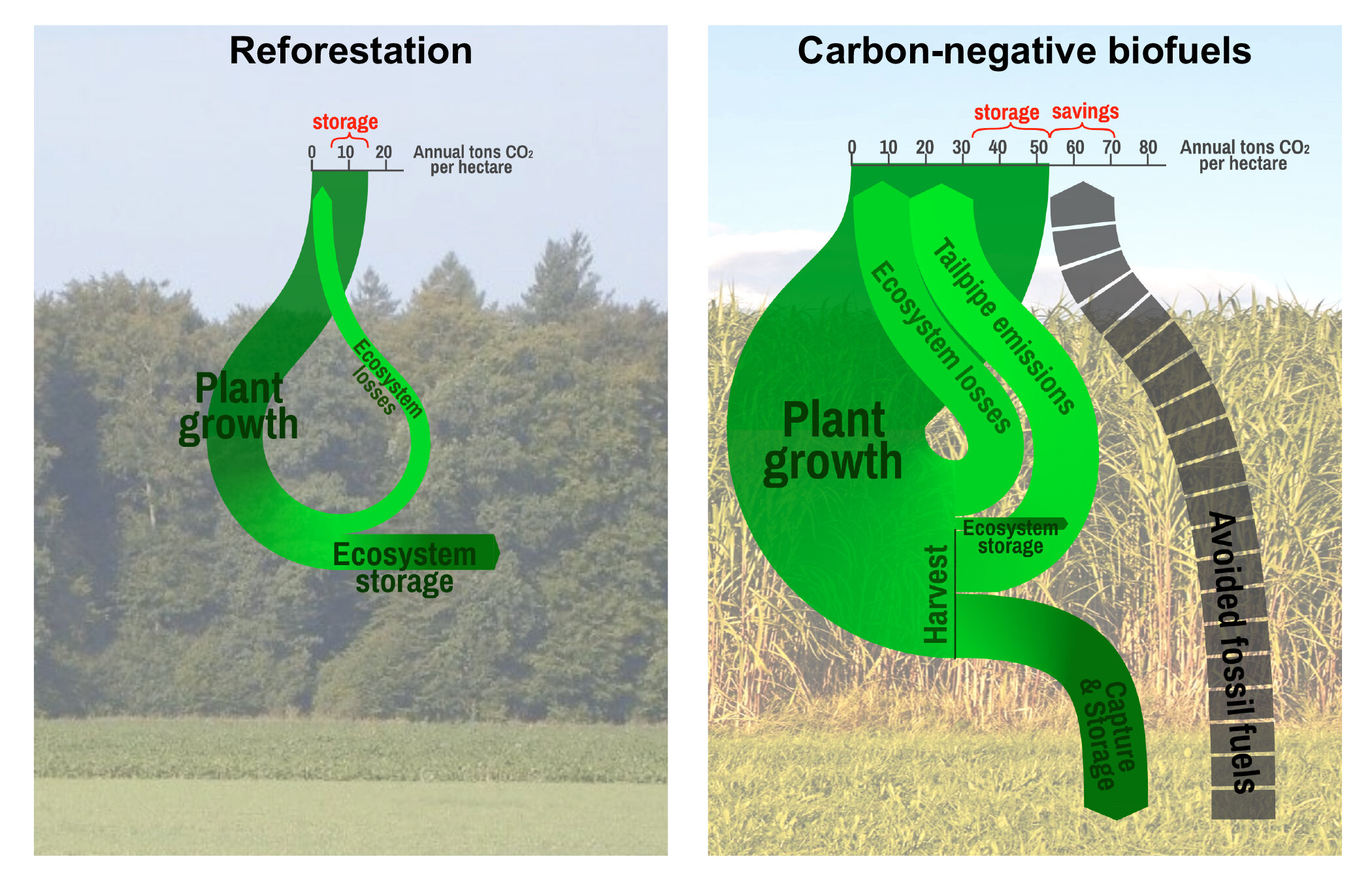 Reforestation carbon cycleland converted from agricultural production (left) or converted to cultivate millet to produce carbon-negative biofuels (right). Credit: John Field.
“We found that about half of the carbonthe millet entering the refinery becomes a by-product that can be used to capture and store carbon, ”the scientists say. The resulting high purity carbon dioxide by-product streams will not require significant separation or purification prior to storage underground.
The research team analyzed threevarious case studies in the United States and found that on land where farmers or land managers switched from crop cultivation or retained pasture for grazing, growing millet for cellulosic ethanol production had the potential to mitigate impacts per hectare, comparable to reforestation, more than grassland restoration ... (A hectare is about two and a half times the size of an average football field.)
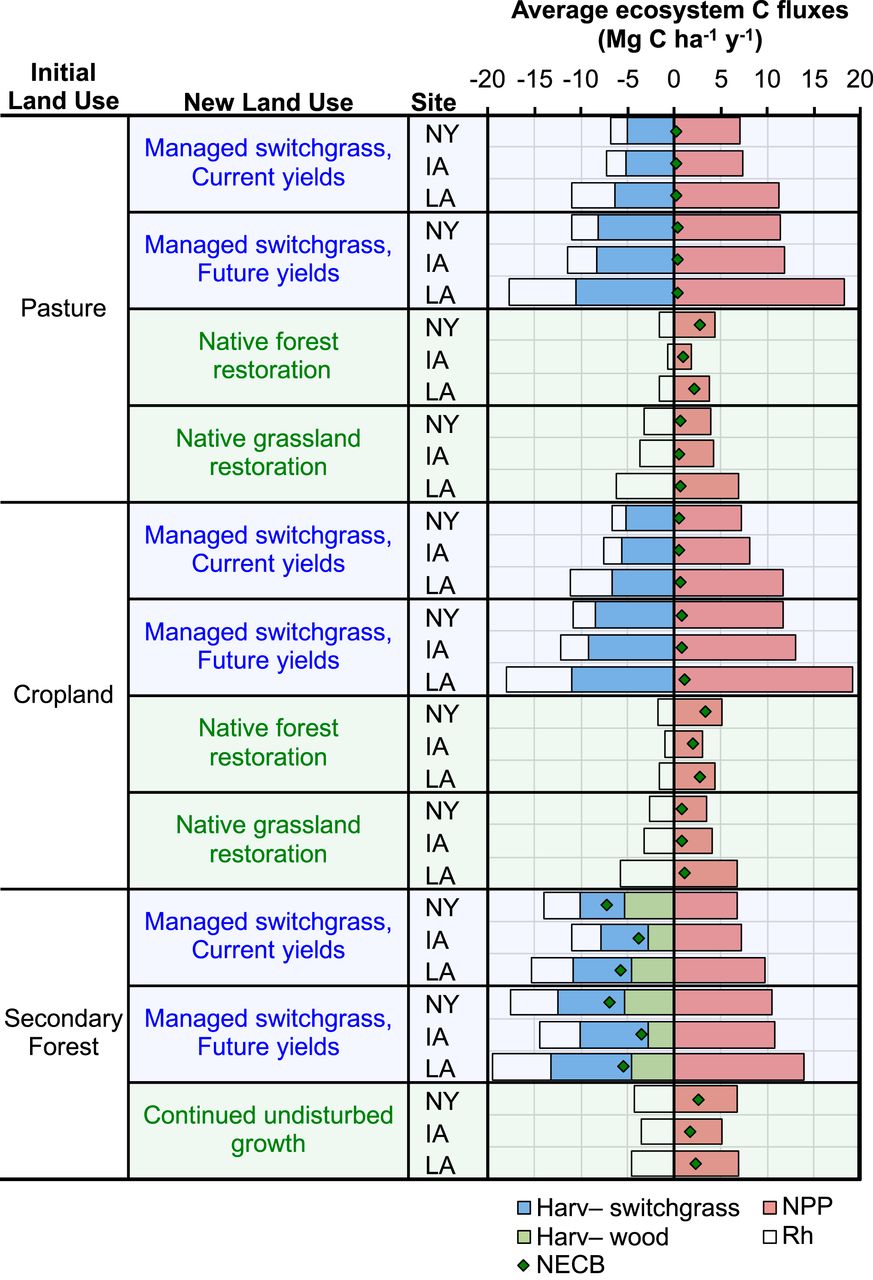 Modeled ecosystem carbon fluxes fordifferent land use scenarios. Stacked histogram showing DayCent estimates of ecosystem carbon inputs through NPP (pink bars) and total carbon losses through both R h (white bars) and yield (Harv) of millet (blue bars) and wood (green bars) for BP for New York (NY), Iowa (Iowa) and Louisiana (Los Angeles) case studies. The resulting NECB is marked with green diamonds, with positive values indicating an increase in ecosystem carbon storage. Results are annual averages over the first 30 years of modeling
The scientists noted that several well-known criticisms of biofuels prompted them to study.
“Our analysis shows that large climaticbenefits can be achieved with biofuels if the intent is to do so, ”said Lee Lind, co-author, and Paul E. and Joan H. Keno, Distinguished Professors in Environmental Engineering at Dartmouth College.
What are negative emissions and “net zero”?
"Negative emissions" - the intake of greenhouse gasesfrom the atmosphere - likely to be required to stabilize global warming by 1.5 degrees Celsius, an aspirational goal that governments have taken on in the Paris Agreement.
There are two main approaches - solutions fornatural climate (NCS) and negative emission technology (NET). Both have limitations on how much you can deploy and there may be drawbacks.
Why “negative outliers”?
To stabilize global warming byat any level, it is necessary to eliminate emissions of carbon dioxide, the main greenhouse gas; reducing them is not enough. Other greenhouse gases like methane also need to be limited.
However, in sectors such as agriculture andaviation, zero emissions may not be possible. Therefore, the only approach is to extract enough greenhouse gases from the atmosphere to balance the remaining emissions - so that emissions reach “net zero”.
If negative and positive outliersbalanced, global warming should stabilize. Currently, the only greenhouse gas with potential negative emissions on a scale is carbon dioxide.
How much is needed and when?
Intergovernmental Group of Experts onClimate Change (IPCC) published a landmark report in 2018 outlining what governments must do to implement the Paris Agreement. The IPCC said that achieving the 1.5°C target would involve achieving net zero CO2 emissions globally by around mid-century, along with significant reductions in other greenhouse gases, and that negative emissions would almost certainly be required.
How much it takes will depend onhow far we have come in reducing emissions. It will also depend on whether warming will release greenhouse gases into the air, for example, by releasing methane trapped in permafrost.
Biofuels are essential to meet climate goals
The scientists said that due to current delays inCombating climate change will need to take a more proactive stance on biofuels and other negative emission technologies if countries like the United States want to limit the impact of global warming to 1.5 degrees Celsius above pre-industrial levels.
“If we want to achieve this goal, wethere really is a need to deploy alternatives to fossil fuels as soon as possible, ”Field said. He also added that it is necessary to remove carbon pollution from the atmosphere and reduce historic emissions.
Eliminating carbon pollution is an ideawhich has been widely discussed since the conclusion of the Paris Agreement under the United Nations Framework Convention on Climate Change in 2016.
“We're going to start cleaning up carbon pollution that has happened in the past because we are cutting our emissions too slowly,” Field said.
There are different ways to accomplish this cleanup, the simplest of which is to grow trees to store more carbon on the ground.
Other alternatives are described and analyzed inresearch, including the use of carbon-negative biofuels. Plants pull carbon from the atmosphere to grow, and carbon is used to make plant tissues.
If this plant material is collected andconverted to energy, some of the resulting carbon dioxide byproduct can be captured and pumped underground into storage in depleted oil wells or other geological formations, rather than sending it back into the atmosphere.
Likewise, cellulosic biofuels areattractive because it can help reduce the use of fossil fuels in aviation, shipping and trucks, in all areas where the transition to electricity is difficult.
Moving forward, the research team hopes to expand their modeling to scale nationally, rather than looking at a few specific sites across the country.
“On a small scale, there are manyelements for the future use of advanced biofuels, the scientists conclude. "The trick is to put all these pieces together and make sure we continue to have support so that it can thrive and skyrocket even when gas prices are relatively low like now."
Read also
See where the Perseverance rover is flying now
Astronomers see how a black hole emits flickering gamma rays
Russia will finalize the bathyscaphe, which sank to the bottom of the Mariana Trench